










Capital Trust reports 18 controls across six gold-loan branches
Key highlights
- CTL launched its gold-loan business in October 2025 and reported more than Rs 45 crore of disbursements in 12 months.
- CTL operates six gold-loan branches, has served more than 1,800 customers and has two live co-lending partners.
- CTL reports 18 security controls, including four A-Eye controls, versus seven controls it says traditional lenders typically use.
- CTL states that 100% of gold-loan collections are made through its app, with no cash counter in branches.
powered by IRIS
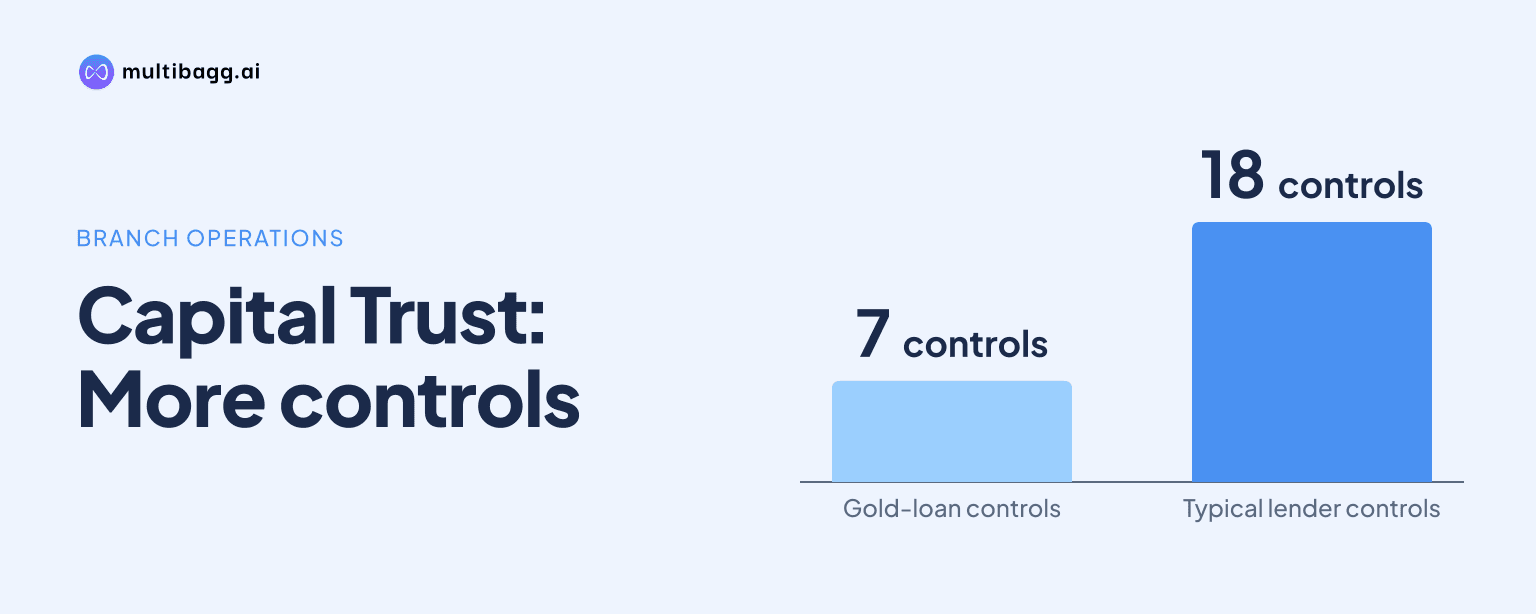
Capital Trust reports 18 security controls, including four powered by A-Eye, across six gold-loan branches that disbursed more than Rs 45 crore in the 12 months after their October 2025 launch. The operating model combines Head Office approval, multiple valuation checks, packet tracking and app-only collections.
Know Capital Trust inside out
Results, valuation, peers and who's buying, in one view.
How does CTL control gold-loan valuation?
CTL uses four checks on every ornament before disbursal: a customer-facing assay, two blind human valuations, an A-Eye artificial-intelligence (AI) assessment and Head Office (HO) approval. The assay is conducted in a secure valuation enclosure recorded by two dedicated cameras. The maker and checker use separate calibrated machines and are blind to each other’s results, while the branch manager reviews all three valuations before HO reviews the data, approves and disburses the loan.
The valuation example presented by CTL records different outcomes rather than relying on one assessment. The first valuer recorded a 22-karat chain at 7.34 grams net weight and Rs 97,052, while the second valuer and A-Eye each recorded 7.38 grams and Rs 97,581. The final confirmation used the second-valuer and A-Eye result. CTL identifies incorrect karat, weight or value, spurious gold, counter-level collusion and manual error as the risks addressed by this process.
The valuation control also includes close-range and wide-angle cameras. CTL says the close-range camera records every test, while the wide-angle camera records the customer, staff and the full testing table. The branch manager confirms the final result, but HO reviews the underlying data and approves the loan, separating branch confirmation from the final disbursal approval.
How does CTL track gold collateral after disbursal?
CTL tracks each sealed packet through five custody checkpoints, from customer-witnessed sealing to A-Eye-verified return at release. The packet is sealed on camera in tamper-evident packaging, then enters the strong room only with two employees and HO approval. CTL’s branch operating map also states that the entrance auto-locks whenever the strong room is open.
At storage, A-Eye verifies the packet number and its placement before the packet enters the safe. CTL specifies dual custody for safe access and says its Safe Shield can be remotely locked by HO. Daily AI reconciliation is designed to verify every packet each day, while release includes a check that the returned packet is the same packet and has the same weight before it is opened.
CTL’s presentation contrasts this arrangement with conventional-lender packet tracking through manual registers. Its own stated process uses packet-number verification, placement verification and daily reconciliation. CTL also says A-Eye monitors the custody route 24 hours a day and flags off-pattern strong-room access in real time; continuous records, access controls and substitution checks are the stated safeguards.
These controls were built into the platform from launch, according to CTL, rather than introduced after branch expansion. CTL says every new branch receives its valuation, custody and zero-cash controls from day one. In the 12 months after the October 2025 launch, the business reached six branches, served more than 1,800 customers and had two live co-lending partners.
Got a follow-up? Ask IRIS
Why does CTL operate zero-cash gold-loan branches?
CTL operates zero-cash branches because gold-loan disbursements are made by bank transfer and 100% of collections are made through its app. HO approves and disburses funds to the customer’s own bank account, including 24/7 top-ups. For repayment, customers pay interest and principal through the Capital Trust App into CTL’s bank account instead of at a branch counter.
The stated operating split is that branch staff handle gold rather than money. CTL says no cash is paid out or collected at the counter and that branches have no cash counter. It describes the resulting records as digital, time-stamped and permanent, replacing manual cash reconciliation with app-based payment records visible when repayment is made.
This payment design operates alongside CTL’s stated 20-minute disbursal and 20-minute release processes, both of which it says are measured on every loan. CTL says the product was built to the Reserve Bank of India (RBI) Gold Loan Directions issued in June 2025. The presentation does not provide branch-level average processing times or a pre-launch cash-collection comparison.
How does CTL’s 18-layer stack compare with conventional lenders?
CTL reports 18 security layers, compared with seven controls that its presentation says traditional lenders typically use, and four of CTL’s layers are powered by A-Eye. The 18 layers include two entry controls, six valuation controls, one sealing control, five storage controls, two release controls and two emergency controls. The emergency measures comprise intelligent intrusion detection, which sends a siren and live alert calls to 10 numbers, and silent panic alarms at the counter and strong room.
The comparison also covers release and record-keeping. CTL says the conventional model shown uses a manual identity check for release, whereas its process uses a live photo and Aadhaar match followed by A-Eye verification of the returned packet. CTL describes its records as paperless, time-stamped and tagged to the employee, compared with paper registers and files in the conventional-lender model in its presentation.
The business remains early in its rollout, but CTL provides operating markers for the first branch and the wider platform. Aligarh, its first branch, crossed Rs 10 crore in portfolio outstanding within its first year and was profitable from month four. CTL describes gold loans as the principal focus for incremental own-book deployment, rather than a side product within its broader lending operations.
Conclusion
CTL’s disclosed gold-loan model combines separated valuation roles, HO-controlled custody, AI-supported packet checks and app-only payment flows across six branches. More than Rs 45 crore of disbursements and more than 1,800 customers in the first 12 months provide the operating scale behind its stated 18-control framework, versus the seven controls it attributes to traditional lenders.
The next issue is execution as CTL makes gold loans the principal focus for incremental own-book deployment. Management says each new branch will receive the full three-part control framework from day one; the relevant measures to monitor are whether the 20-minute service process, daily reconciliation and Aligarh’s early profitability are maintained as the branch network expands.