










Capital Trust shifts 79% of AUM toward secured exposures
Key highlights
- CTL reported Rs 317 crore of AUM in September 2026, with 79% classified as secured or zero-risk.
- Secured or zero-risk AUM rose from 0% in H1 FY26 to 56% in H2 FY26 and 79% in H1 FY27.
- H1 FY27 disbursements reached Rs 222.5 crore, compared with Rs 110.1 crore in H2 FY26.
- CTL reported GNPA of 2.2% in H1 FY27, down from 9.4% in H1 FY26.
powered by IRIS
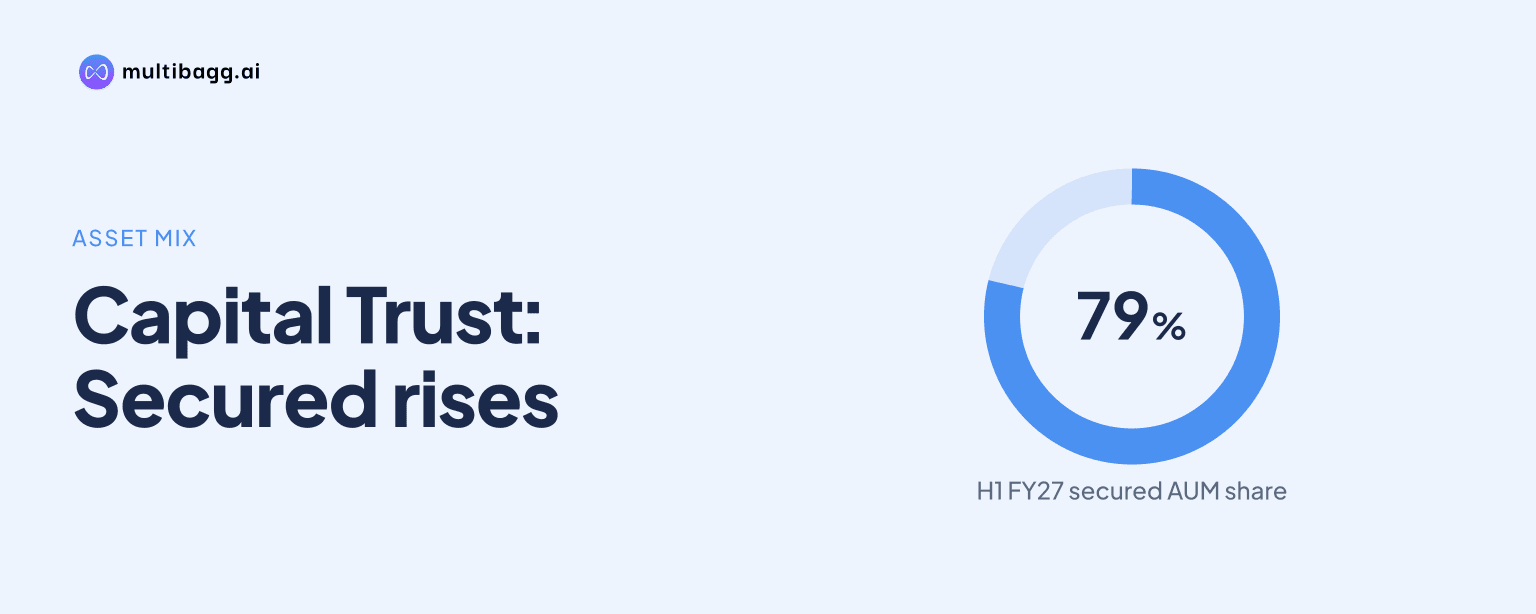
Capital Trust Limited had shifted 79% of its Rs 317 crore assets under management, or AUM, into secured or zero-risk exposures by September 2026, from 0% in March 2025. CTL achieved the change by retaining gold loans on its balance sheet while originating and servicing micro, small and medium enterprise, or MSME, loans funded by partners; it reported gross non-performing assets, or GNPA, of 2.2%.
Know Capital Trust inside out
Results, valuation, peers and who's buying, in one view.
How has CTL changed its lending model?
CTL has replaced unsecured MSME lending held on its own balance sheet with a model that combines own-book gold loans and partner-funded MSME originations. The presentation dates the new model to 2025 and states that gold loans remain on CTL's books, while banks and non-banking financial company, or NBFC, partners hold the MSME loans.
Under the earlier structure, CTL absorbed the full credit risk of unsecured MSME loans and used its capital for every loan. Under the current arrangement, physical gold collateral supports the own-book product, while partner MSME arrangements leave CTL with zero-to-capped credit exposure. CTL describes this as a change in risk architecture while retaining a franchise built over more than 40 years since 1985.
The redesign also changes the intended use of capital and branches. CTL says gold loans have short tenors that permit capital to be recycled quickly, while its 250-plus MSME distribution branches can generate loans using partner capital. The resulting revenue streams are interest spread on gold lending and sourcing and servicing fees from partners, rather than earnings driven only by unsecured own-book credit outcomes.
How do CTL's gold and MSME businesses operate?
CTL uses gold loans as its principal product for incremental own-book growth, financed by equity and term debt and secured by physical gold. The presentation refers to disciplined loan-to-value, or LTV, practices but does not disclose a numerical LTV limit. CTL had six gold branches in Delhi National Capital Region and western Uttar Pradesh by September 2026.
CTL's MSME business uses lending capacity supplied by banks and NBFC partners. CTL sources borrowers, services loans and collects repayments through its branch network, earning sourcing and servicing income while partners provide the underlying capital. The model is intended to make the 250-plus-branch network a distribution platform rather than solely an operating cost attached to an own-book MSME portfolio.
The presentation reports different scale indicators for the two businesses. CTL had made more than Rs 45 crore of cumulative gold disbursements over 12 months, and its Aligarh branch had portfolio outstanding above Rs 10 crore. Management also cited MSME originations for bank and NBFC partners of about Rs 35 crore a month, with collections above 99% on loans originated under the new model.
What evidence shows CTL's portfolio has changed?
CTL's reported portfolio mix shows the move toward secured and zero-risk exposures: their share rose from 0% in H1 FY26 to 56% in H2 FY26 and 79% in H1 FY27. That was a 23-percentage-point increase from March 2026 to September 2026, while closing AUM increased from Rs 158.0 crore to Rs 317.2 crore.
H1 FY27 disbursements of Rs 222.5 crore were more than twice the Rs 110.1 crore recorded in H2 FY26, and closing AUM likewise doubled from Rs 158.0 crore to Rs 317.2 crore. Total income rose to Rs 25.6 crore from Rs 20.9 crore in the same period comparison. The presentation defines H1 FY27 as April to September 2026 and identifies H2 FY26, October 2025 to March 2026, as the period when the new model launched.
Reported asset quality also changed over the periods shown. GNPA declined from 9.4% in H1 FY26 to 2.8% in H2 FY26 and 2.2% in H1 FY27. In the September 2026 snapshot, CTL reported AUM of Rs 317 crore, up 32% from Rs 240 crore in Q1 FY27, while the secured or zero-risk share rose from 72% to 79%.
Got a follow-up? Ask IRIS
What has the shift meant for CTL's capital and earnings?
CTL reported a capital adequacy ratio of 39.4% in the September 2026 quarter, compared with 39.8% in Q1 FY27, while external debt to total net worth, or TNW, increased to 0.9 times from 0.6 times. The company also disclosed two new term-loan sanctions from IDFC FIRST and Shriram at rates of 13.5% to 15%.
Quarterly total income was Rs 13.4 crore in the September 2026 quarter, 9% above Rs 12.3 crore in Q1 FY27. Profit after tax was Rs 26 lakh, compared with Rs 20 lakh in Q1 FY27. For H1 FY27, profit before tax was Rs 30 lakh, following a loss before tax of Rs 2.2 crore in H2 FY26.
Management's operating-leverage case rests on using existing infrastructure for higher volumes. CTL had more than 250 MSME distribution branches across 10 states and 74 districts, and it said all six gold branches were close to operating breakeven in the September 2026 quarter. Its expectation that incremental AUM will contribute more to earnings than cost is a management view, not a reported financial outcome.
Why does CTL's branch network matter to the strategy?
CTL's branch network provides the distribution link between gold loans and partner-funded MSME lending. The company says it has disbursed more than Rs 4,500 crore to over 12 lakh clients across rural and semi-urban India since 1985. That operating history gives the partner-led model an established network spanning 10 states rather than a newly built channel.
The network's stated role has moved from supporting own-book unsecured MSME lending to generating sourcing and servicing income for third-party lenders. This allows CTL to use more than 250 branches for MSME originations even as 79% of September 2026 AUM was classified as secured or zero-risk. The presentation does not disclose the fee rate, economics by partner or the monetary amount of CTL's capped MSME credit exposure.
Conclusion
CTL's portfolio redesign is reflected in the increase in secured or zero-risk AUM to 79% in H1 FY27, from 0% in H1 FY26, alongside closing AUM of Rs 317.2 crore and GNPA of 2.2%. Gold loans provide secured balance-sheet lending, while partner-funded MSME originations allow CTL to use its established branch network without funding every MSME loan itself.
The disclosed next focus is H2 FY27 execution across both businesses, including further activity from six gold branches and continued partner-led MSME originations of about Rs 35 crore a month. The key matters to watch are whether gold-loan scale, collections above 99% on new-model MSME loans and fee generation persist as CTL funds growth through term loans priced at 13.5% to 15%.