










Capital Trust AUM reaches Rs 317 crore with 79% secured
Key highlights
- CTL ended Q2 FY27 with AUM of Rs 317 crore, up 32% from Rs 240 crore in Q1 FY27.
- Secured or zero-risk assets reached 79% of CTL's AUM at September 2026, versus 56% at March 2026.
- CTL's GNPA ratio fell to 2.2% in Q2 FY27 from 9.4% in Q2 FY26.
- CTL reported Rs 13.4 crore of total income and Rs 0.26 crore of profit after tax in Q2 FY27.
powered by IRIS
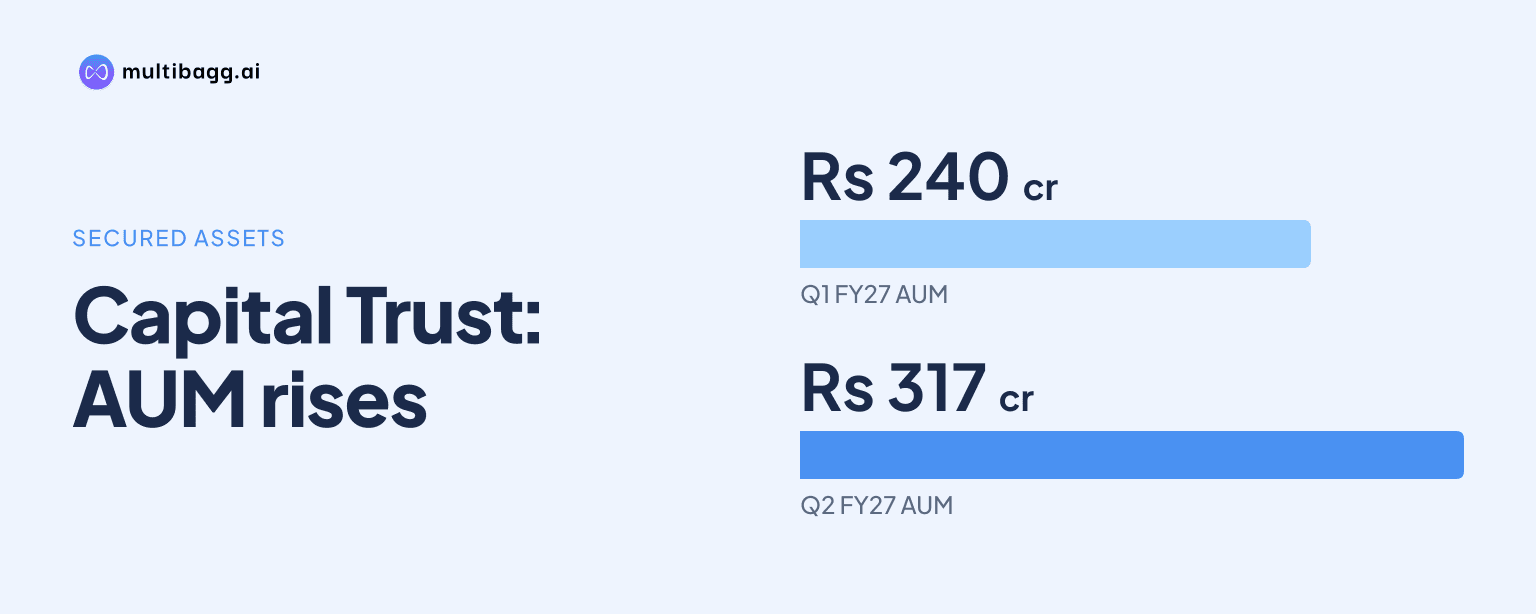
Capital Trust ended Q2 FY27 with Rs 317 crore of assets under management (AUM), 79% in secured or zero-risk assets and a 2.2% gross non-performing asset (GNPA) ratio, as AUM rose 32% quarter on quarter from Rs 240 crore. CTL also reported a Rs 77 crore quarterly AUM increase.
Know Capital Trust inside out
Results, valuation, peers and who's buying, in one view.
How did CTL's AUM change in Q2 FY27?
CTL's AUM reached Rs 317 crore at the end of Q2 FY27, compared with Rs 240 crore in Q1 FY27 and Rs 158 crore in Q4 FY26. The Rs 77 crore quarterly increase represented 32% growth, following 52% increases in Q4 FY26 and Q1 FY27. CTL described the Rs 317 crore balance as about three times the Rs 104 crore reported in Q3 FY26.
Partner-led micro, small and medium enterprise (MSME) AUM was Rs 279 crore in Q2 FY27, while gold and secured AUM was Rs 38 crore. MSME AUM increased by Rs 74 crore from Rs 205 crore in Q1 FY27, compared with a Rs 3 crore increase in gold and secured AUM from Rs 35 crore. The latest quarter's expansion was therefore mainly in the partner-led MSME portfolio.
Closing AUM for H1 FY27 was Rs 317.2 crore, compared with Rs 158.0 crore at the end of H2 FY26. H1 FY27 disbursements were Rs 222.5 crore, more than twice the Rs 110.1 crore in H2 FY26. The presentation defines H1 FY27 as April to September 2026 and H2 FY26 as October 2025 to March 2026.
Why did CTL's loan-risk mix change?
CTL reported that secured or zero-risk assets represented 79% of AUM at September 2026, up from 72% at June 2026 and 56% at March 2026. In value terms, secured or zero-risk AUM rose from Rs 89 crore at March 2026 to Rs 173 crore at June 2026 and Rs 250 crore at September 2026. The share was 0% in March 2025, according to the presentation.
The capped-risk and legacy portfolio was Rs 67 crore at September 2026, close to Rs 66 crore at June 2026 and Rs 69 crore at March 2026. That comparison indicates that the mix shift resulted from growth in secured or zero-risk assets rather than growth in the legacy portfolio. CTL said the legacy book is in run-off and that it has made no new unsecured own-book loans.
GNPA, defined by CTL as loans more than 90 days past due as a percentage of AUM, declined to 2.2% in Q2 FY27 from 2.7% in Q1 FY27 and 9.4% in Q2 FY26. This was a 50-basis-point sequential decline and a 7.2-percentage-point year-on-year reduction while AUM grew 2.6 times year on year. CTL also reported collection efficiency above 99% on new partner-led MSME loans.
Got a follow-up? Ask IRIS
Did CTL's higher lending translate into earnings growth?
CTL maintained quarterly disbursements at Rs 111 crore in Q2 FY27, close to Rs 112 crore in Q1 FY27. This followed Rs 90 crore in Q4 FY26 and Rs 19 crore in Q3 FY26, taking disbursements in the first 12 months of the new model, from October 2025 through September 2026, to Rs 332 crore. Monthly MSME disbursement reached Rs 35 crore in August 2026.
Gold disbursements were deliberately paced during Q2 FY27 because CTL said it tightened loan-to-value terms as gold prices fell. The company reported cumulative gold disbursements above Rs 45 crore in 12 months and six gold branches close to operating breakeven. Its Aligarh branch had more than Rs 10 crore of portfolio outstanding within its first year and was profitable from month four, according to the presentation.
Total income increased to Rs 13.4 crore in Q2 FY27 from Rs 12.3 crore in Q1 FY27, a 9% sequential increase and 51% year-on-year growth. Profit after tax was Rs 0.26 crore, compared with Rs 0.20 crore in Q1 FY27, a 29% increase. Profit before tax for H1 FY27 was Rs 0.3 crore, compared with losses of Rs 2.2 crore in H2 FY26 and Rs 34.2 crore in H1 FY26.
How is CTL funding secured-book growth?
CTL reported external borrowings of Rs 22.8 crore in Q2 FY27, up from Rs 15.3 crore in Q1 FY27 but below Rs 93.2 crore in Q1 FY26. External debt was 0.9 times tangible net worth at Q2 FY27, while capital adequacy was 39%. These figures followed a FY26 deleveraging programme and a Rs 23.8 crore rights issue that was subscribed 1.33 times.
Management's FY27 plan is to re-leverage against secured gold assets after building the gold book on equity from October 2025 through June 2026. CTL disclosed term-loan sanctions from IDFC FIRST Bank and Shriram Finance at 13.5% and 15.0%, respectively. It reported an overall cost of borrowing of 15.0% in Q2 FY27, down from 15.7% in Q1 FY27 and 16.2% a year earlier.
The gold-loan product, launched in October 2025, had six branches in Delhi National Capital Region and Uttar Pradesh, more than 1,800 customers served in 12 months and two live co-lending partners. CTL said gold loans are the principal focus for incremental own-book deployment. The product was built around the Reserve Bank of India Gold Loan Directions issued in June 2025, with stated 20-minute disbursal and release processes.
Conclusion
CTL's Q2 FY27 performance combined a Rs 317 crore loan book with a major change in portfolio composition: secured or zero-risk assets reached Rs 250 crore and 79% of AUM, while GNPA fell to 2.2%. Total income rose to Rs 13.4 crore and profit after tax to Rs 0.26 crore as quarterly disbursements remained near Rs 111 crore.
The next disclosed execution point is management's FY27 re-leveraging plan, including the IDFC FIRST Bank and Shriram Finance sanctions at 13.5% and 15.0%. The presentation also identifies gold loans as CTL's main focus for incremental own-book deployment after gold disbursements exceeded Rs 45 crore in the 12 months to September 2026.