










Everest Kanto Q2 FY27 EBITDA rose 35% as margin reached 15%
Key highlights
- EKC reported Q2 FY27 revenue of Rs 399 crore, up 11% year on year.
- Q2 FY27 EBITDA rose 35% year on year to Rs 58 crore, with EBITDA margin reaching 15%.
- EKC reported India revenue of Rs 255 crore, up 10% year on year and 26% quarter on quarter.
- USA revenue increased 29% year on year to Rs 112 crore and USA segment margin reached 19%.
powered by IRIS
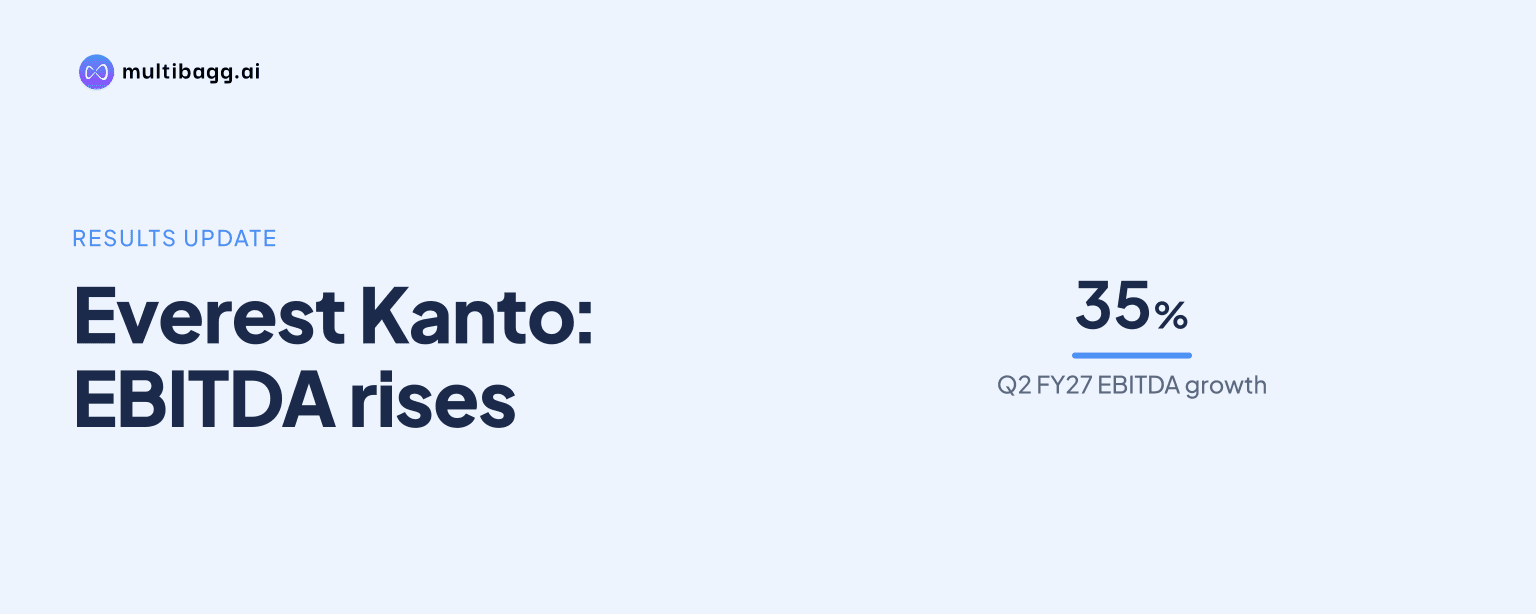
Everest Kanto (EKC) reported second-quarter fiscal 2027 (Q2 FY27) earnings before interest, tax, depreciation and amortisation (EBITDA) of Rs 58 crore, up 35% year on year, as revenue rose 11% to Rs 399 crore and EBITDA margin expanded 267 basis points to 15%.
Know Everest Kanto Cylinder inside out
Results, valuation, peers and who's buying, in one view.
How did EKC’s Q2 FY27 revenue and profit compare with last year?
EKC increased Q2 FY27 revenue from operations by 11% to Rs 399 crore from Rs 360 crore in Q2 FY26, while EBITDA increased 35% to Rs 58 crore from Rs 43 crore. The presentation reported a 15% EBITDA margin in its operating highlights and a more precise 14.6% figure in its quarterly overview, compared with 12% a year earlier.
Profit after tax (PAT) rose 46% to Rs 20 crore from Rs 14 crore, and diluted earnings per share increased 48% to Rs 1.80 from Rs 1.22. Profit before tax (PBT) was Rs 34 crore, compared with Rs 32 crore in the detailed profit and loss statement, a 6% increase. This differs from the presentation’s headline page, which describes PBT as up 23%; the detailed table provides the comparison used below.
What drove EKC’s Q2 EBITDA margin expansion?
EKC’s EBITDA margin increased by 267 basis points, equivalent to 2.67 percentage points, from 12% in Q2 FY26 to 15% in Q2 FY27. EBITDA rose by Rs 15 crore while revenue increased by Rs 39 crore, meaning operating profit grew faster than sales. The presentation linked the outcome to resilient India operations and improved margins, alongside better USA revenue and profitability.
The disclosed expense mix also changed relative to revenue. Cost of goods sold increased 4% to Rs 196 crore from Rs 188 crore, below the 11% revenue increase. Employee benefits expense rose 10% to Rs 47 crore, while other expenses increased 14% to Rs 98 crore. Together, these three expense categories totalled Rs 341 crore, up Rs 24 crore from Rs 317 crore in Q2 FY26.
Which markets contributed to EKC’s Q2 improvement?
EKC reported India revenue of Rs 255 crore, up 10% year on year and 26% quarter on quarter in Q2 FY27. The presentation described this as a sequential recovery in business activity. Standalone EBITDA, representing the domestic entity rather than the consolidated group, increased 43% year on year to Rs 37 crore, and standalone EBITDA margin improved by 345 basis points to 15%.
EKC also reported USA revenue growth of 29% year on year to Rs 112 crore. USA segment profitability increased 76% year on year and segment margin reached 19%, according to the presentation. India and USA revenue together was Rs 367 crore, compared with consolidated revenue of Rs 399 crore. EKC said United Arab Emirates performance remained subdued but did not provide a revenue or profit figure for that operation.
Got a follow-up? Ask IRIS
Why did EKC’s PBT grow more slowly than EBITDA?
EKC’s PBT increased 6% despite 35% EBITDA growth because costs below EBITDA rose and other income fell. Finance costs increased to Rs 7 crore in Q2 FY27 from Rs 4 crore in Q2 FY26, while depreciation and amortisation rose to Rs 18 crore from Rs 11 crore. Other income was nil, compared with Rs 5 crore in the previous-year quarter.
Tax expense increased to Rs 14 crore from Rs 7 crore, while neither quarter’s reported PAT comparison contained an exceptional item in Q2 FY27. Q2 FY26 included an exceptional loss of Rs 11 crore. PAT nevertheless increased to Rs 20 crore from Rs 14 crore, and PAT margin rose by 121 basis points to 5% from 4%.
How did EKC’s H1 FY27 performance differ from Q2?
EKC’s first-half fiscal 2027 (H1 FY27) revenue was Rs 745 crore, compared with Rs 747 crore in H1 FY26, while EBITDA was Rs 105 crore compared with Rs 104 crore. The H1 EBITDA margin was 14%, up 21 basis points year on year. This was a smaller margin movement than the 267-basis-point expansion reported in Q2.
Below EBITDA, the half-year result was lower than the prior-year period. H1 FY27 PBT declined 15% to Rs 73 crore from Rs 85 crore, while PAT declined 23% to Rs 50 crore from Rs 65 crore. Diluted earnings per share fell to Rs 4.48 from Rs 5.82. H1 employee benefits expense rose 15% to Rs 93 crore and depreciation and amortisation increased to Rs 33 crore from Rs 22 crore, although cost of goods sold declined 8% to Rs 359 crore.
What developments could affect EKC after Q2 FY27?
EKC’s Egypt manufacturing facility commenced commercial production of compressed natural gas (CNG) cylinders in September 2026, followed by commercial dispatches in October 2026. The presentation does not disclose Egypt revenue, volume or profit in Q2 FY27, so the facility’s financial contribution cannot be determined from the reported results.
In November 2026, EKC Egypt SAE signed a one-year framework memorandum of understanding with CARGAS in Egypt. The parties will explore manufacturing CNG transportation units, known as multiple-element gas containers, and associated gas transport through a virtual pipeline system. The proposed project is intended to serve Egyptian, Middle Eastern and African markets, but EKC disclosed no investment, order, production-volume or revenue target.
Conclusion
EKC’s Q2 FY27 result showed operating profit growing faster than revenue, with EBITDA rising 35% to Rs 58 crore and revenue increasing 11% to Rs 399 crore. India provided Rs 255 crore of quarterly revenue and a 43% rise in standalone EBITDA, while USA revenue rose 29% and segment margin reached 19%. The quarterly improvement contrasted with flat H1 revenue and only 1% H1 EBITDA growth.
The next reported developments to watch are the ramp-up of Egypt’s CNG cylinder facility, which began production in September 2026 and dispatches in October 2026, and progress under the one-year CARGAS framework agreement signed in November 2026. EKC has not disclosed financial targets for either initiative, while USA profitability and subdued United Arab Emirates performance remain relevant to future consolidated results.