










Deepak Fertilisers’ projects are 98% complete for Q4 FY27
Key highlights
- Both Gopalpur TAN and Dahej nitric-acid projects were 98% complete, with COD expected in Q4 FY27.
- Gopalpur will add 376 KTPA of TAN capacity at a stated capex of Rs 2,675 crore.
- Dahej will add 300 KTPA of WNA and 150 KTPA of CNA capacity at a stated capex of Rs 1,983 crore.
- Deepak Fertilisers says 65% of new Dahej CNA capacity is tied up under a 20-year contract.
powered by IRIS
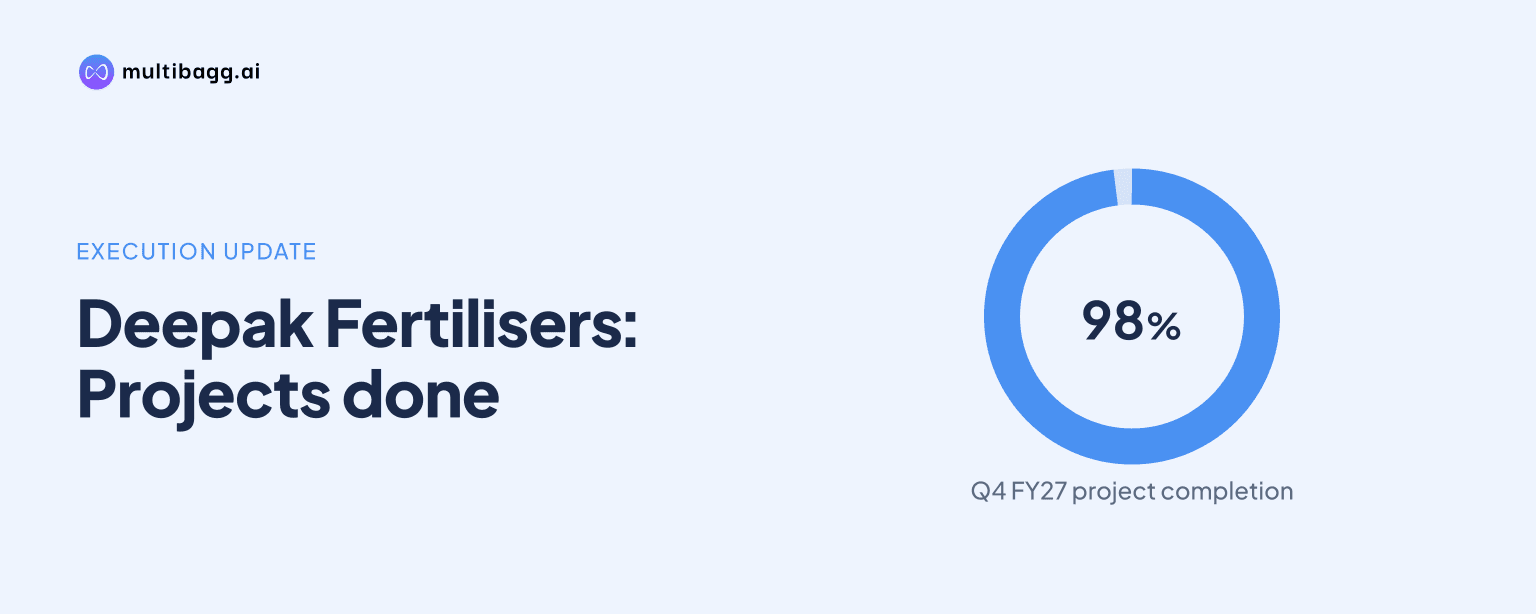
Deepak Fertilisers and Petrochemicals Corporation Limited reports that its roughly Rs 4,650 crore Gopalpur technical ammonium nitrate (TAN) and Dahej nitric-acid projects were each 98% complete, with expected commercial operation dates (COD) in Q4 FY27. The additions comprise 376 thousand tonnes per annum (KTPA) at Gopalpur and 300 KTPA of WNA plus 150 KTPA of CNA at Dahej.
Know Deepak Fertilisers & Petrochemicals Corp inside out
Results, valuation, peers and who's buying, in one view.
What is Deepak Fertilisers building at Gopalpur and Dahej?
Deepak Fertilisers is building a 376 KTPA TAN plant at Gopalpur and a nitric-acid project at Dahej with 300 KTPA of weak nitric acid (WNA) and 150 KTPA of concentrated nitric acid (CNA). Gopalpur has stated capital expenditure of Rs 2,675 crore, while Dahej has stated capital expenditure of Rs 1,983 crore, and both have expected COD in Q4 FY27.
The individually stated project costs total Rs 4,658 crore, while the presentation describes the capex programme as approximately Rs 4,650 crore. The Gopalpur plant is the larger project by disclosed spending, accounting for Rs 2,675 crore against Rs 1,983 crore for Dahej, while Dahej contains two specified nitric-acid streams totalling 450 KTPA.
How close are Deepak Fertilisers’ new plants to commercial operation?
Both the Gopalpur TAN project and the Dahej nitric-acid project were reported as 98% complete. The disclosed update leaves 2% of overall progress outstanding for each facility before the Q4 FY27 COD target, although the presentation does not provide a breakdown of the remaining construction, commissioning or approval milestones.
The two projects carry a common Q4 FY27 expected COD despite their different scales and product configurations: 376 KTPA of TAN at Gopalpur and 450 KTPA across WNA and CNA at Dahej. Deepak Fertilisers does not disclose the precise start-up month, trial-run production, utilisation path or a phased ramp-up timetable for either asset.
The 98% status is a progress report rather than confirmation that either plant has begun operations. The next disclosed operating event is therefore the expected Q4 FY27 COD for both projects, following capital expenditure of Rs 774 crore across the company in H1 FY27.
How will the projects change Deepak Fertilisers’ capacity?
The Gopalpur project is intended to lift Deepak Fertilisers’ total ammonium nitrate (AN) capacity to about 1.0 million metric tonnes per annum (MMTPA). Management says that post-expansion position would make Deepak Fertilisers the world’s third-largest pure-play TAN producer, based on the 376 KTPA addition and the stated total capacity of about 1.0 MMTPA.
The Dahej project is intended to lift total WNA capacity to about 1.2 MMTPA after the 300 KTPA WNA addition. Management says this would make Deepak Fertilisers Asia’s largest nitric-acid manufacturer; the presentation separately identifies 150 KTPA of new CNA capacity but does not give a post-expansion total for CNA.
The two expansions serve different disclosed geographic positions. Deepak Fertilisers identifies Gopalpur as being closer to major mining areas in East India and as a port-based location favourable for exports, while it identifies Dahej as being closer to major consumers in West and Central India.
Got a follow-up? Ask IRIS
What Dahej capacity is under a long-term contract?
Deepak Fertilisers says 65% of the new 150 KTPA CNA capacity at Dahej is tied up under a 20-year long-term contract. The presentation does not name the counterparty, state contracted volumes in tonnes, or disclose the pricing and other commercial terms of the agreement.
The stated 65% arrangement applies specifically to the new CNA stream at Dahej, rather than to its 300 KTPA WNA stream or the 376 KTPA TAN project at Gopalpur. No contracted share is disclosed for the remaining 35% of new CNA capacity, Dahej WNA capacity or Gopalpur TAN capacity.
Deepak Fertilisers links the two facilities to market access mechanisms rather than treating them as identical capacity additions. Gopalpur’s stated mechanisms are proximity to eastern mining areas and port access, while Dahej combines access to western and central consumers with the 20-year contract for 65% of its new CNA capacity.
How has Deepak Fertilisers’ balance sheet changed during expansion?
At Sep-26, Deepak Fertilisers reported net debt of Rs 4,743 crore, down Rs 81 crore from Rs 4,824 crore at Mar-26, despite Rs 774 crore of capital expenditure in H1 FY27. The company attributed the reduction in net debt to operational free cash flow, while its net-debt-to-equity ratio moved to 0.58x from 0.65x.
Total debt declined to Rs 5,288 crore at Sep-26 from Rs 5,486 crore at Mar-26. Short-term debt fell by Rs 246 crore to Rs 814 crore, whereas long-term debt rose by Rs 48 crore to Rs 4,474 crore; cash and bank balances declined to Rs 458 crore from Rs 536 crore over the same period.
The Sep-26 net-debt-to-earnings before interest, tax, depreciation and amortisation (EBITDA) ratio was 1.49x, compared with 2.86x at Mar-26. The presentation does not disclose remaining project capex, the funding mix required until COD, or any forecast revenue, EBITDA or cash-flow contribution once the facilities begin operations.
Conclusion
Deepak Fertilisers has two major projects approaching the same Q4 FY27 COD, each at 98% overall progress. Gopalpur adds 376 KTPA of TAN and is intended to take total AN capacity to about 1.0 MMTPA, while Dahej adds 300 KTPA of WNA and 150 KTPA of CNA, with 65% of new CNA capacity covered by a 20-year contract.
The next disclosed checkpoint is Q4 FY27, when management expects both facilities to begin commercial operation. Investors can watch completion of the remaining reported 2%, spending after the Rs 774 crore H1 FY27 capex outlay, and net-debt movement from the Sep-26 level of Rs 4,743 crore; the presentation does not disclose exact start-up dates, remaining costs or ramp-up schedules.