










United Foodbrands targets 425–450 restaurants by FY30 from 274
Key highlights
- United Foodbrands targets 425–450 restaurants by FY30, up from 274 outlets in November 2026.
- Barbeque Nation India contributed 76% of annualized H1 FY27 revenue of Rs 1,710.5 crore.
- Barbeque Nation International reported 40.5% store-level ROCE and a 2.5–3.0-year payback period.
- United Foodbrands reported H1 FY27 revenue of Rs 855.2 crore, up 42.1% year on year.
powered by IRIS
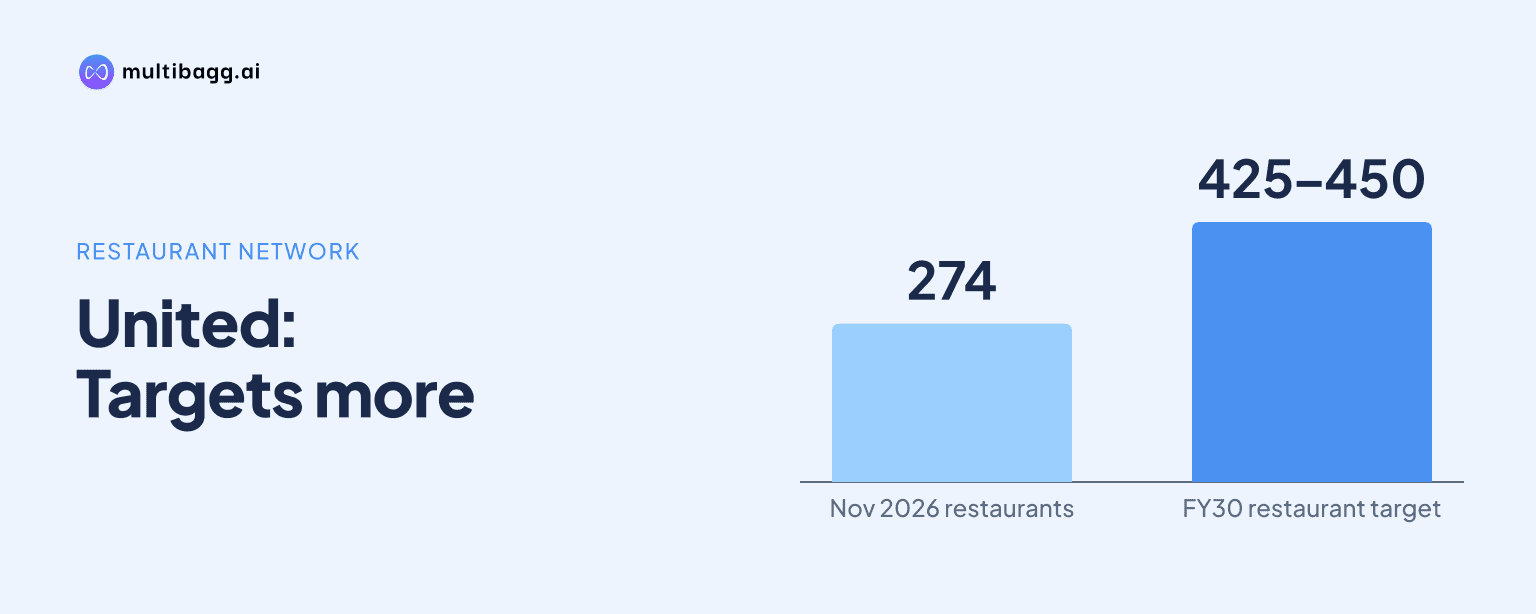
United Foodbrands Limited plans to expand from 274 restaurants to 425–450 by FY30, requiring 151–176 additional outlets, according to its November 2026 corporate presentation. The company reports segment store-payback periods of 2.5–3.5 years and store-level return on capital employed ranging from 26.2% to 40.5%.
Know United Foodbrands inside out
Results, valuation, peers and who's buying, in one view.
How many restaurants does United Foodbrands plan to operate by FY30?
United Foodbrands plans to operate 425–450 restaurants by FY30, compared with its current network of 274 restaurants across India, the Middle East and South East Asia. The target requires 151–176 additional outlets from the disclosed base. The presentation describes the opportunity as expansion across markets through a proven store-rollout model, but does not provide annual opening targets or a segment-by-segment allocation of the FY30 network.
The 274-outlet base comprises 216 Barbeque Nation India restaurants, 16 Barbeque Nation International restaurants and 42 premium casual dining, or CDR, restaurants. The company’s network was four restaurants in 2006, 76 in 2016 and 274 in 2026. Its disclosed revenue run rate over those points was Rs 1 crore, Rs 350 crore and Rs 1,710.5 crore, respectively.
United Foodbrands’ FY30 plan is a group-wide target rather than a commitment for a particular brand or geography. Its November 2026 presentation identifies scalable expansion as one of three growth engines alongside its domestic Barbeque Nation, international and premium CDR businesses. It does not disclose the number of planned additions in its 88 Indian cities, nine international cities or six premium CDR cities.
Which United Foodbrands segments provide the largest revenue base?
United Foodbrands’ Barbeque Nation India segment is its largest revenue contributor, representing 76% of annualized H1 FY27 revenue, compared with 14% for premium CDR and 10% for Barbeque Nation International. H1 FY27 means the first half of financial year 2027. The group reported annualized consolidated revenue of Rs 1,710.5 crore for that period.
Barbeque Nation India has the widest footprint, with 216 restaurants across 88 Indian cities, while Barbeque Nation International has 16 restaurants in nine cities across seven countries. Premium CDR has 42 restaurants in six Indian cities and includes the Toscano and Salt formats. The FY30 objective does not state whether future additions will retain the present revenue mix, in which domestic Barbeque Nation accounts for 76%.
The group reported H1 FY27 revenue of Rs 855.2 crore, up 42.1% year on year, and annualized it to Rs 1,710.5 crore. It attributed H1 FY27 growth across its three engines to Barbeque Nation revenue growth of 42.4%, international revenue growth of 52.9% and premium CDR revenue growth of 32.2%. Those growth rates measure different segments, while the 42.1% figure is consolidated revenue growth.
Got a follow-up? Ask IRIS
What are United Foodbrands’ store payback periods and returns?
United Foodbrands reports store payback periods of 2.5–3.5 years across its three operating segments, with Barbeque Nation International recording the highest disclosed store-level return on capital employed, or ROCE, at 40.5%. The presentation also reports pre-Indian Accounting Standards, or pre-Ind AS, restaurant operating margins. Unit economics for Barbeque Nation India and premium CDR are based on the matured H1 FY27 portfolio.
Barbeque Nation International reported revenue per restaurant of Rs 13.3 crore, above Rs 7.1 crore for premium CDR and Rs 6.6 crore for Barbeque Nation India. It also had the highest average capital expenditure, or capex, per store at Rs 6.5 crore, compared with Rs 3 crore for premium CDR and Rs 2.5 crore for Barbeque Nation India. Its stated 26.3% pre-Ind AS restaurant operating margin was also above 19.1% and 14.4% for those two segments.
United Foodbrands defines store-level ROCE as pre-Ind AS restaurant operating earnings before interest, tax, depreciation and amortisation, less depreciation, divided by store capex. The international metrics are based on H2 FY26 and exclude what the company describes as temporary Gulf Cooperation Council inflationary pressures in H1 FY27. This differs from the H1 FY27 matured-portfolio measurement used for Barbeque Nation India and premium CDR.
What supports United Foodbrands’ restaurant rollout?
United Foodbrands identifies ownership of its brands, technology systems and a captive customer base as parts of its model for pursuing the 425–450 restaurant target by FY30. Its brand portfolio includes 232 Barbeque Nation stores, 27 Toscano stores, 15 Salt stores and 12 Omm Nom Nomm stores. Dum Safar and UBQ operate through the Barbeque Nation network.
The company says ownership of every brand gives it control over strategy, menu innovation, guest experience and the pace of expansion. Barbeque Nation was established in 2006, Toscano in 2008, Salt in 2012, UBQ and Omm Nom Nomm in 2018, and Dum Safar in 2023. The portfolio spans dine-in and delivery formats, with the 2026 revenue run rate split 84% dine-in and 16% delivery.
United Foodbrands reported that 90% of dine-in volumes came through its own app, call centre and walk-in channels in H1 FY27. It also reported 10 million or more cumulative app downloads at Q2 FY27, compared with 8.5 million at Q2 FY26. Dine-in transactions through owned digital channels rose from 42.3% in Q2 FY26 to 65.3% in Q2 FY27.
The presentation reported same-store sales growth of 26.1% and dine-in volume growth of 59.8% in H1 FY27. It also said more than 80% of dine-in transactions were pre-reserved, largely through its digital channels, and that monthly active users across owned platforms were about 2.3 million, up 132.5% year on year. These measures provide trading and customer-access context for management’s expansion plan rather than a disclosed outlet-opening schedule.
Conclusion
United Foodbrands’ FY30 target would increase its network by 151–176 restaurants from the 274 reported in November 2026. Barbeque Nation India supplies 76% of annualized H1 FY27 revenue of Rs 1,710.5 crore, while Barbeque Nation International has the highest disclosed revenue per restaurant, pre-Ind AS operating margin and 40.5% store-level ROCE. The three segments have disclosed payback ranges of 2.5–3.5 years.
What to watch next is how management translates the 425–450 restaurant FY30 plan into openings by segment and geography. The presentation does not disclose interim opening targets, aggregate expansion capex or the intended mix between the 216 domestic Barbeque Nation, 16 international and 42 premium CDR restaurants. The comparability of international unit economics also depends on its H2 FY26 basis, which excludes temporary Gulf Cooperation Council inflationary pressures in H1 FY27.