










United Foodbrands says captive channels drive over 90% of dine-in
Key highlights
- United Foodbrands says captive channels drive more than 90% of dine-in transactions.
- United Foodbrands reported 10.0 million cumulative app downloads in Q2 FY27, up from 8.5 million in Q2 FY26.
- United Foodbrands’ own-digital dine-in share rose to 65.3% in Q2 FY27 from 42.3% in Q2 FY26.
- United Foodbrands reported about 2.3 million monthly active users, up 132.5% year on year.
powered by IRIS
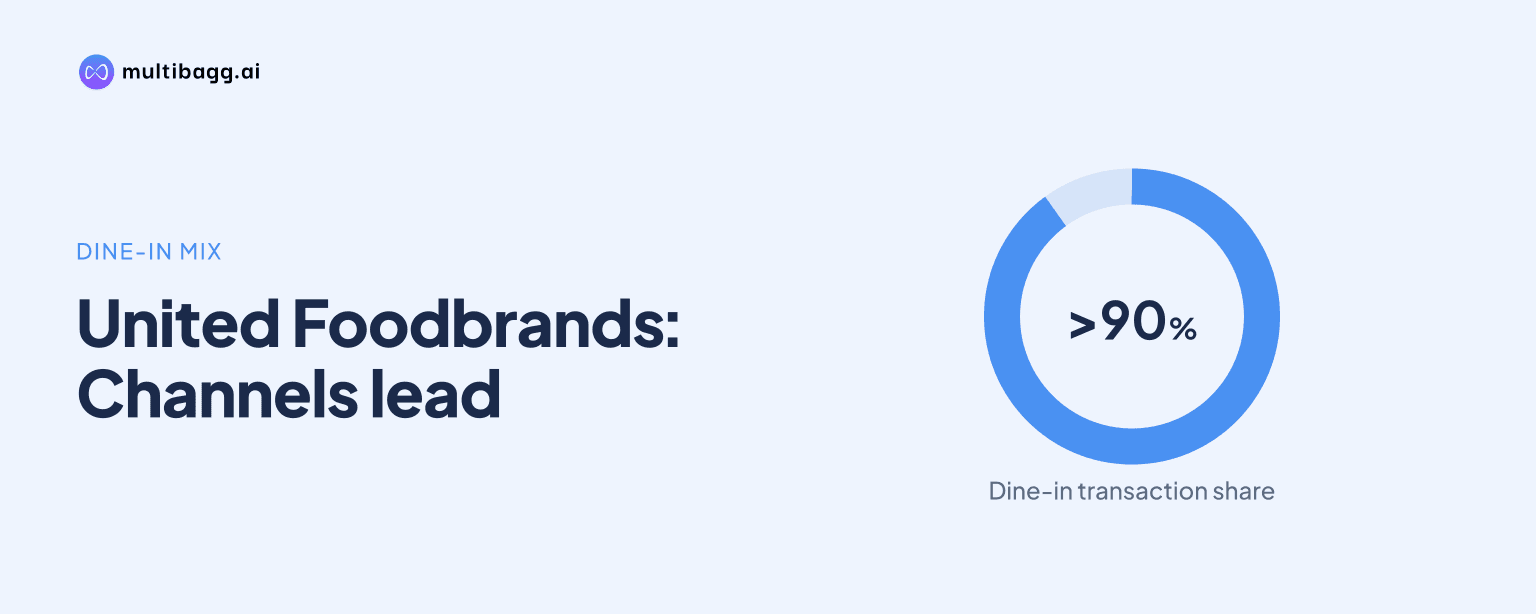
In Q2 FY27, United Foodbrands reported that captive channels drove more than 90% of dine-in transactions, while owned digital channels accounted for 65.3% and cumulative app downloads reached 10.0 million. United Foodbrands also reported about 2.3 million monthly active users across owned platforms, up 132.5% year on year.
Know United Foodbrands inside out
Results, valuation, peers and who's buying, in one view.
What share of United Foodbrands dine-in transactions comes through captive channels?
United Foodbrands says captive channels drive more than 90% of dine-in transactions. The presentation places this measure alongside its omnichannel reservation system and reports that more than 80% of dine-in transactions are pre-reserved, largely through United Foodbrands’ own digital channels.
United Foodbrands separately reported that 65.3% of dine-in transactions came through own digital channels in Q2 FY27. The presentation does not define or reconcile the difference between the more than 90% captive-channel measure and the 65.3% own-digital measure, so they should be treated as separately disclosed indicators.
The pre-reservation figure shows the operating mechanism behind the direct relationship with diners. United Foodbrands uses an omnichannel reservation system, while its app screen lists functions including table bookings, reservations, vouchers, catering and takeaway; the presentation does not disclose the split of bookings by app, website or other owned channels.
How fast has United Foodbrands’ owned digital use increased?
United Foodbrands’ cumulative app downloads rose to 10.0 million in Q2 FY27 from 8.5 million in Q2 FY26, an increase of 1.5 million. Downloads increased in every reported quarter, moving from 9.1 million in Q4 FY26 to 9.7 million in Q1 FY27 and then to 10.0 million in Q2 FY27.
United Foodbrands’ own-digital share of dine-in transactions increased by 23.0 percentage points, from 42.3% in Q2 FY26 to 65.3% in Q2 FY27. The largest reported quarter-on-quarter increase was 11.0 percentage points between Q2 FY26 and Q3 FY26, while the increase moderated to 0.2 percentage points between Q1 FY27 and Q2 FY27.
United Foodbrands also reported about 2.3 million monthly active users, or MAUs, across owned platforms, with year-on-year growth of 132.5%. The presentation describes app downloads as cumulative and MAUs as active users, but it does not state the prior-year MAU base or the relationship between downloads and active users.
What technology supports United Foodbrands’ direct diner relationship?
United Foodbrands says its technology platform is intended to drive conversion, engagement and efficiency through its omnichannel reservation system. Customer relationship management, or CRM, campaigns are used for targeted engagement and repeat consumption, while quick-response, or QR, based ordering supports in-restaurant digital engagement.
United Foodbrands says it uses artificial intelligence, or AI, led booking optimisation to improve conversion efficiency and reduce cancellations. The presentation identifies the mechanism but does not disclose booking conversion rates, cancellation rates or quantified savings from the AI-led process.
United Foodbrands also uses cloud-based real-time business intelligence to track restaurant-level metrics for decision-making. The presentation does not identify the individual metrics, reporting frequency or the number of restaurants using the system, but it positions the data platform alongside guest-management and reservation tools.
Got a follow-up? Ask IRIS
How does United Foodbrands link digital systems with its restaurant network?
United Foodbrands says its technology stack includes automated vendor and supply-chain management systems, an enterprise resource planning, or ERP, system, and internal applications for daily operations. These tools sit alongside the 10.0 million-download app ecosystem and are described as supporting operations as well as diner engagement.
United Foodbrands had 274 restaurants in September 2026, compared with 262 in March 2026. The September 2026 network comprised 216 Barbeque Nation India restaurants, 16 Barbeque Nation International restaurants and 42 premium casual dining restaurants, although the presentation does not provide segment-level digital transaction shares.
United Foodbrands’ metro and Tier I restaurant count increased to 216 in September 2026 from 207 in March 2026, while Tier II and Tier III locations rose to 58 from 55. United Foodbrands reported a presence in 97 cities across eight countries, giving its reservation, CRM and operating systems a network wider than the 262 restaurants reported in March 2026.
United Foodbrands lists Barbeque Nation, Toscano and Salt as dine-in-plus-delivery formats, while Dum Safar, UBQ and Omm Nom Nomm are delivery formats. The 65.3% metric specifically covers dine-in transactions through own digital channels, and the presentation does not state a corresponding owned-channel share for delivery orders.
Conclusion
United Foodbrands’ disclosures show that direct digital tools are closely connected to its dine-in model: captive channels account for more than 90% of dine-in transactions, more than 80% are pre-reserved, and the own-digital dine-in share reached 65.3% in Q2 FY27. The 10.0 million cumulative downloads, 2.3 million MAUs and reported threefold year-on-year increase in loyalty-program adoption provide the disclosed measures of platform scale and engagement.
The next disclosure to watch is whether United Foodbrands clarifies the distinction between captive channels and own digital channels, reported as more than 90% and 65.3% of dine-in transactions respectively. United Foodbrands provides no future target for app downloads, MAUs, loyalty membership, bookings or digital transaction mix, leaving subsequent presentations to show whether the Q2 FY27 levels continue to rise.