










Devson plans 5,088 MTPA plant, lifting capacity to 11,293
Key highlights
- Devson plans to add 5,088 MTPA through a second manufacturing facility.
- Devson reported 6,205 MT of installed capacity and 86.8% overall utilisation in FY26.
- Ceramic-ball utilisation reached 90.9% in FY26 on installed capacity of 3,660 MT.
- The planned Ambawadi GIDC facility has an area of 10,960.30 square metres.
powered by IRIS
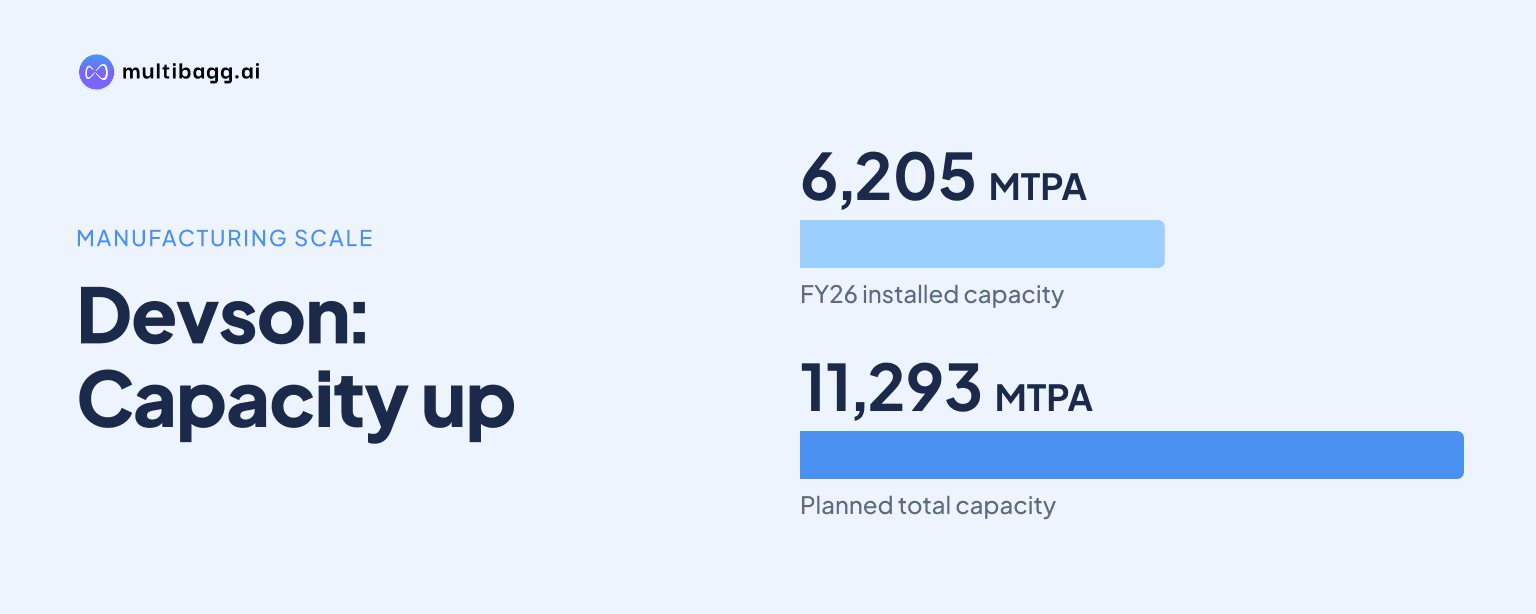
Devson Catalyst plans a second manufacturing facility adding 5,088 MTPA, which would lift its disclosed capacity from 6,205 MT in FY26 to a calculated 11,293 MTPA. The proposal follows FY26 overall utilisation of 86.8%, including 90.9% utilisation in ceramic balls, the company’s highest reported operating segment rate.
Know Devson Catalyst inside out
Results, valuation, peers and who's buying, in one view.
How much capacity would Devson add?
Devson would add 5,088 MTPA through its planned second manufacturing facility. The investor presentation describes this as a proposed capacity addition intended to support future growth and anticipated demand, rather than capacity already available for production.
Adding the proposed 5,088 MTPA to Devson’s FY26 installed capacity of 6,205 MT produces a calculated total of 11,293 MTPA. This represents an increase of about 82% from the FY26 base, based on the capacities disclosed in the presentation.
The second facility is planned at Ambawadi, Gujarat Industrial Development Corporation, or GIDC, Wadhwan, near NH-48. Its planned area is 10,960.30 square metres, compared with 7,737.30 square metres for Devson’s existing Wadhwan City, Surendranagar facility.
The presentation does not disclose a project cost, funding source, construction status, commissioning date or a phased operating schedule for the 5,088 MTPA expansion. It also does not specify how the new capacity would be divided between catalyst, adsorbent and ceramic-ball products.
What was Devson’s total capacity utilisation in FY26?
Devson’s total capacity utilisation was 86.8% in FY26, up from 82.4% in FY25 but below 92.4% in FY24. Total installed capacity was 6,205 MT in FY26, covering catalyst, adsorbent and ceramic-ball operations.
Installed capacity increased by 779 MT between FY24 and FY26, while utilisation ended 5.6 percentage points below the FY24 level. Capacity rose by 587 MT in FY25 and by a further 192 MT in FY26, as utilisation first declined and then recovered by 4.4 percentage points.
The FY26 utilisation rate indicates that Devson had 13.2% of disclosed total capacity unused on the presentation’s basis. Management links the planned second plant to future growth and anticipated demand, rather than stating that existing total capacity is fully utilised.
Which Devson products were closest to capacity in FY26?
Devson’s ceramic-ball segment had the highest disclosed FY26 utilisation, at 90.9% on installed capacity of 3,660 MT. Catalyst and adsorbent capacity, which the presentation reports as one segment, operated at 81.0% on 2,545 MT.
Ceramic-ball capacity increased by 192 MT between FY25 and FY26, while utilisation rose by 12.8 percentage points from 78.1%. Its FY26 utilisation remained below the 99.4% reported in FY24, when installed capacity was 3,468 MT.
Catalyst and adsorbent capacity rose from 1,958 MT in FY24 to 2,545 MT in FY25 and remained unchanged in FY26. Utilisation in that segment increased from 80.0% in FY24 to 88.2% in FY25 before falling to 81.0% in FY26, unlike the ceramic-ball segment’s FY26 recovery.
Got a follow-up? Ask IRIS
How does the expansion relate to Devson’s revenue mix?
Devson generated 50.56% of FY26 revenue from catalyst, 38.59% from ceramic balls and 10.85% from adsorbents. The presentation does not allocate the proposed 5,088 MTPA capacity by product, so the expansion cannot be directly matched to the FY26 revenue mix.
Catalyst’s contribution increased by 12.06 percentage points from 38.50% in FY25 to 50.56% in FY26. Ceramic balls also increased, from 26.07% to 38.59%, while adsorbents declined from 35.43% to 10.85% during the same period.
Compared with FY24, FY26 catalyst revenue contribution was slightly higher than 50.22%, and ceramic balls were above 36.64%. Adsorbents were below their FY24 contribution of 13.14%, while activated alumina and molecular sieve products are described by Devson as materials used to remove moisture and impurities from gases and liquids.
What manufacturing base would Devson expand from?
Devson’s existing facility is in Wadhwan City, Surendranagar, Gujarat, with 6,205 MTPA of capacity and an area of 7,737.30 square metres. The site holds ISO 9001:2015 quality and ISO 45001:2018 safety certifications, according to the presentation.
The existing facility has zero liquid discharge, meaning Devson reports no liquid wastewater discharge from manufacturing operations. It also has 263.7 kilowatt-peak rooftop solar capacity, which Devson says meets 80% of the facility’s power requirements through captive solar power.
The proposed Ambawadi GIDC plant area is 3,223.00 square metres larger than the current 7,737.30-square-metre facility. The presentation does not state whether the new site will have zero liquid discharge, rooftop solar capacity or the same ISO certifications.
Conclusion
Devson’s proposed 5,088 MTPA second plant would increase disclosed capacity to a calculated 11,293 MTPA, compared with 6,205 MT in FY26. The plan follows a FY26 improvement in overall utilisation to 86.8%, with ceramic balls at 90.9% and catalyst and adsorbent capacity at 81.0%.
The next items to watch are the project’s commissioning timetable, capital cost, funding and product allocation, none of which the presentation discloses. Devson has identified a 10,960.30-square-metre Ambawadi GIDC site and states that the expansion is intended to support future growth and anticipated demand.