










1Point1 Solutions Ltd. says up to 30% fees can link to outcomes
Key highlights
- 1Point1 says up to 30% of fees can be indexed to client-defined outcomes.
- 1Point1 cites 40–60% autonomous resolution of Tier-1 volume in its agentic AI layer.
- 1Point1 cites a 25–35% productivity uplift per full-time equivalent in its DX layer.
- 1Point1 cites a 30–40% total cost of ownership reduction for AI-enabled workflows.
powered by IRIS
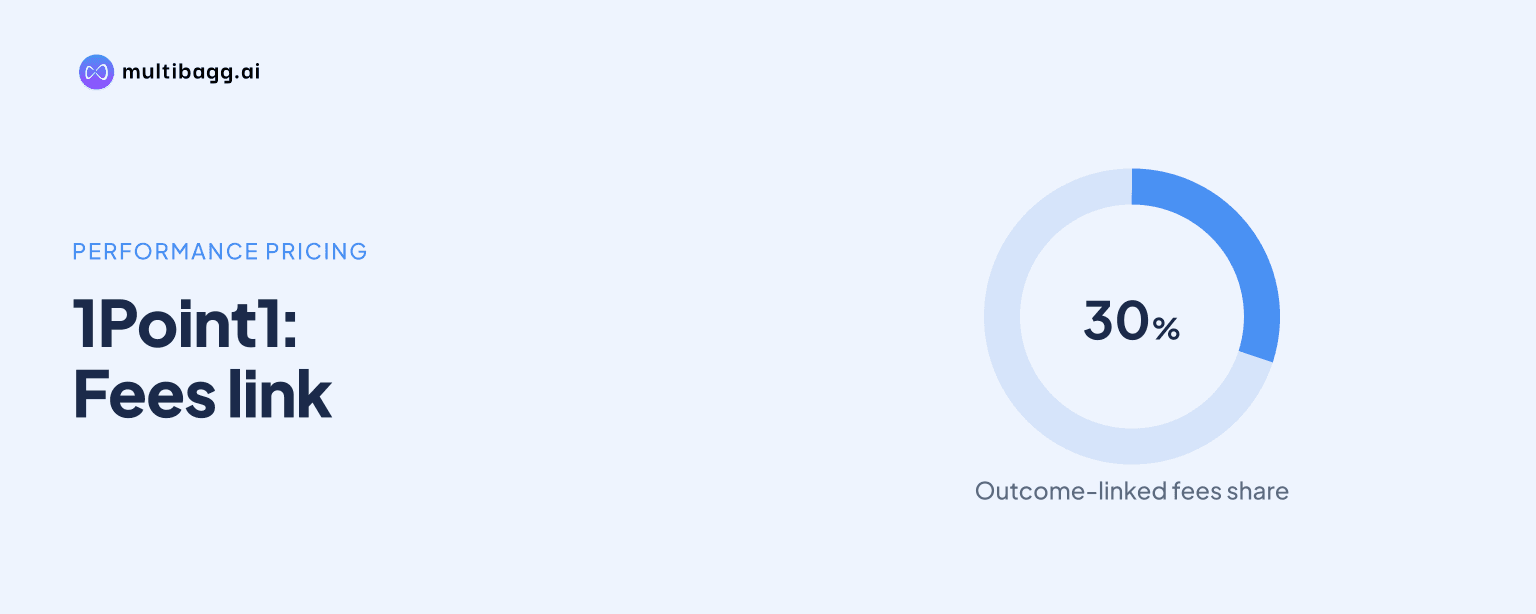
1Point1 Solutions Ltd. says up to 30% of its fees can be indexed to client-defined outcomes under its Resolution-as-a-Service model, alongside a stated 40–60% range for autonomous resolution of Tier-1 volumes. The presentation positions this as a move towards accountability for completed resolutions rather than delivery activity alone.
Know One Point One Solutions inside out
Results, valuation, peers and who's buying, in one view.
How will 1Point1 price client outcomes?
1Point1 says up to 30% of fees can be indexed to outcomes defined by an individual client. The presentation describes this as an outcome-linked commercial structure under its governance and commercial layer, which is designed for transparency, control and human-informed decision-making.
The company identifies conversions and retention, recoveries and resolved cases, and turnaround time as examples of measures that can evidence outcomes. These measures differ from billing solely for activity, capacity or interactions handled because they focus on a completed business result. The source does not set out a single formula, minimum threshold or payment mechanism applicable to all clients.
The 30% figure is presented as an upper limit, not as the reported share of all current fees that are outcome-linked. 1Point1 does not disclose the number of contracts using this structure, the revenue involved, a timetable for deployment or client-specific outcome thresholds. The commercial effect will therefore depend on the scope and outcome definition agreed with each client.
1Point1 places this approach within Resolution-as-a-Service, or RaaS, which is part of its agentic artificial intelligence, or AI, layer. RaaS combines a domain-trained agentic AI model with a unified stack for multichannel communication, while the company’s operating business provides global delivery, domain expertise, human judgement and enterprise accountability.
What operational benefits does 1Point1 present from AI?
1Point1 presents benefits across customer experience, digital experience and agentic AI layers, with the figures describing its intended operating model. The presentation distinguishes between reducing customer contacts, improving workflow productivity and automating the resolution of Tier-1 volume.
The comparison shows a progression from managing inbound demand to changing the cost and speed of workflows, then resolving work autonomously. The CX layer cites 10–15% contact elimination and 10–13% deflection, whereas the DX layer cites a 25–35% productivity uplift per full-time equivalent. The agentic AI layer carries the stated 40–60% autonomous-resolution range.
For end-to-end customer experience transformation, 1Point1 divides the process into eliminate, deflect and enrich stages. Elimination addresses simple inbound requests, deflection is intended to support lower-cost interactions, and enrichment covers medium-to-complex queries. The company also cites a potential 8–10% improvement in first-contact resolution and approximately 30–40% improvement in total cost of ownership, subject to validation of a given client opportunity.
Got a follow-up? Ask IRIS
How do 1Point1 and ResolX divide the work?
1Point1 assigns global operations, domain expertise, human judgement and enterprise accountability to its operating business, while ResolX provides the proprietary agentic AI platform and resolution orchestration. The presentation calls these the company’s dual engines of growth and describes ResolX as a 1Point1 company.
On the operations side, 1Point1 says its global CX and enterprise-operations delivery can support upselling and cross-selling to customers. On the platform side, ResolX is intended to use AI applications and workflows for product innovation, orchestration of multi-step processes and outcome-linked commercial models. This combination means the proposed outcome model includes both automated and human-led work.
The company says that, as automation increases, revenue mix shifts towards higher-margin AI, orchestration and outcome-linked models while human expertise moves to complex, judgement-led work. That is management’s stated direction rather than a reported revenue-mix change: the presentation provides no current percentage of revenue from AI, orchestration, RaaS or outcome-linked arrangements.
1Point1 describes its offering as built in live operations rather than in a lab. It lists production deployments, end-to-end query resolution, completion and hand-off accuracy, workflow libraries, language coverage and regulated-industry references as evidence categories. Pages 13 to 16 do not provide numerical deployment totals, accuracy results, client counts or contract values for these categories.
Which measures can support 1Point1's outcome model?
1Point1 identifies conversion, retention, recoveries, resolved cases and turnaround time as potential measures for client-defined outcomes. Those measures can connect the pricing structure to the workflow and customer-experience improvements that the company says its AI-enabled operating model is designed to deliver.
At the inbound stage, cognitive channels include natural language processing interactive voice response, chat bots and email bots intended to eliminate simple queries. Assisted care can include live chat, SMS engagement, case management, persona-based service, a 360-degree view, auto call tagging, intuitive call trees and next-best-action tools. These mechanisms span unassisted and assisted customer care rather than one individual communications channel.
The presentation gives separate metrics for workload and workflow changes. A 10–15% reduction in contacts, 10–13% contact deflection and 10–15% average handling time improvement can alter incoming workload, while a 25–35% productivity uplift per full-time equivalent and 30–40% total cost of ownership reduction relate to workflow delivery. The source labels end-to-end transformation benefits as indicative and subject to validation for the relevant opportunity.
Governance is part of the proposed commercial design. 1Point1 says the governance and commercial layer spans global certifications in technology, risk governance and operational excellence, and is designed for control and transparency. It does not name the certifications, identify audit procedures, disclose performance penalties or explain how disputes over client-defined outcomes would be resolved.
Conclusion
1Point1’s presentation sets out a commercial model in which up to 30% of fees can be tied to client-defined outcomes, supported by a delivery model combining operations, workflow orchestration and agentic AI. The key stated operating figures range from 10–15% contact elimination to 25–35% workforce productivity improvement and 40–60% autonomous resolution of Tier-1 volumes.
The next point to watch is whether individual client scopes validate the stated 30–40% total-cost-of-ownership improvement and lead to disclosed outcome-linked contracts or revenue. 1Point1 has not disclosed a rollout timetable, current share of fees under this structure, contract volume or revenue contribution from ResolX, RaaS or AI orchestration.