










Dhabriya Polywood has Rs 140 crore aluminium order book
Key highlights
- Dhabriya Polywood reported a Rs 140 crore aluminium windows and facade order book in Q2 FY27.
- Aluminium represented about 58% of Dhabriya Polywood’s Rs 240 crore disclosed project order book.
- Dhabriya Polywood said aluminium execution will begin in Q3 FY27, with contracts generally lasting 12 to 24 months.
- Management expects initial aluminium margins to be 2 to 3 percentage points below Dhabriya Polywood’s overall margin.
powered by IRIS
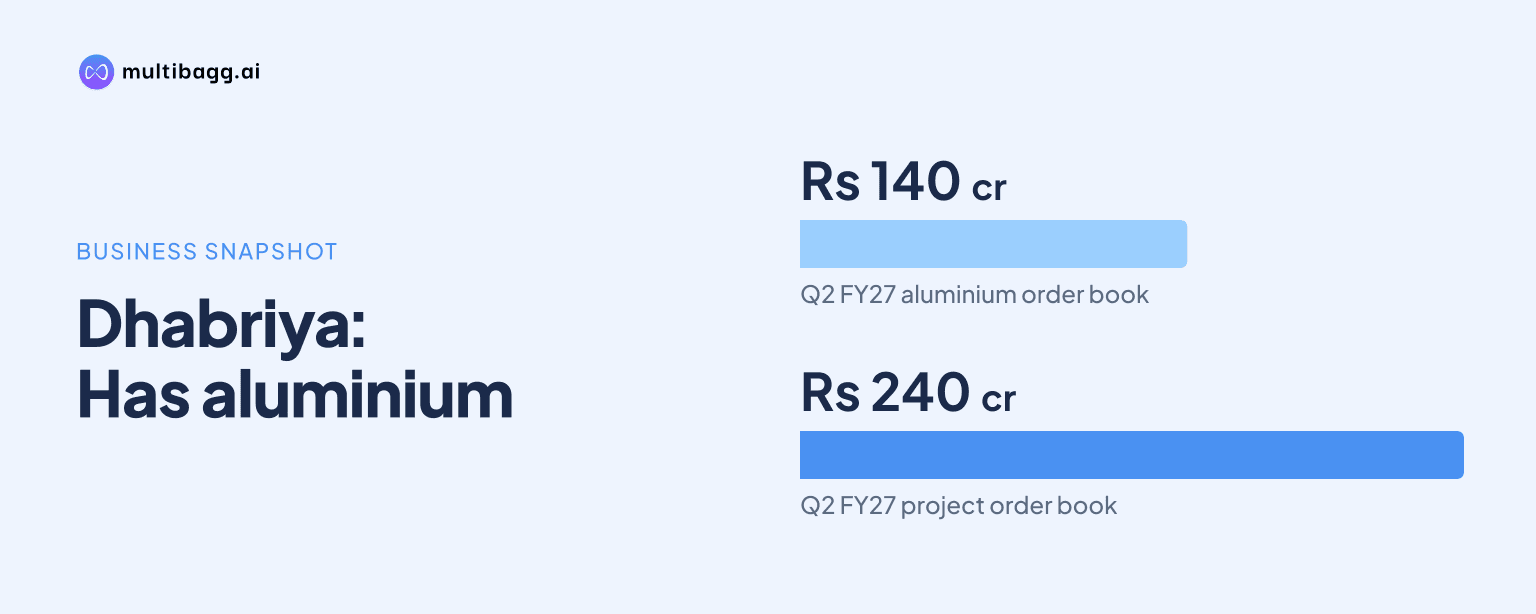
Dhabriya Polywood Limited reported a Rs 140 crore aluminium windows and facade order book in Q2 FY27, equal to about 58% of its Rs 240 crore disclosed project backlog, and said supplies and execution will begin in Q3 FY27. Management said these contracts generally take 12 to 24 months to execute, delaying much of the revenue conversion.
Know Dhabriya Polywood inside out
Results, valuation, peers and who's buying, in one view.
What is Dhabriya Polywood’s aluminium order book?
Dhabriya Polywood’s aluminium windows and facade order book was Rs 140 crore at the time of its Q2 FY27 call, making it the largest of its three disclosed project-business verticals. The balance comprised Rs 70 crore of unplasticised polyvinyl chloride (uPVC) windows orders and Rs 30 crore of furniture orders, taking the project order book to Rs 240 crore.
The Rs 140 crore aluminium backlog had risen from around Rs 56 crore previously and from the Rs 100 crore-plus level management discussed earlier in the call. Management said a typical aluminium doors, windows and facade order is generally above Rs 10 crore, indicating that the order book consists of several large project contracts rather than short-cycle sales.
Management named Godrej, MR and M3M among the aluminium-project customers whose larger orders had been disclosed to exchanges. It did not provide order values, project locations, billing milestones or delivery dates for each customer, so the Rs 140 crore figure represents aggregate contracted work across multiple projects.
When will Dhabriya Polywood recognise aluminium revenue?
Dhabriya Polywood said supplies and execution will start in Q3 FY27, while the new vertical’s revenue should become visible in Q4 FY27. Management said the schedule had not slipped because projects first require design approvals, soft drawings, structural calculations and customised system development.
Management described Q4 FY27 as an initial execution period in which revenue will take time to build, depending on civil-site conditions. When an analyst asked whether Q4 revenue could be close to Rs 20 crore, management said it should be, while also characterising this as a starting-stage contribution rather than formal quarterly guidance.
The larger portion of the Rs 140 crore order book is expected to convert in the following financial year. Management said aluminium project execution normally spans 12, 15 or 24 months and expects about 60% to 70% of the aluminium backlog to become revenue next year, showing why order booking and revenue recognition will be separated across periods.
Is Dhabriya Polywood ready to execute its aluminium projects?
Dhabriya Polywood has commissioned two lines at its Jaipur aluminium facility, completed trials and started operations, enabling Q3 FY27 project execution, management said. Full implementation of the Jaipur facility is planned by the end of FY27, leaving further capacity installation to be completed while initial project work begins.
The company said its aluminium-related manufacturing and project setup covers Bangalore, Jaipur and Coimbatore, but it did not disclose site-specific aluminium capacity or revenue potential. For all existing plants and product verticals together, management said more than Rs 400 crore of revenue was achievable, though it did not assign that figure to aluminium.
The wider manufacturing base was already being expanded alongside the aluminium launch. Extrusion capacity utilisation was above 65% in H1 FY27, compared with 66% in FY26, and management said it had ordered equipment to add 8,000 metric tonnes of extrusion capacity within three to six months; that programme relates to the broader extrusion business, not a stated aluminium capacity figure.
Got a follow-up? Ask IRIS
How could aluminium affect Dhabriya Polywood’s margins and growth?
Dhabriya Polywood expects initial aluminium margins to be 2 to 3 percentage points below its overall margin, according to management. It attributed the difference to the early stage of the new business and the need to build an order book against competitors, while saying pricing was set with existing group margin levels in mind.
The company has not disclosed a separate aluminium earnings before interest, tax, depreciation and amortisation (EBITDA) margin. Management said product-level profitability is not regularly monitored or captured, although it indicated that margins across product lines are generally within a 2 to 3 percentage-point range and extrusion has a higher margin than other lines.
Consolidated EBITDA rose 19.9% year on year to Rs 16.38 crore in Q2 FY27, with margin increasing to 21.1% from 20.4% in Q2 FY26. In H1 FY27, EBITDA increased 23.5% to Rs 32.14 crore and margin reached 22.0%, compared with 20.2% a year earlier, providing the reported group benchmark before aluminium revenue becomes material.
Aluminium enters a business that remains led by plastic products and windows. Q2 FY27 plastic-products revenue was around Rs 70 crore, including about Rs 54 crore from PVC profiles and Rs 16 crore from the windows division, while consolidated revenue increased 16.1% year on year to Rs 77.78 crore.
Other newer products have different revenue timetables. Fluted panels generated around Rs 29 crore in H1 FY27 against management’s approximately Rs 65 crore full-year target, while commercially launched wood-plastic composite doors are projected to add around Rs 5 crore in FY27 after an implementation delay. Management has not issued specific FY27 guidance but said its longer-term objective is 25% to 30% annual revenue growth through capacity additions and product expansion.
Conclusion
The Rs 140 crore aluminium order book makes aluminium Dhabriya Polywood’s largest disclosed project vertical, exceeding the Rs 70 crore uPVC windows backlog and Rs 30 crore furniture backlog. Its significance is primarily in future revenue coverage: Q3 FY27 execution starts from a limited operating base, while 12-to-24-month contracts spread billing and delivery over a longer period.
The next disclosed milestones are Q4 FY27 revenue visibility from the new segment and completion of Jaipur’s full implementation by the end of FY27. Management’s expectation that 60% to 70% of the aluminium backlog converts next year, alongside its indication of initially lower margins, will determine how rapidly the Rs 140 crore backlog affects reported growth and profitability.