










Dhabriya Polywood says 21%-22% margin reflects product mix
Key highlights
- Dhabriya Polywood said EBITDA margins rose from 16% in FY25 to about 21%-22% currently.
- PVC extrusion generates more than 65% of Dhabriya Polywood's revenue through more than 800 channel partners.
- Dhabriya Polywood reported about Rs 30 crore of fluted-products revenue in H1, versus about Rs 38 crore in FY24.
- Dhabriya Polywood plans to add 8,000 metric tonnes of extrusion capacity within 3 to 6 months.
powered by IRIS
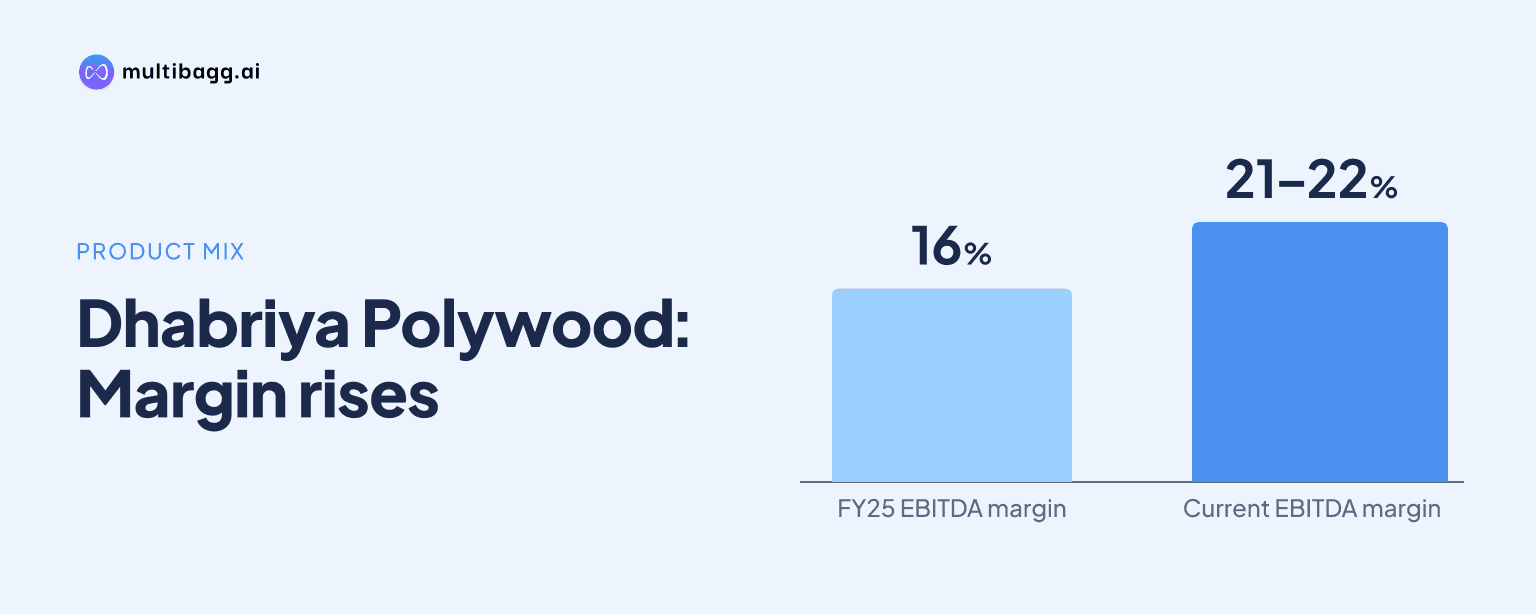
Dhabriya Polywood Limited said its earnings before interest, tax, depreciation and amortisation (EBITDA) margin rose from 16% in FY25 to about 21%-22% currently because a shift to fluted and soffit panels, furniture profiles, higher-range doors and windows, and refined modular-furniture products improved its mix rather than because of price increases.
Know Dhabriya Polywood inside out
Results, valuation, peers and who's buying, in one view.
Why did Dhabriya Polywood's EBITDA margin rise to 21%-22%?
Dhabriya Polywood said its EBITDA margin improvement came from a refined product mix, not from temporary price increases. Asked about the move from 16% in FY25 to about 21%-22% currently, Hitesh Agrawal said the company had progressively replaced lower-cost, highly competitive offerings with upgraded products across its business lines over the last 8 to 10 quarters.
Management identified fluted and soffit panels, furniture profiles, higher-range doors and windows, and refined modular-furniture products aimed at individual customers, architects and interior designers as the main changes. Dhabriya Polywood does not regularly monitor or capture product-wise EBITDA margins, but management said margins across product segments are broadly within 2% to 3% of each other, with extrusion carrying a higher margin than other lines.
What evidence shows Dhabriya Polywood's product mix has changed?
Dhabriya Polywood cited its fluted-products business as an indication of the upgraded portfolio, reporting revenue of about Rs 30 crore in the current first half, or H1, compared with about Rs 38 crore in FY24. The comparison is between an H1 period and a full financial year, so it does not establish a like-for-like annual growth rate, but it shows the product was a material revenue contributor during H1.
Management's explanation centres on the composition of sales rather than sales volume alone. It said earlier volumes were generated by low-cost or intensely competitive products, while the current mix includes differentiated panels, profiles and higher-range doors, windows and furniture solutions. This matters because the business-to-business PVC extrusion channel generates more than 65% of Dhabriya Polywood's revenue through more than 800 channel partners across India.
Are price increases or imports behind Dhabriya Polywood's margins?
Dhabriya Polywood said price hikes were not the reason for the current 21%-22% EBITDA margin range. Management described margin improvement over the last 8 to 10 quarters as the result of its product upgrade across PVC extrusion, doors and windows, and modular furniture. This is management's explanation rather than a disclosed reconciliation of product pricing, raw-material costs and segment profitability.
Management also described a different competitive setting for extrusion products. It said Chinese imports of profiles used in ceiling panelling and doors had faced wider competition earlier, but that this competition had almost vanished over the last 2 to 3 years as domestic manufacturing capacity developed. Digvijay Dhabriya added that import tariffs had changed materially, while management said Dhabriya Polywood's 34 years in the segment and continuing research and development supported its broader range of solutions.
Got a follow-up? Ask IRIS
Which businesses are shaping Dhabriya Polywood's margin outlook?
Dhabriya Polywood identified PVC extrusion and doors and windows as its primary business, the main contributor to revenue and the key current growth driver. Management said extrusion earns a better margin than its other lines, while the newer aluminium windows and facade business may initially operate about 2% to 3% below the established range as it builds an order book and competes for new work.
The aluminium windows and facade business is directed mainly at large builders and developers. Management said these relationships have been built through unplasticised polyvinyl chloride, or uPVC, windows and modular furniture since 2006, and indicated that aluminium revenue for the financial year should be close to Rs 20 crore. It did not disclose a separate aluminium EBITDA margin or specify when the business could reach the established margin range.
Modular furniture had a different revenue pattern in H1. Management said H1 revenue was about Rs 16 crore, compared with about Rs 23 crore in the prior-year H1, because some project executions were delayed. It said deliveries began in the preceding month and that it expected to clear this backlog in the following 6 months; Studio Arezzo, its design-to-execution format, contributes about 20%-22% of modular-furniture revenue.
Can Dhabriya Polywood sustain the upgraded mix?
Dhabriya Polywood's ability to sustain its mix depends on execution in extrusion and adoption of newer offerings. Management said existing capacity across its plants and product verticals could support revenue of more than Rs 400 crore. It has also ordered equipment to add 8,000 metric tonnes of extrusion capacity within 3 to 6 months, saying multiple lines are needed to run different moulds and product applications before full capacity utilisation is reached.
Newer product categories have less established revenue visibility. Management reduced its projection for wood-plastic composite, or WPC, doors and wall-ceiling products to about Rs 5 crore to Rs 6 crore in the financial year from an initial expectation of Rs 15 crore, citing delays in project implementation. It did not give an FY28 forecast, saying WPC is a new product for the Indian market and customer response is still being assessed.
Conclusion
Dhabriya Polywood attributes the rise from a 16% EBITDA margin in FY25 to about 21%-22% currently to a deliberate move towards higher-value panels, profiles, doors, windows and modular-furniture products. Its largest revenue channel remains PVC extrusion, which contributes more than 65% of revenue, while management also says competition from Chinese imports in relevant extrusion products has largely receded over the last 2 to 3 years.
The next measures to watch are execution-related. Management plans to add 8,000 metric tonnes of extrusion capacity within 3 to 6 months, expects delayed modular-furniture work to be delivered over the next 6 months, and has indicated aluminium windows and facade revenue could approach Rs 20 crore in the financial year. Product-level EBITDA margins and an FY28 WPC revenue forecast remain undisclosed.