










Dhabriya Polywood Ltd reports 16.1% revenue growth in Q2 FY27
Key highlights
- Dhabriya Polywood reported Q2 FY27 consolidated revenue of ₹77.78 crore, up 16.1% year-on-year.
- Q2 FY27 EBITDA rose 19.9% to ₹16.38 crore and EBITDA margin reached 21.1%.
- Q2 FY27 PAT increased 20.9% to ₹9.21 crore, while EPS rose to ₹8.51 from ₹7.03.
- Dhabriya Polywood said its order book exceeded ₹240 crore and its polymer business generated 89% of gross turnover.
powered by IRIS
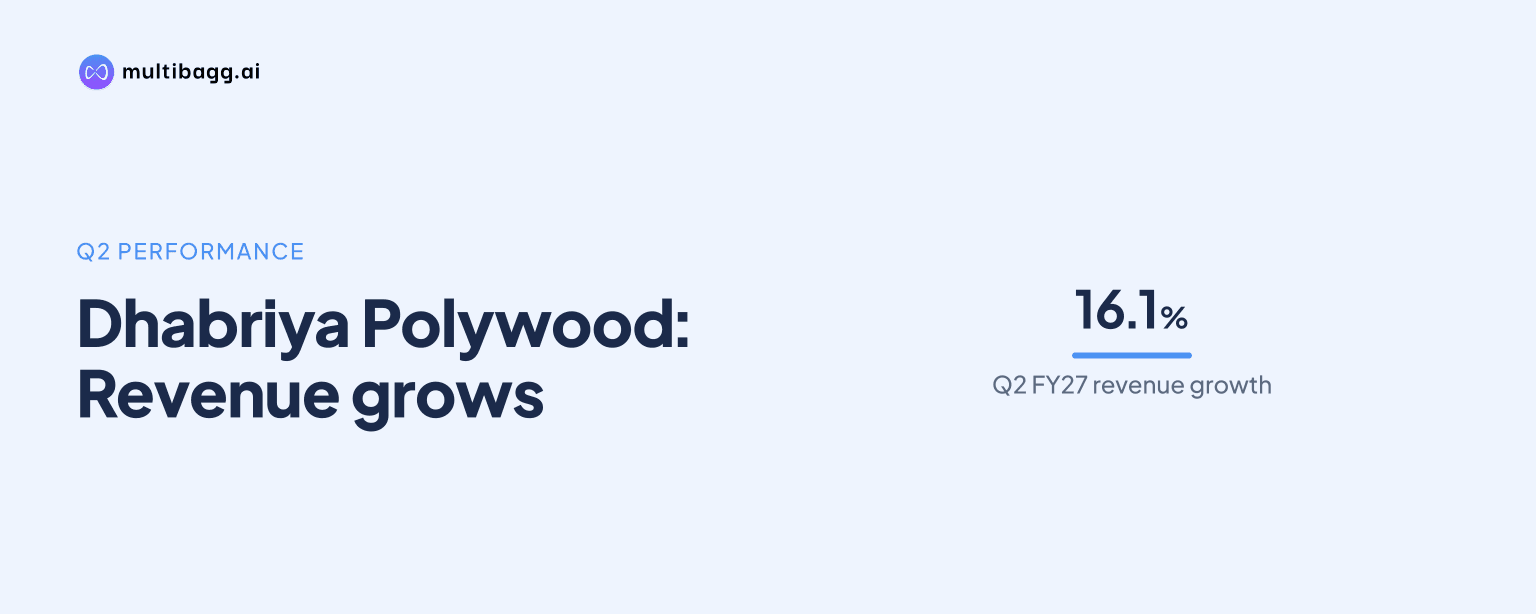
Dhabriya Polywood Ltd reported record consolidated revenue of ₹77.78 crore in Q2 FY27, a 16.1% year-on-year increase, while profit after tax rose 20.9% to ₹9.21 crore. The company said the quarter was its strongest yet for revenue, EBITDA, PAT and earnings per share, with profitability growing faster than sales.
Know Dhabriya Polywood inside out
Results, valuation, peers and who's buying, in one view.
What did Dhabriya Polywood report for Q2 FY27?
Dhabriya Polywood reported consolidated revenue from operations of ₹77.78 crore for the quarter ended 30 September 2026, compared with ₹66.99 crore in Q2 FY26. Revenue was also 13.9% higher sequentially, according to management's earnings-call presentation on 13 November 2026.
EBITDA increased 19.9% year-on-year to ₹16.38 crore from ₹13.66 crore. The EBITDA margin improved by 70 basis points to 21.1%. Profit before tax rose 26.6% to ₹12.44 crore, while PAT grew to ₹9.21 crore from the prior-year quarter.
Quarterly earnings per share stood at ₹8.51, compared with ₹7.03 in Q2 FY26. Management described the period as the company's highest-ever quarterly performance across its key reported financial measures. The stronger rate of EBITDA and PAT growth than revenue indicates an improvement in operating profitability during the quarter.
How did Dhabriya Polywood perform in the first half of FY27?
Dhabriya Polywood recorded consolidated revenue from operations of ₹146.10 crore in H1 FY27, up 13.2% from ₹129.08 crore in H1 FY26. The half-year result covers the six months ended 30 September 2026 and reflects continued growth across both reported quarters of the financial year.
H1 EBITDA rose 23.5% to ₹32.14 crore, while PAT increased 27.6% to ₹18.06 crore. The company reported an H1 EBITDA margin of 22% and a PAT margin of 12.4%. It said the EBITDA margin had improved by 180 basis points and the PAT margin by 140 basis points year-on-year.
Profit before tax for the first half increased 30.4% to ₹24.34 crore. H1 earnings per share were ₹16.69. These figures show that first-half profit growth exceeded revenue growth, consistent with the quarterly pattern reported by the company.
What drove Dhabriya Polywood's growth during the quarter?
Dhabriya Polywood said its core polymer business was the principal contributor to the reported performance, accounting for 89% of gross turnover. This concentration makes the polymer operation central to the company's revenue growth and operating performance.
Management also cited a diversified order book exceeding ₹240 crore. An order book represents business that has been secured but not yet recognised as revenue, and its size provides visibility into planned execution. The company did not provide a detailed order-book split by product, customer or delivery schedule in the supplied call material.
The company is expanding its distribution footprint across India while pursuing capacity additions. Management said it sees long-term revenue growth of 25% to 30% annually, supported by the order book and wider distribution network. This was management guidance, rather than an announced financial result or a confirmed forecast.
Got a follow-up? Ask IRIS
What investments is Dhabriya Polywood making?
Dhabriya Polywood is undertaking a capital-expenditure programme to expand extrusion capacity and establish manufacturing infrastructure for aluminium windows and facades in Jaipur. The planned investment points to an effort to add production capacity while broadening the company's product offering beyond its existing polymer-led business.
The supplied material does not specify the total capital-expenditure amount, commissioning timeline, financing method or expected capacity from the Jaipur project. Those details remain relevant for investors because the financial effect of an expansion depends on execution, demand, utilisation and the investment required.
The aluminium window and facade initiative could increase the range of products offered by Dhabriya Polywood. However, the company did not quantify any revenue contribution from this business during the Q2 FY27 call. For now, the reported turnover mix remains dominated by the core polymer segment.
How do the results affect investors and industry operations?
For investors, the central feature of the Q2 and H1 results is that profit increased faster than revenue. Q2 EBITDA rose 19.9% against 16.1% revenue growth, and PAT grew 20.9%. In H1, EBITDA rose 23.5% and PAT 27.6%, compared with 13.2% revenue growth.
Margin movement is also important because it indicates the proportion of sales retained after operating and tax-related costs. Dhabriya Polywood reported a Q2 EBITDA margin of 21.1% and an H1 EBITDA margin of 22%, alongside an H1 PAT margin of 12.4%. The company did not provide a detailed breakdown of cost changes behind these margin movements in the supplied transcript.
For operations, the order book above ₹240 crore and the planned capacity programme provide context for the company's expansion plans. But the call material does not disclose customer concentration, raw-material costs, capital-spending outlay, debt impact or project commissioning dates. These remain factors investors would need to assess alongside the reported earnings growth.
Conclusion
Dhabriya Polywood delivered a record Q2 FY27, with consolidated revenue rising to ₹77.78 crore and PAT reaching ₹9.21 crore. The result was supported by the polymer business, which accounted for 89% of gross turnover, while EBITDA and PAT growth outpaced sales growth in both the quarter and first half.
The next areas to watch are execution of the extrusion and Jaipur aluminium window and facade investments, conversion of the order book exceeding ₹240 crore, and progress towards management's stated long-term revenue-growth target of 25% to 30%. The company has not disclosed the project cost, capacity or commissioning schedule for these initiatives in the provided material.