










Dhanlaxmi Crop Science Limited says non-cotton is 66% FY26 revenue
Key highlights
- Dhanlaxmi reported Rs 25.47 crore of FY26 revenue from non-cotton seeds, equal to 66% of total revenue.
- Dhanlaxmi lists eight non-cotton crop categories in its core commercial seed portfolio.
- Dhanlaxmi has three chilli varieties under evaluation and two okra varieties advancing towards commercial readiness.
- Dhanlaxmi reports a 16-acre research farm and five PPV&FR applications.
powered by IRIS
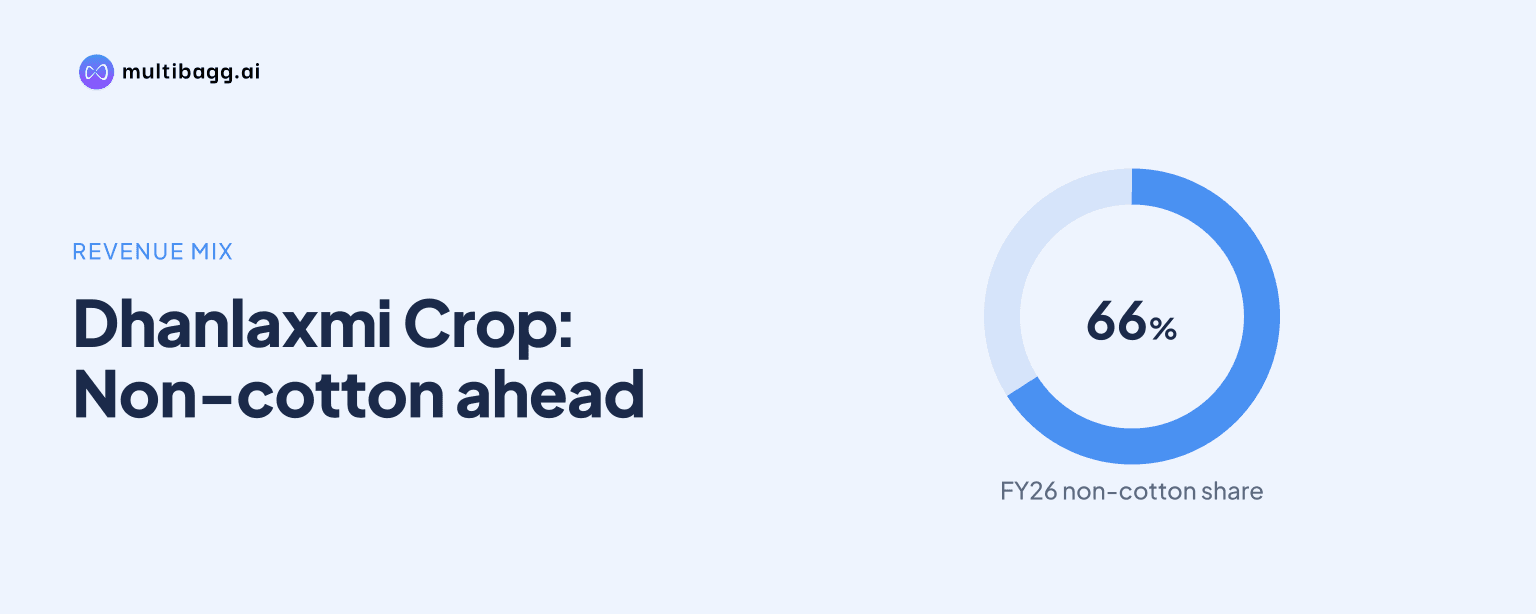
Dhanlaxmi Crop Science Limited said non-cotton seeds generated Rs 25.47 crore, or 66% of FY26 revenue, showing that crops beyond cotton formed the larger disclosed share of its sales mix. Dhanlaxmi’s commercial portfolio covers eight non-cotton crop categories, while chilli, okra and additional maize products remain in development stages.
Know Dhanlaxmi Crop Science inside out
Results, valuation, peers and who's buying, in one view.
What does Dhanlaxmi’s 66% non-cotton revenue share mean?
Dhanlaxmi’s Rs 25.47 crore non-cotton revenue represented 66% of FY26 total revenue, making non-cotton the larger reported component of its revenue mix. The company presents this figure within its portfolio transformation strategy, which it describes as moving from a cotton-led portfolio towards a diversified multi-crop platform.
The 66% non-cotton share implies that 34% of FY26 revenue was outside that portfolio, based on the disclosed percentage. Dhanlaxmi does not provide cotton revenue in rupees, crop-wise sales, volumes or profitability in the presentation, so the contribution of cotton cannot be compared directly with maize, paddy, soybean or another individual crop category.
Cotton remains part of Dhanlaxmi’s core commercial range through the ZCH-545 and ZCH-547 varieties, listed for Central and South India. The diversification measure is instead supported by commercial offerings in pearl millet, soybean, paddy, mustard, maize, wheat, gram and cumin, spanning Central, North and South markets.
Which commercial crops support Dhanlaxmi’s non-cotton portfolio?
Dhanlaxmi lists eight non-cotton categories in its core commercial portfolio, compared with one cotton category. Paddy and pearl millet each have five named varieties, maize has four, and soybean, wheat and cumin have three each, giving the non-cotton catalogue a wider range of listed products than the two cotton varieties.
Paddy varieties include Karina, Karishma, Mahima, Janki Gold and Amruta, while maize includes 32D12, 32D55, Legend and RanBanka. Dhanlaxmi lists Janki-88, Navratna and Soniya-101 for soybean, placing each of soybean, paddy and maize in Central and South regions.
The regional allocation differs among the commercial crops. Wheat, mustard, cumin and pearl millet are mapped to Central and North India, while gram is listed only for Central India. Dhanlaxmi provides no revenue or market-share figures by state or region, but its product table identifies crop placements across more regions than the Central and South markets stated for cotton.
What seed products are in Dhanlaxmi’s development pipeline?
Dhanlaxmi’s disclosed pipeline includes three chilli varieties under evaluation, two okra varieties advancing towards commercial readiness, two gram varieties and maize products under evaluation. The chilli candidates are Dhanlabh, Dhantej and Dhanshakti, while the named okra candidates are Kalyani and Shivani.
These pipeline products are separately labelled from the commercial portfolio, so the presentation does not establish them as contributors to the Rs 25.47 crore FY26 non-cotton revenue figure. It gives no launch date, expected sales contribution or approval timeline for chilli, okra, gram or maize pipeline products.
The pipeline introduces vegetable opportunities through chilli and okra within research across 11 crop categories. Those categories are cotton, maize, pearl millet, soybean, paddy, wheat, gram, cumin, mustard, chilli and okra, with Dhanlaxmi citing hybrid development, crop suitability, maturity, disease resistance and climatic adaptability as research focus areas.
Got a follow-up? Ask IRIS
How does Dhanlaxmi develop and supply its multi-crop seeds?
Dhanlaxmi operates a 16-acre research and development farm in Himatnagar, Gujarat, and says Dr. Fula Bhila Patil leads the work with more than 50 years of experience. The company has filed five applications under the Protection of Plant Varieties and Farmers’ Rights, or PPV&FR, framework.
Its stated development process moves from germplasm and crossing to multi-season breeding, multi-location field trials, agronomic and quality evaluation, the state agricultural university or approval process, foundation seed and commercial seed. The presentation identifies Kharif, Rabi and Zaid testing cycles, but does not quantify the number of active trials, approvals or launches by crop.
Dhanlaxmi reports a seed-production network of more than 3,000 acres and more than 1,000 contracted grower-farmers across multiple agro-climatic zones. Its Himatnagar facility has processing and packing capability of 60,000 metric tonnes a year, depending on crop, and integrated processing capacity of 7.3 metric tonnes an hour.
How broad is Dhanlaxmi’s distribution reach for these seeds?
Dhanlaxmi reports more than 1,500 registered dealers and distributors and market presence across nine states. Its distribution model also includes demonstration plots, variety trials, agronomic advisory and direct field engagement through the crop cycle.
The presentation names Rajasthan, Gujarat, Haryana, Madhya Pradesh, Maharashtra, Telangana, Karnataka and Andhra Pradesh, which totals eight states despite the stated nine-state presence. This disclosure difference leaves one state in the reported footprint unnamed, while the dealer and distributor count is disclosed only as more than 1,500.
The company’s processing facility occupies 87,000 square feet in Himatnagar, alongside the 16-acre research farm. Dhanlaxmi says processing and packaging are also undertaken through local partners in key seed-producing regions, providing an operating mechanism for crops produced across its more than 3,000-acre production network.
Conclusion
Dhanlaxmi’s FY26 disclosure establishes that non-cotton seeds accounted for the larger reported share of revenue, at Rs 25.47 crore and 66%. The commercial catalogue contains eight non-cotton categories, with paddy, pearl millet and maize carrying four or five listed varieties each, alongside continued sales of two cotton varieties.
The next disclosed milestones are the evaluation of three chilli varieties and maize products, and the progress of two okra varieties towards commercial readiness. Dhanlaxmi has not provided launch dates, crop-wise revenue or a numerical portfolio target, so future disclosures on approvals, commercial introductions and the FY26 mix will show how the multi-crop plan develops.