










Dhanuka Agritech Q2 revenue rose 9.9% on insecticide sales
Key highlights
- Dhanuka Agritech's Q2 FY27 revenue rose 9.91% to Rs 657.51 crore from Rs 598.24 crore.
- Insecticides contributed 47% of Q2 FY27 turnover, compared with 8% for herbicides.
- Q2 FY27 profit after tax increased 16.23% to Rs 109.22 crore.
- Management said Q2 FY27 value growth was about 10%, compared with about 6% volume growth.
powered by IRIS
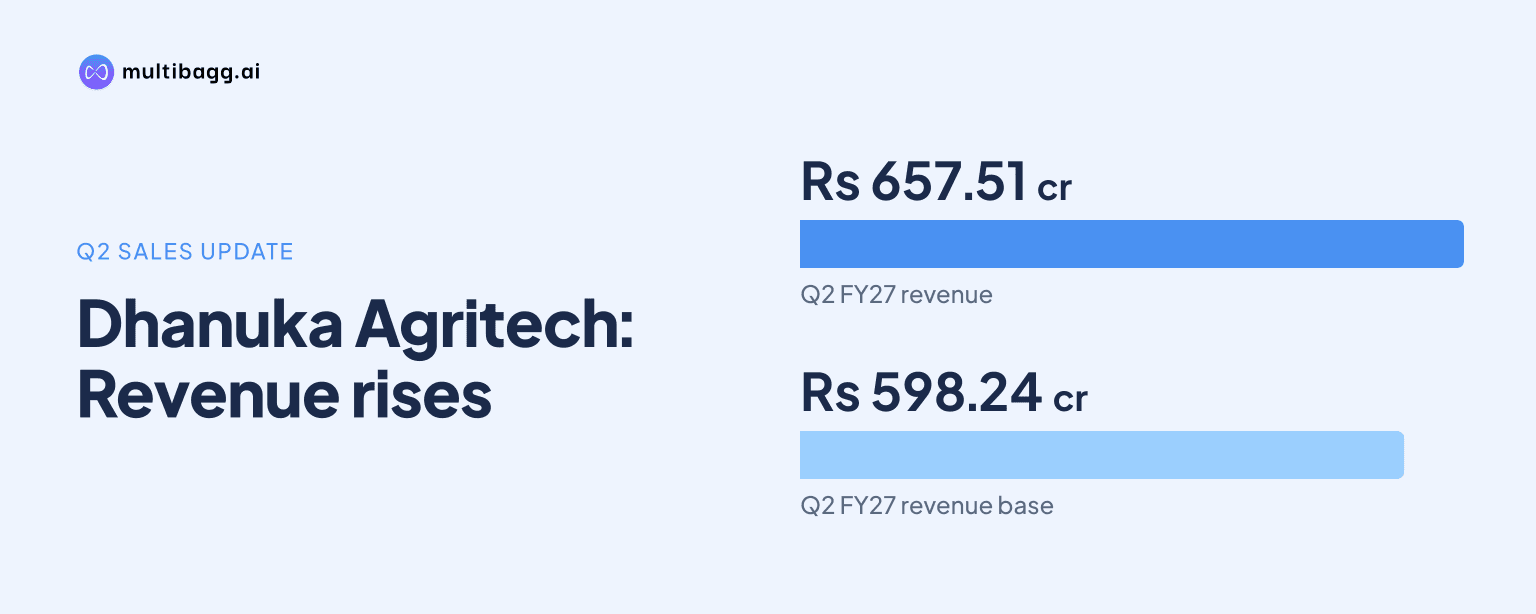
Dhanuka Agritech Limited increased revenue from operations 9.91% year on year to Rs 657.51 crore in Q2 FY27, despite monsoon rainfall being 13% lower, because insecticide sales, targeting of irrigated markets and lean distributor inventory offset pressure on herbicides and farmer-level consumption.
Know Dhanuka Agritech inside out
Results, valuation, peers and who's buying, in one view.
What drove Dhanuka Agritech's Q2 FY27 revenue growth?
Dhanuka Agritech's Q2 FY27 growth came from a product-specific push into insecticides rather than a broad agrochemical-market recovery. Revenue from operations rose to Rs 657.51 crore from Rs 598.24 crore in Q2 FY26, while management said erratic rainfall had delayed crop-care applications, compressed industry volumes and margins, and significantly affected herbicide demand.
Management said it identified insecticides as a better opportunity than herbicides and fungicides in the El Nino year, then increased emphasis on insecticides, plant growth regulators and nutritional products. It also focused demand-generation activity in regions with water availability and did not front-load the distribution channel during Q1 FY27, allowing supply-chain replenishment in Q2 FY27.
Management separated the quarterly outcome into about 10% value growth and about 6% volume growth. The difference shows that the revenue increase was not entirely volume-led, although Dhanuka Agritech did not disclose revenue for individual products such as LaNevo, Miyako or Mortar.
Which products led Dhanuka Agritech's Q2 FY27 sales?
Insecticides led Dhanuka Agritech's sales mix, accounting for 47% of Q2 FY27 turnover, compared with 25% for fungicides, 8% for herbicides and 20% for other products. Management said LaNevo, Miyako and Mortar received extraordinary focus, alongside plant growth regulators and nutritional products, after dry weather disrupted traditional crop-care cycles.
Management identified LaNevo as one of the products leading Q2 FY27 growth. Dhanuka Agritech introduced the insecticide with Nissan Chemicals of Japan and said it had been favoured by farmers in South India's chilli belt and elsewhere; however, it declined to disclose LaNevo sales when an analyst cited the Rs 1,000 crore market opportunity discussed at its May 2024 launch.
The herbicide Purge delivered moderate performance in June and July, according to management, after poor monsoon conditions in Maharashtra, Gujarat and Madhya Pradesh affected soybean demand. MYCORe Super, a product management said helps make crops drought resilient, had performed well so far and was expected by management to remain relevant in the following quarter.
Why did inventory and irrigated markets matter to Dhanuka Agritech?
Lean inventory mattered because Dhanuka Agritech said it avoided front-loading distributors in Q1 FY27 and entered the Rabi season with optimal channel inventory. Management described the approach as zero channel stuffing, contrasting it with high-cost inventory issues affecting parts of the sector during the weather-disrupted Q2 FY27 season.
Irrigated northern markets also gave Dhanuka Agritech access to demand less dependent on rainfall. North India supplied 31% of Q2 FY27 turnover, followed by South India at 29%, West India at 28% and East India at 12%; management cited canal irrigation in Punjab, Haryana and western Uttar Pradesh as a relative advantage.
Management did not claim a market-share gain in North India, despite an analyst citing about 22% quarterly regional growth. It said North India was generally an industry-favoured market, while Gujarat, Maharashtra and other rain-dependent areas were more stressed, so the result reflected the targeting of available demand rather than disclosed evidence of share gains.
Got a follow-up? Ask IRIS
What increased Dhanuka Agritech's Q2 FY27 profit?
Dhanuka Agritech's profit after tax rose 16.23% to Rs 109.22 crore in Q2 FY27, exceeding the 9.91% revenue increase, while EBITDA rose 11.88% to Rs 152.97 crore. Management attributed the result to product mix, operational efficiencies and disciplined cost management in a quarter affected by elevated raw-material procurement costs.
The finance chief said gross margin was slightly lower than Q2 FY26 because that earlier period included goods and services tax refunds. EBITDA-margin improvement instead came mainly from lower other expenses, while management said product mix maintained gross margin despite generic-product pricing pressure and lower contributions from herbicides.
Royalty income was about Rs 6.5 crore in Q2 FY27, against about Rs 4.3 crore in Q2 FY26. The Dahej business reported around Rs 55 crore of sales in H1 FY27, and its loss reduced to about Rs 1.79 crore from around Rs 3.5 crore in the prior-year first half, according to management.
What does Dhanuka Agritech expect for FY27 and FY28?
Dhanuka Agritech is maintaining its single-digit FY27 growth expectation, and management said Q2 FY27's 9.91% revenue growth should not be treated as the rate for the remaining two quarters. The chairman said the company remained subdued on Q3 and Q4, although initial Rabi movement looked promising in certain regions.
Management was relatively more confident in South and East India than Central and West India for Q3 and Q4 because returning monsoons can affect the South and areas including Bengal, parts of Bihar, Odisha and Chhattisgarh. It said the rainfall opportunity in West and Central India was largely over by the October 30, 2026 call.
For FY28, management said it had aligned capacity expansion at Dahej to increase output of existing products and add two new products. It expects Dahej to have four products from two currently sold, with the additions mainly fungicides for India; international registrations for those products had not yet been initiated.
Conclusion
Dhanuka Agritech's Q2 FY27 result reflected a selective response to a difficult agrochemical season rather than a market-wide recovery. Insecticides represented 47% of turnover, revenue reached Rs 657.51 crore and profit after tax rose to Rs 109.22 crore, while management cited irrigated-market focus, product mix and inventory discipline as the operating mechanisms behind the outcome.
The next disclosed indicators are Rabi demand and the returning monsoon's effect on South and East India during Q3 and Q4. Management's single-digit FY27 growth expectation, the performance of drought-oriented and insecticide products, and the planned FY28 expansion of Dahej from two to four products will show whether the quarter's drivers continue.