










Dhanuka targets four Dahej products by FY28 as loss halves
Key highlights
- Dhanuka plans to raise the Dahej portfolio from 2 products to 4 products in FY28.
- Dahej recorded H1 sales of about Rs 55 crore and an EBITDA loss of about Rs 1.79 crore.
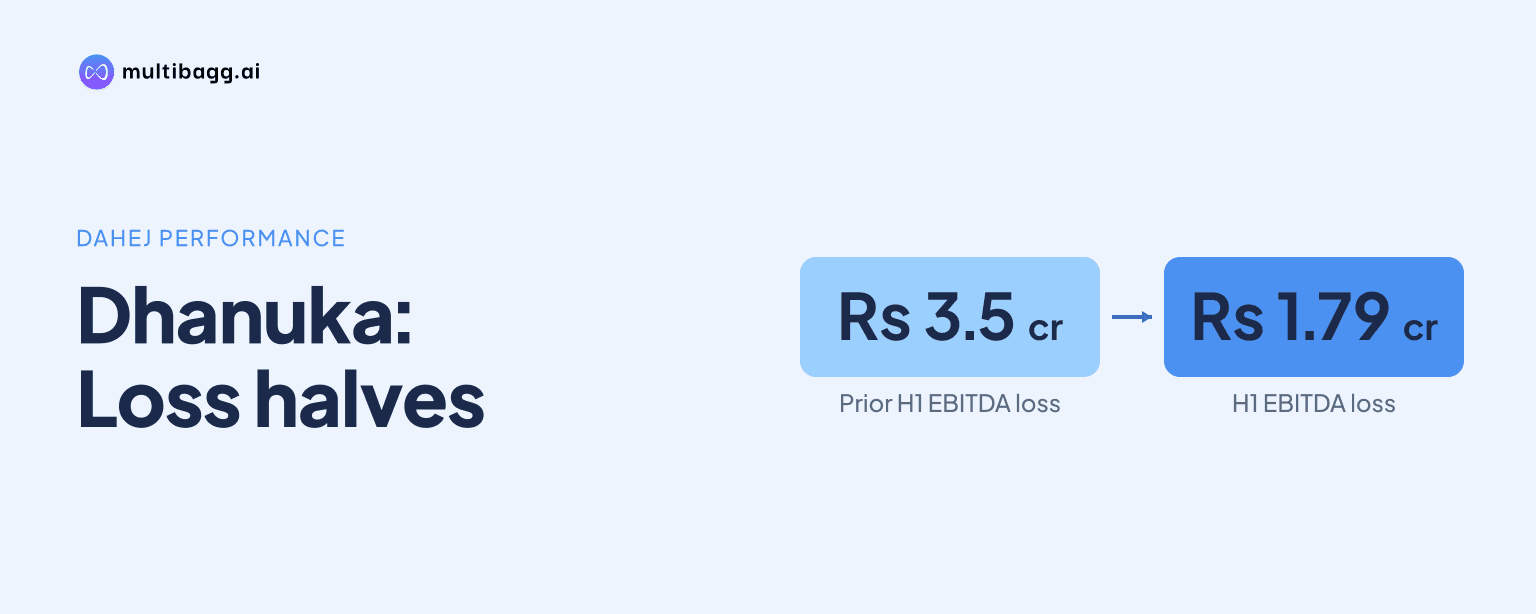
- Dahej’s H1 EBITDA loss was about 50% lower than the prior-year level of about Rs 3.5 crore.
- Dhanuka reported 10% second-quarter value growth and around 6% volume growth.
powered by IRIS
Dhanuka Agritech plans to lift its Dahej plant portfolio to four products by FY28, adding two mainly fungicide products for India, after H1 sales reached Rs 55 crore and its earnings before interest, tax, depreciation and amortisation (EBITDA) loss halved to Rs 1.79 crore.
Know Dhanuka Agritech inside out
Results, valuation, peers and who's buying, in one view.
What is Dhanuka’s Dahej expansion plan?
Dhanuka plans to add two products at the existing Dahej plant and raise capacity for its current products, taking the portfolio to four products in FY28 from two currently being sold. Harsh Dhanuka said the company had recently aligned on the capacity expansion, but did not disclose capital expenditure, additional capacity volumes, commissioning dates or product names.
Dhanuka said the two additions will be mostly fungicides and are intended mainly for the Indian market. International registrations for these new products have not been initiated, and management said overseas registrations would take time. This makes domestic market uptake, rather than exports, the stated basis for the Dahej expansion plan.
An analyst described Dahej as operating at close to 70% utilisation, but Dhanuka did not confirm that figure in its response. Management instead focused on expanding existing-product capacity alongside the two additions, so the transcript does not establish a formal utilisation target or a capacity ramp timetable.
The planned product mix differs from the demand pattern that supported Dhanuka’s second-quarter growth. Management said insecticides had a better opportunity than herbicides and fungicides during the El Niño year, whereas Dahej’s proposed additions are mostly fungicides. The expansion therefore adds products in a category that management said saw lower demand in chilli than insecticides during the quarter.
How did Dhanuka’s Dahej plant perform in H1?
Dhanuka’s Dahej business recorded about Rs 55 crore in sales in H1 and an EBITDA loss of about Rs 1.79 crore, according to V.K. Bansal. The loss was around 50% lower than the approximately Rs 3.5 crore reported in the prior-year first half, showing that the business remained loss-making while reducing its operating deficit.
The reported loss reduction of about Rs 1.71 crore came alongside Rs 55 crore of H1 sales, but Dhanuka did not provide Dahej revenue for the previous comparable half-year. It also did not disclose plant-level gross margin, fixed costs, product-wise sales, depreciation, cash flow or a date for reaching EBITDA profitability.
Dhanuka’s management described the loss as not very significant, but did not quantify the reasons for the year-on-year improvement. The transcript supports only the comparison between the two H1 EBITDA-loss figures. Whether further capacity and two new products will eliminate the loss remains unresolved because the company gave neither a profitability target nor a sales target for FY28.
Got a follow-up? Ask IRIS
What drove Dhanuka’s second-quarter sales and margins?
Dhanuka reported 10% value growth and around 6% volume growth in the second quarter, with management saying value growth exceeded volumes. Rahul Dhanuka said the growth was product-specific and centred on insecticides, particularly LaNevo, Miyako and Mortar, as well as plant-growth-regulator and nutritional products.
Management said it adjusted sales activity for an El Niño year by focusing on insecticides and locations where water was available. It also said it did not front-load the sales channel in the first quarter, allowing its supply chain to service channel demand later. Dhanuka did not publish revenue contribution or unit volumes for LaNevo, despite identifying it as a product leading second-quarter growth.
Second-quarter EBITDA margin improved mainly because of tight control of other expenses, according to V.K. Bansal. He said gross margin was slightly lower than the previous year’s second quarter because of Goods and Services Tax, or GST, refunds, while product mix maintained gross margin. Dhanuka therefore attributed margin improvement to lower other expenses rather than an improvement in gross margin.
Royalty income was Rs 6.5 crore in the second quarter, compared with about Rs 4.3 crore in the prior-year quarter. Separately, Dhanuka’s biostimulant revenue from four named molecules rose to Rs 11.7 crore in the second quarter from Rs 8.4 crore a year earlier, an increase of Rs 3.3 crore. Management said billing had begun for Dhanzyme Granule and Dhanzyme Gold Granule, while Dhanzyme Gold liquid awaited internal-process clearance despite approval and was planned for a December launch.
Which markets and products is Dhanuka watching next?
Dhanuka said North India performed better because Punjab, Haryana and western Uttar Pradesh have relatively available canal irrigation, while Gujarat and Maharashtra were more rain-dependent and stressed. Management did not claim market-share gains in the North, stating only that the region was an industry-favoured market in the conditions described.
For the remainder of the year, Dhanuka said it was relatively more confident about southern and eastern India than western and central India because returning monsoon conditions could still benefit the South and East. In the South, management identified chilli, oilseeds, pulses and cotton as supportive crops, with repeated insecticide sprays in cotton linked to high cotton prices.
LaNevo, introduced with Nissan Chemicals of Japan, was identified as a favourite among chilli growers in South India and as one product leading second-quarter growth. Dhanuka said Purge, a soybean herbicide, delivered moderate performance in June and July after poor monsoon conditions in Maharashtra, Gujarat and Madhya Pradesh. MYCORe Super, positioned by management as helping crops become drought resilient, had performed well and was expected by management to remain a preferred product in the next quarter.
Dhanuka maintained a low single-digit growth expectation for the year, rather than extrapolating its 10% second-quarter value growth. Management said demand was under stress and complete pass-through of raw-material cost increases might not be possible. It also said raw-material prices moved in both directions from the first to the second quarter, with selective price increases passed to the market where possible.
Conclusion
Dhanuka is pursuing a domestic-led Dahej expansion while the plant remains EBITDA-loss-making. The reduction in the H1 loss to Rs 1.79 crore from about Rs 3.5 crore and H1 sales of Rs 55 crore show a better operating result, but do not establish when the site could become profitable. At the company level, second-quarter value growth of 10% exceeded volume growth of around 6%, while lower other expenses, not higher gross margin, drove EBITDA-margin improvement.
Investors will next watch whether Dhanuka provides capacity, capital-spending and commissioning details for the two planned Dahej fungicides, which are intended to lift the portfolio to four products in FY28. Other disclosed milestones include the planned December launch of Dhanzyme Gold liquid and management’s low single-digit full-year growth expectation, with southern and eastern markets dependent on the returning monsoon opportunity.