










DMCC targets Rs 25-50 crore annual EOR product revenue
Key highlights
- DMCC expects Rs 25-50 crore of annualised revenue from one approved EOR polymer intermediate.
- DMCC said commercial supplies of the EOR intermediate have begun and the product will serve multiple customers.
- Management said DMCC is entering the EOR market from a zero base and plans to take share from incumbents.
- DMCC said it has at least 25% to 30% room to expand downstream products.
powered by IRIS
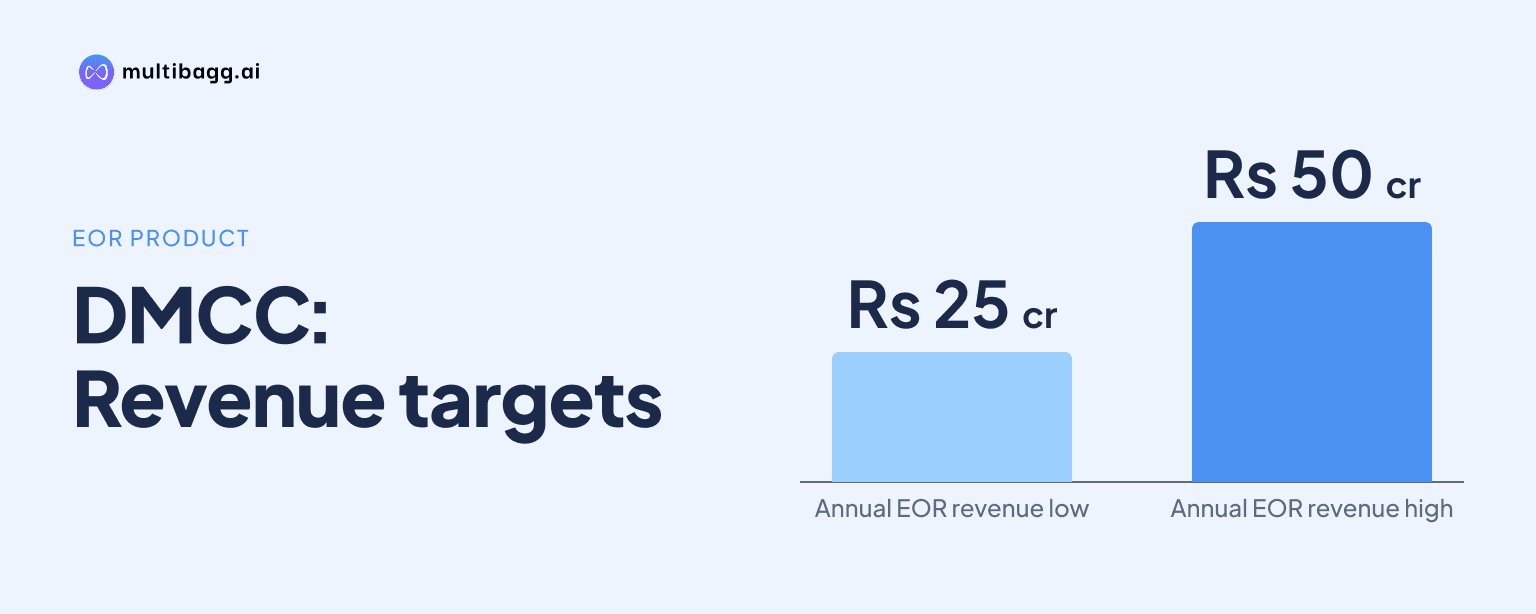
The Dharamsi Morarji Chemical Company Limited has started commercial supplies of an approved intermediate used in enhanced oil recovery (EOR) polymers, and management expects Rs 25-50 crore of annualised revenue from this one product. DMCC said the product will serve multiple customers and represents entry into a market from a zero base.
Know DMCC Speciality Chemicals inside out
Results, valuation, peers and who's buying, in one view.
How much revenue does DMCC expect from the EOR intermediate?
DMCC expects Rs 25-50 crore of annualised revenue from the approved EOR polymer intermediate. Management disclosed the range after confirming that commercial supplies had begun, placing the product beyond development and customer-approval stages described on the call.
The estimate applies to a single product, not to DMCC's wider speciality pipeline. Management did not disclose current revenue, quarterly sales, production volumes, realised prices or the time needed to reach the Rs 25-50 crore annualised range. It also did not quantify the product's contribution to total speciality revenue.
DMCC described the EOR initiative as a zero-base entry and said it intends to take market share from incumbent suppliers. That means the stated potential is based on management's commercial expectation rather than an already disclosed recurring revenue stream. The call did not identify the incumbents, the markets in which DMCC will compete, or the size of the addressable market.
The company said commercial supplies have been made and that the product has been approved. However, DMCC did not state whether further customer-specific qualification is needed for every buyer, whether customers have committed volumes, or whether supply arrangements carry fixed durations. Those factors will determine how quickly commercial supply converts into reported sales.
Will DMCC sell the EOR intermediate to multiple customers?
Yes, DMCC said the EOR intermediate is one product for multiple customers. Management made this distinction when asked whether the Rs 25-50 crore annualised opportunity was linked to a single customer, confirming that it was not a one-buyer opportunity.
A multiple-customer model differentiates the target from a disclosed contract value with one purchaser. DMCC did not disclose the number of customers already receiving commercial supplies, the revenue concentration among them, or their locations. It also did not name any oilfield operators, polymer producers or distribution partners associated with the new product.
Management's answer indicated that approval has been obtained for the product, but it did not provide the approval process, testing period or qualification criteria. The transcript therefore supports that commercial sales have commenced, but not a conclusion on the breadth of customer adoption within the Rs 25-50 crore potential.
DMCC's broader speciality business is being developed in India and overseas. Management said exports were higher in absolute terms than in both the previous quarter and the previous year, although exports represented about 12% of revenue in the quarter cited by the analyst. The company did not connect that export figure specifically to the EOR intermediate.
How could crude prices affect demand for DMCC's EOR product?
Management said higher crude prices could result in more crude being pumped and therefore higher consumption of the EOR-related product. It also said there would be a requirement for the product regardless, while presenting market-share gains from incumbents as the basis for DMCC's entry.
This is management's description of the demand mechanism, not a numerical sales forecast tied to crude prices. DMCC did not provide an oil-price threshold, a correlation between crude prices and EOR polymer consumption, or a sensitivity analysis for the Rs 25-50 crore annualised revenue estimate.
The company did not disclose the geography of its EOR customers or whether their end markets are exposed to particular crude benchmarks. It also did not state whether pricing for the intermediate is indexed to crude oil, to feedstock costs, or to another market reference. The available disclosure therefore identifies an operational demand link but not the product's earnings sensitivity to oil-price movements.
DMCC's approach to the new product is occurring alongside a shift in speciality market focus. Management said it views Europe's chemical-industry challenges as structural, citing energy costs and issues with industrial integration, and does not expect significant growth there. It said it had achieved good success in Latin America and Japan, was exploring Korea, and expected growth in India.
Got a follow-up? Ask IRIS
What other products is DMCC developing?
DMCC is developing speciality Boron fine-chemical products for catalytic applications and as an agrochemical intermediate. Management said both products were developing well, but declined to provide further details on their chemistry, customers, launch dates or potential revenue.
Management said the margin profile of newer products should be substantially better than the existing margin profile. That is a management expectation, rather than a reported profitability outcome, because DMCC did not disclose product-level margins for the EOR intermediate, the Boron products or its existing speciality portfolio.
All current research and development spending is directed toward new-product development, according to management. An analyst referred to annual research and development spending of about Rs 2 crore, while management said higher expenditure would become visible shortly and that the plan remained on course. DMCC did not provide a separate research and development budget for EOR, Boron or geographic expansion.
Management also said some products originally intended for Europe had been placed in other markets, while others had been replaced with new products. It said customer qualification cycles in Asia and Latin America had involved time lags because end users are sophisticated and Latin American customers include multinational companies, but that the company was past that stage for most countries.
Does DMCC have capacity for new speciality products?
DMCC said it has at least 25% to 30% room to expand across downstream products. Management cautioned that utilisation varies between products, so the stated headroom does not establish the capacity available specifically for the EOR intermediate or for the Boron pipeline.
The company said some expansion could be achieved with very low capital expenditure rather than through construction of an entirely new plant. Management added that a new plant could be required if DMCC chose to make an entirely new product. It did not provide an expansion budget, timetable or utilisation threshold for further spending.
DMCC also said it can maintain margins on Latin American and Asian orders that are replacing European business. This compares with management's expectation of limited European growth, while Latin America, Japan, Korea and India are being pursued as speciality markets. The company did not disclose regional revenue, segment margins or the share of European business replaced.
In a separate discussion of integrated operations, management estimated that completely shutting the sulfuric-acid operation could increase speciality chemical costs by about 10%. DMCC said it did not shut the plant and instead operated it at a level sufficient to provide utilities for downstream plants. That operating approach may support speciality production, but management did not link it directly to EOR output.
Conclusion
DMCC has commercialised an approved EOR polymer intermediate and attached an annualised revenue expectation of Rs 25-50 crore to one multi-customer product. The opportunity starts from a zero base, according to management, and depends on gaining share from incumbent suppliers as well as demand for oilfield-related polymers. Its potential is distinct from DMCC's Boron development pipeline and wider speciality-market expansion.
Next, investors can watch for reported revenue from commercial supplies, additional detail on the multiple-customer base and any indication of the time required to approach the annualised range. Management has said research and development spending should rise shortly, Boron products are developing, and at least 25% to 30% downstream expansion room remains, while it has not disclosed EOR-specific capacity or a revenue timeline.