










DMCC says sulphur spike made acid operations loss-making
Key highlights
- DMCC reported Q2 FY27 revenue of about Rs 273 crore and EBITDA of Rs 11.6 crore.
- Sulphur rose from about $500 per tonne before the Iran crisis to $1,100-$1,200 per tonne afterward.
- DMCC operated its sulphuric-acid plant at about 65% utilisation in Q2 FY27 rather than sell additional volumes below cost.
- DMCC expects its enhanced-oil-recovery intermediate to generate annualised revenue of Rs 25 crore to Rs 50 crore.
powered by IRIS
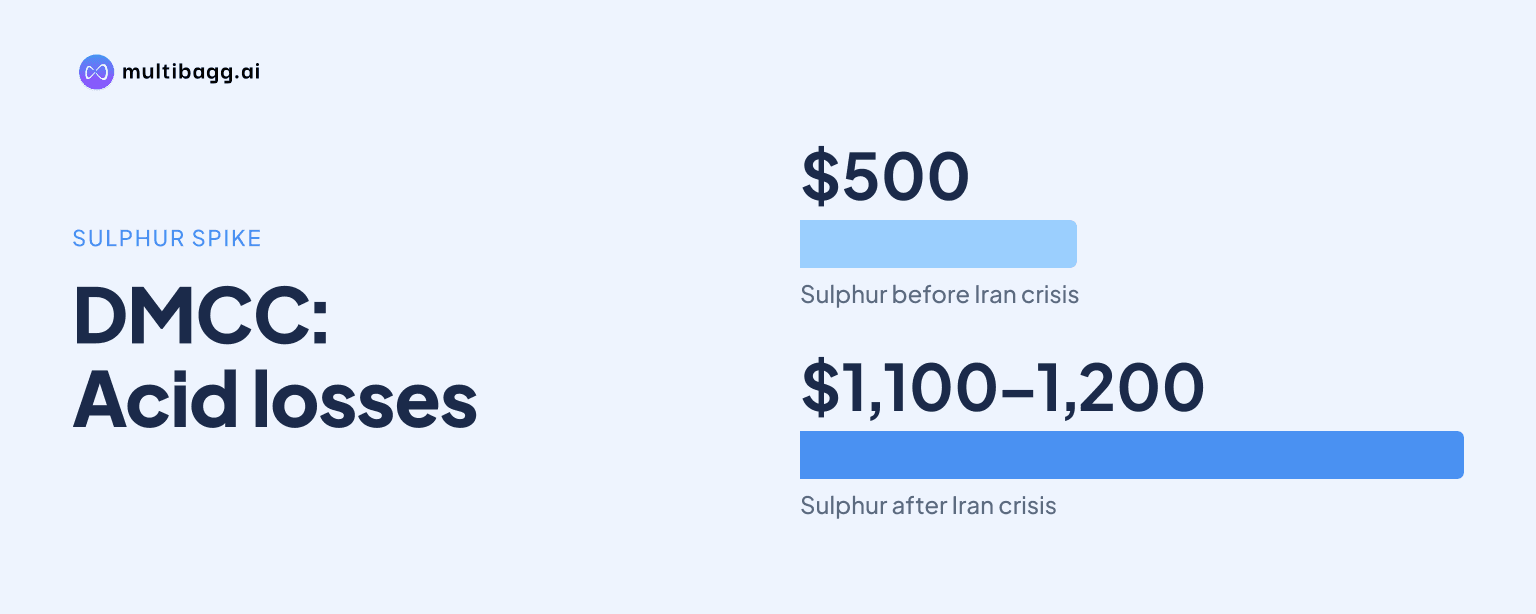
DMCC Speciality Chemicals Limited said its sulphuric-acid operations were loss-making at the variable-cost level in Q2 FY27 after sulphur rose from about $500 per tonne before the Iran crisis to $1,100-$1,200 per tonne. DMCC reported revenue of about Rs 273 crore and earnings before interest, tax, depreciation and amortisation (EBITDA) of Rs 11.6 crore for the quarter.
Know DMCC Speciality Chemicals inside out
Results, valuation, peers and who's buying, in one view.
Why did DMCC's sulphuric-acid business become loss-making in Q2 FY27?
DMCC said high-cost sulphur produced sulphuric acid that end-use markets could not absorb in Q2 FY27, leaving the business unable to recover its variable sulphur cost. Management said it had passed through higher sulphur prices in Q1 FY27, but could not do so in Q2 FY27 because the input price stayed elevated through the quarter.
Sulphur was about $500 per tonne before the Iran crisis and subsequently reached $1,100-$1,200 per tonne, according to management. DMCC said sulphur had begun to taper by the November 18, 2026 call, but prices had remained high for the full Q2 FY27 period. Management described this as a market-wide issue rather than one confined to India.
Management cited a presentation at a sulphur and sulphuric-acid conference indicating significant demand destruction once the sulphuric-acid equivalent price exceeds about Rs 30,000 per tonne. DMCC said that threshold matched its experience in India, where high acid prices curtailed customer demand rather than enabling further recovery of the sulphur cost.
How did DMCC manage acid output during the Q2 FY27 demand decline?
DMCC reduced acid-plant utilisation to about 65% of capacity in Q2 FY27 rather than sell incremental volumes below cost. Management illustrated the decision by saying that a plant with capacity represented as 100 was operated at about 65, because producing more acid at a variable loss did not make economic sense.
DMCC did not shut the acid plants, despite management acknowledging that shutdown and restart costs can be expensive. Instead, it used available turndown flexibility to operate at a lower rate and made sulphuric acid only to the extent required for its downstream speciality products.
The lower run rate also reduced utilities that the acid plant would otherwise provide to downstream operations. Management said overhead absorption was not the key Q2 FY27 issue because the acid business was already losing money on sulphur variable costs; the quarter reflected both compressed selling-price-to-input-cost spreads and reduced output.
Why did DMCC's EBITDA fall despite Rs 273 crore of Q2 revenue?
DMCC said Q2 FY27 revenue was about Rs 273 crore, while EBITDA was Rs 11.6 crore, because the gap between selling prices and raw-material costs contracted substantially from Q1 FY27. Management called the EBITDA outcome a sharp decline from the prior quarter even though reported revenue remained high.
Higher commodity revenue did not represent DMCC's normal operating level, management said, because sulphuric-acid selling prices mechanically rise with sulphur prices. An analyst put H1 FY27 revenue at roughly Rs 525 crore and EBITDA margin at about 8% to 8.5%; management did not provide a product-level split of the Q2 EBITDA movement.
Management had said at the end of Q1 FY27 that inventory gains could not continue. When sulphur prices rise, lower-cost sulphur already in inventory can be converted into acid and sold at a higher acid price, but the benefit does not persist when replacement input costs rise beyond what customers will pay. In Q2 FY27, DMCC said demand destruction prevented another full pass-through.
Got a follow-up? Ask IRIS
What did DMCC say about speciality-chemicals growth and markets?
DMCC said its speciality-chemicals operations had gained traction in overseas markets and new countries in Q2 FY27, although sulphur-price volatility overshadowed that progress in the consolidated result. Management said exports in absolute terms were higher than in both the previous quarter and the previous year, without disclosing export revenue.
Management said DMCC would be close to a 50:50 speciality-to-commodity revenue mix if sulphur returned to its prewar level of $500 per tonne. This was a conditional management assessment, not a disclosed segment mix, because higher sulphuric-acid prices had mathematically increased commodity revenue and distorted the revenue-share comparison.
DMCC described Europe as a structural challenge, citing energy costs and wider pressures on the region's chemical industry, and said it did not expect substantial growth there. Management said DMCC had achieved good results in Latin America and Japan, was exploring South Korea, and saw growth in Indian speciality chemicals; it also said margins in Latin American and Asian business had been maintained.
Which product and funding developments should readers track?
DMCC has started commercial supplies of an intermediate used in a polymer for enhanced oil recovery, with product approvals in place. Management expects annualised revenue of Rs 25 crore to Rs 50 crore from that single product, supplied to multiple customers, and said DMCC is entering the market from a zero base against incumbent suppliers.
The company is also developing boron-based fine chemicals, including a catalytic application and an agrochemical intermediate. Management did not disclose a launch date or sales estimate, but said the products were developing well and would have a substantially better margin profile than existing products. DMCC said it had at least 25% to 30% room to expand downstream products, with some additional capacity possible through low capital expenditure.
Working-capital requirements increased with higher raw-material prices, receivables and topline, according to management. DMCC said debtor days were within 45 days, bank borrowing rates ranged from 7.5% to 8.5%, and it had taken about Rs 10 crore under the Emergency Credit Line Guarantee Scheme at about 8.5% interest while continuing scheduled term-loan repayments.
Conclusion
DMCC's Q2 FY27 performance shows that higher commodity prices can increase reported revenue while reducing profit when end markets cannot absorb the input-cost increase. Sulphur's movement from about $500 per tonne to $1,100-$1,200 per tonne compressed the sulphuric-acid spread, caused demand destruction and led DMCC to operate its acid plant at about 65% utilisation, resulting in Rs 11.6 crore of EBITDA on about Rs 273 crore of revenue.
The next issue is whether the sulphur-price decline noted on November 18, 2026 produces the demand recovery management said it had started to see. Readers can also track whether the enhanced-oil-recovery intermediate reaches management's Rs 25 crore to Rs 50 crore annualised revenue expectation, the development of boron products, and the unresolved Maharashtra government compliance process following a Supreme Court order on land near Amarnath.