










DOMS prioritises volumes as raw-material costs rise 15%
Key highlights
- DOMS said overall raw-material inflation was close to 15% in Q2 FY27.
- DOMS reported Q2 FY27 operating revenue of Rs 667.8 crore, up 17.6% year on year.
- DOMS reported Q2 FY27 EBITDA of Rs 82.8 crore and a 12.4% margin.
- More than 80% of roughly 18% growth discussed on the call came from volumes, management said.
powered by IRIS
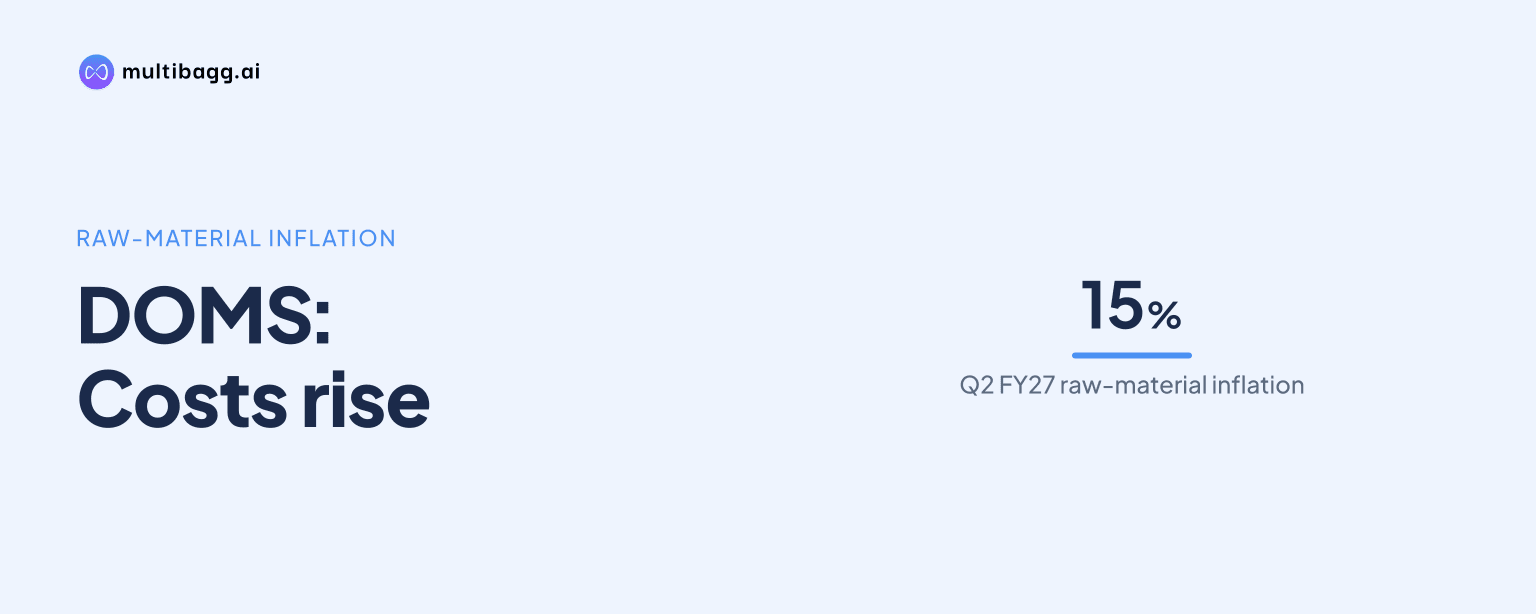
DOMS Industries Limited said raw-material inflation reached about 15% in Q2 FY27 and it will prioritise volume-led market-share growth over immediate cost recovery, accepting near-term margin pressure as a result. DOMS reported earnings before interest, tax, depreciation and amortisation (EBITDA) of Rs 82.8 crore and a 12.4% margin for the quarter.
Know Doms Industries inside out
Results, valuation, peers and who's buying, in one view.
How much did raw-material costs rise for DOMS in Q2 FY27?
DOMS said overall cost inflation was close to 15% in Q2 FY27 after accounting for lower raw-material prices during the quarter's first few weeks. Management said costs began climbing again from early to mid-August and had risen substantially by the November 3, 2026 call. It described prices as changing each week and said they were probably at their peak since the West Asian conflict began.
The timing created a different cost pattern from Q1 FY27. DOMS said consumption margins improved sequentially in Q2 FY27 because of earlier cost easing and certain price increases, but the later input-cost rise reduced that benefit. Management did not provide product-level inflation rates or a single portfolio-wide price-pass-through figure, so the 15% estimate is an overall measure rather than a uniform increase across categories.
Why is DOMS not fully passing on higher input costs immediately?
DOMS said it cannot immediately pass through an input-cost increase because its products are sold at printed maximum retail prices, or MRPs. The company carries about two months of printed packaging-material inventory, and management said a pricing decision usually takes three to four months to reach the market. That delay limits how quickly an August cost increase can be reflected in retail pricing.
DOMS said it reviews the cost sheet for each domestic and export product instead of applying one broad category-level increase. Depending on the product, the company can alter the MRP, change channel-level selling prices, reduce trade schemes or adjust margins. Management said schemes and discounts were lower than in the previous year, which it cited as evidence that average selling prices had increased and supported consumption margins.
Is DOMS choosing volumes over near-term EBITDA margin?
Yes. DOMS said its calibrated response has caused near-term margin pressure, but management considers sustained volumes, market-share gains and support for super stockists, distributors, retailers and consumers more important than a rapid margin recovery. Of the roughly 18% growth discussed on the call, management said more than 80% came from volumes and about 20% came from realisations.
Operating revenue rose 17.6% year on year to Rs 667.8 crore in Q2 FY27, despite an estimated 300 to 350 basis-point impact on sales growth from heavy rainfall and flooding in Gujarat. EBITDA was Rs 82.8 crore, with a 12.4% margin that DOMS said was maintained sequentially. The same 12.4% EBITDA margin was reported for H1 FY27, when EBITDA totalled Rs 165.3 crore.
Higher manpower expense also affected the quarter's profitability. The Reynolds sales and support teams joined DOMS from July 1, while revenue from the acquired assets remained limited during their relocation to Umbergaon. Management said this temporary mismatch between employee costs and related revenue weighed on Q2 FY27 profitability and should normalise as the transferred operations scale up.
Got a follow-up? Ask IRIS
When does DOMS expect margins to recover?
DOMS retained its 16% to 17% EBITDA-margin target, but management said it would be patient for a couple of quarters before determining whether more significant price increases or other operating measures are needed. It explicitly did not commit to a quarter for returning to that range. Management said its preference is for a sustainable margin recovery supported by volumes rather than a short-term improvement that disrupts demand.
Profit after tax was Rs 38.3 crore in Q2 FY27, representing a 5.7% margin and including a one-time Rs 10.4 crore loss from flood-related damage. DOMS said it had initiated insurance claims and expects recoveries to substantially offset the financial effect in due course. Separately, the company said its working-capital cycle remained within its guided 55-to-60-day range despite volume growth and marginally higher inventory carrying costs.
What developments could affect DOMS's margin path in FY27?
DOMS commissioned the first building at its 50-acre manufacturing site, adding about 1.70 lakh square feet of manufacturing space mainly for Reynolds pen production. Management expects revenue contribution from the facility from Q3 FY27 onwards and said Reynolds-manufactured goods should gain momentum in Q4 FY27. Production had begun for Brite and 045 pens, while trial production for the Jetter click pen had started.
DOMS invested more than Rs 200 crore in capital expenditure during H1 FY27 and expects to invest a further Rs 100 crore to Rs 125 crore during the rest of FY27. The spending covers common infrastructure and machinery at the greenfield site, adjacent land additions and the Reynolds asset purchase. Management also plans to add wooden-pencil manufacturing infrastructure and additional office-supplies capacity before the close of FY27, while maintaining consolidated sales-growth guidance of 18% to 20%.
Conclusion
DOMS is absorbing part of roughly 15% raw-material inflation while using selective product-level pricing and trade actions to preserve volume growth. That choice helped keep Q2 FY27 EBITDA margin sequentially steady at 12.4%, but it leaves the company below management's 16% to 17% target range. The company's reported mix, with more than 80% of roughly 18% growth coming from volumes, shows the operational priority behind the approach.
The next indicators are raw-material movements and the effect of pricing measures over the couple of quarters management identified for review. Investors can also monitor the planned Q3 FY27 Reynolds revenue contribution, expected Q4 FY27 momentum from the new facility, remaining FY27 capital expenditure of Rs 100 crore to Rs 125 crore and progress toward the 18% to 20% sales-growth guidance.