










Dynamatic Technologies aerospace revenue rose 18.1% as margin fell
Key highlights
- Dynamatic aerospace revenue rose 18.1% year on year to Rs 210.77 crore in Q2FY2027.
- Dynamatic aerospace EBITDA margin declined to 21.6% in Q2FY2027 from 26.8% a year earlier because of project mix.
- Aerospace represented 47% of Dynamatic’s Rs 452.73 crore Q2FY2027 consolidated revenue.
- Dynamatic reported a Rs 28.436 crore year-on-year foreign-exchange benefit to Q2FY2027 revenue.
powered by IRIS
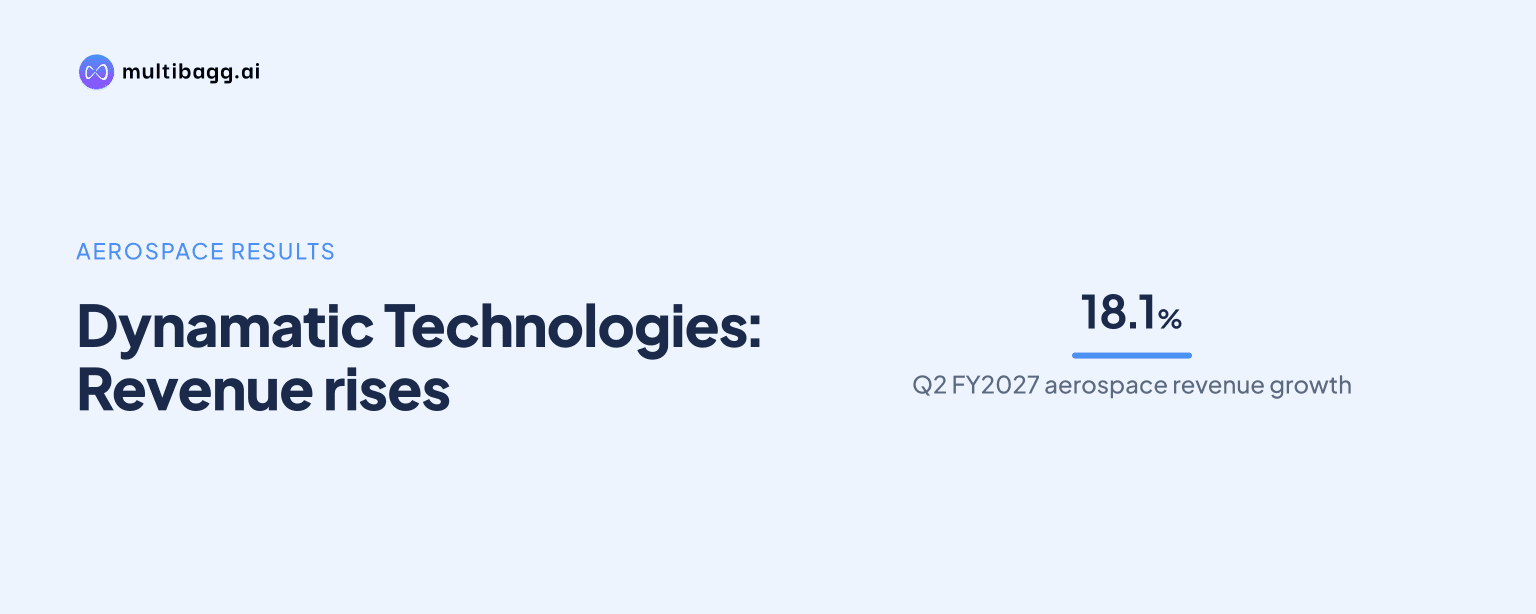
Dynamatic’s aerospace revenue increased 18.1% year on year to Rs 210.77 crore in the second quarter of FY2027, with FY denoting financial year, while earnings before interest, tax, depreciation and amortisation (EBITDA) margin fell to 21.6% from 26.8% because of project mix. The segment remained the group’s largest revenue contributor at 47%.
Know Dynamatic Technologies inside out
Results, valuation, peers and who's buying, in one view.
How fast did Dynamatic aerospace grow in Q2FY2027?
Dynamatic aerospace revenue grew 18.1% year on year and 4.2% sequentially to Rs 210.77 crore in Q2FY2027. The segment generated Rs 178.52 crore in Q2FY2026 and Rs 202.25 crore in Q1FY2027, showing that quarterly sales increased both from the prior-year quarter and the immediately preceding quarter. The company attributed growth to steady volumes in component and detailed-part manufacturing and Airbus programmes.
Aerospace was the biggest of Dynamatic’s three operating segments in Q2FY2027, contributing 47% of consolidated revenue of Rs 452.73 crore. Hydraulics contributed 31%, or Rs 140.40 crore, while Metallurgy contributed 22%, or Rs 101.36 crore. Aerospace’s share rose by 1 percentage point from 46% in Q2FY2026, when its revenue was Rs 178.52 crore.
For the first half (H1) of FY2027, aerospace revenue rose 17.5% to Rs 413.02 crore from Rs 351.44 crore in H1FY2026. Its H1 contribution was 46% of group revenue of Rs 877.54 crore, compared with 47% a year earlier. The segment’s revenue nevertheless increased by Rs 61.58 crore over the prior-year first half.
Why did Dynamatic aerospace margin fall despite higher revenue?
Dynamatic’s aerospace EBITDA margin fell by 5.2 percentage points year on year to 21.6% in Q2FY2027 because of project mix. EBITDA declined 4.9% to Rs 45.57 crore from Rs 47.92 crore in Q2FY2026 despite a Rs 32.25 crore increase in revenue. The presentation identifies project mix as the reason for the lower margin, without quantifying the contribution of individual programmes or costs.
The decline also continued from Q1FY2027, when aerospace EBITDA margin was 23.8%. Q2 EBITDA of Rs 45.57 crore was 5.4% below the Rs 48.19 crore recorded in Q1, while revenue increased 4.2% over the same period. EBIT fell 8.0% sequentially to Rs 33.11 crore, and the EBIT margin narrowed to 15.7% from 17.8%.
At the H1 level, the same pattern was less pronounced but still evident. Aerospace EBITDA grew 6.6% to Rs 93.76 crore as revenue rose 17.5% to Rs 413.02 crore, reducing the EBITDA margin to 22.7% from 25.0% in H1FY2026. H1 EBIT rose 5.0% to Rs 69.10 crore, but the EBIT margin declined by 2.0 percentage points to 16.7% from 18.7%.
Got a follow-up? Ask IRIS
What is driving Dynamatic aerospace revenue?
Dynamatic said steady revenue from aerospace component manufacturing, including component and detailed-part volumes, supported Q2FY2027 growth of 18.1%. Management also said the Airbus A220 doors programme continued to advance, adding to the company’s aerostructure-manufacturing capabilities. The presentation does not disclose revenue, profitability, production rate or order value for the A220 doors programme.
The company is widening capabilities across structures, composites, components and detailed-part manufacturing, according to its segment review. Management’s strategy is to bring newer aerostructure programmes to steady-state production, improve margins through programme mix and manufacturing efficiency, deepen relationships with global original equipment manufacturers, and build defence and unmanned-systems capabilities. These are stated plans rather than financial targets with a disclosed completion date.
Management described commercial-aerospace demand as supported by original equipment manufacturer order books and rising build rates. Its outlook says aerospace margins are expected to improve as programmes move towards steady-state production. The presentation provides no numerical margin target, timetable for steady-state production or programme-by-programme profitability data, leaving project mix and execution as the main disclosed variables behind that expectation.
How does aerospace compare with Dynamatic’s other segments?
Dynamatic’s aerospace segment had the highest Q2FY2027 revenue and EBITDA margin among its businesses, although Hydraulics produced the largest improvement in operating profitability. Hydraulics revenue increased 11.2% to Rs 140.40 crore and its EBITDA margin rose to 11.5% from 5.7%. Metallurgy revenue grew 15.8% to Rs 101.36 crore and its margin turned positive at 3.4%, compared with negative 1.7% in Q2FY2026.
Group revenue rose 15.4% to Rs 452.73 crore in Q2FY2027, while consolidated EBITDA increased 20.3% to Rs 55.63 crore. Consequently, group EBITDA margin improved to 12.3% from 11.8%, in contrast to the aerospace margin decline to 21.6%. The improvement in Hydraulics and Metallurgy coincided with a higher consolidated margin despite the aerospace project-mix effect.
Foreign-exchange movements also affected reported consolidated results. Dynamatic said the year-on-year change in average exchange rates added Rs 28.436 crore to Q2FY2027 revenue and Rs 3.698 crore to EBITDA. On the company’s constant-currency calculation, Q2 revenue would have been Rs 424.294 crore, up 8.13%, while EBITDA would have been Rs 51.932 crore; these adjustments are group-wide and are not allocated to aerospace in the presentation.
Conclusion
Dynamatic’s Q2FY2027 results show a larger aerospace business with lower segment profitability: revenue reached Rs 210.77 crore, but EBITDA fell to Rs 45.57 crore and margin narrowed to 21.6% as project mix changed. Aerospace remained the largest contributor at 47% of group revenue, while Hydraulics and Metallurgy posted margin improvements that helped lift consolidated EBITDA margin to 12.3%.
The next issue to watch is whether newer aerostructure programmes, including the advancing Airbus A220 doors programme, reach steady-state production and change the mix that management says affected Q2 margins. Management expects aerospace margins to improve through programme mix and manufacturing efficiency, but it has not disclosed a margin target or timing, making subsequent quarterly segment margins and programme execution the relevant reported indicators.