










Earkart Limited presentation reports ₹3,107 lakh H1 FY27 revenue
Key highlights
- Earkart Limited’s H1 FY27 investor presentation reported revenue of ₹3,107 lakh and consolidated PAT of ₹71.77 lakh.
- Standalone revenue from operations rose 38.68% year on year to ₹3,090.75 lakh in H1 FY27.
- Standalone PAT declined 37.15% year on year to ₹116.68 lakh, while operating margin fell to 6.76% from 14.09%.
- Standalone cash declined to ₹227.86 lakh at September 30, 2026, with operating cash flow of negative ₹991.58 lakh.
powered by IRIS
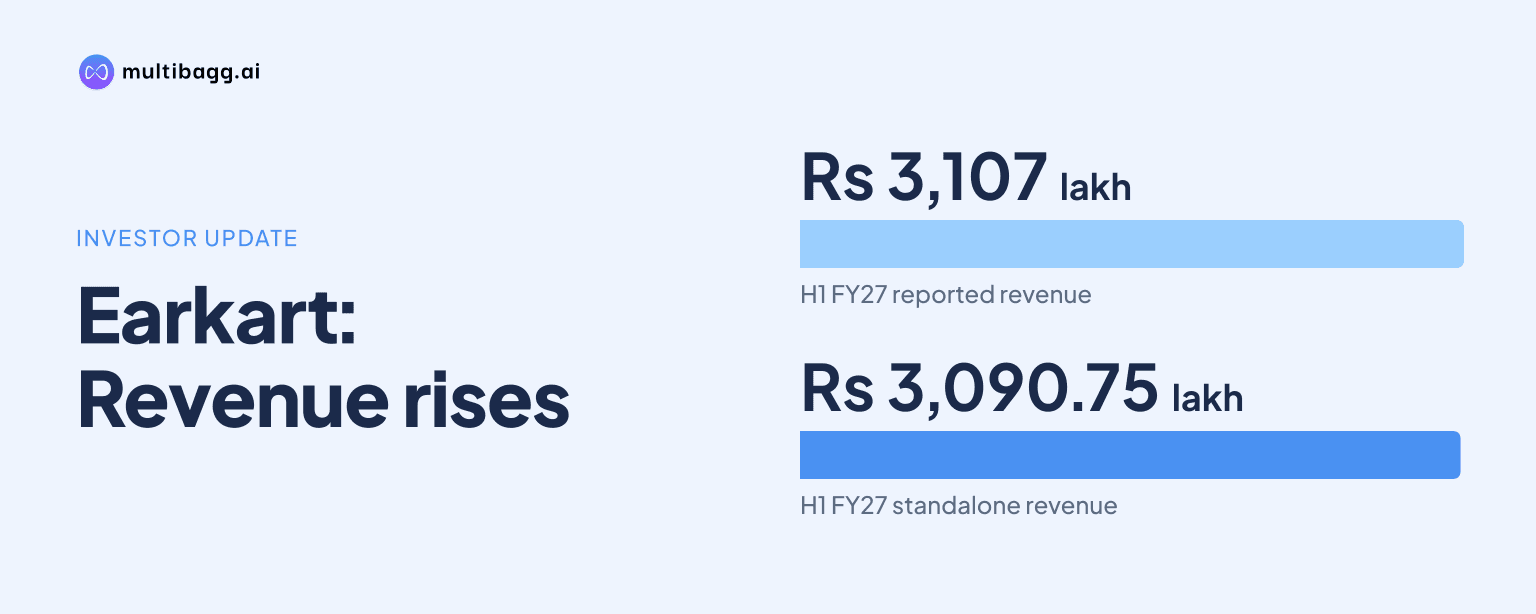
Earkart Limited’s H1 FY27 investor presentation reported revenue of ₹3,107 lakh and consolidated profit after tax of ₹71.77 lakh for the half year ended September 30, 2026. The filing places the company’s reported revenue growth alongside a lower profitability outcome and disclosures on operating costs, working capital and overseas expansion.
Know Earkart inside out
Results, valuation, peers and who's buying, in one view.
What did Earkart Limited disclose in its H1 FY27 investor presentation?
Earkart Limited released an investor presentation covering its unaudited standalone and consolidated financial results for the half year ended September 30, 2026. The presentation is the subject of the filing dated November 21, 2026, and provides investors with financial and operating context for the first half of FY27.
The headline figures in the presentation are H1 FY27 revenue of ₹3,107 lakh and consolidated profit after tax of ₹71.77 lakh. These figures represent the consolidated financial outcome cited in the filing material. Earkart operates in the manufacture and distribution of hearing aids and related accessories.
The presentation follows the company’s November 5, 2026 disclosure of unaudited half-yearly results. On that date, the board approved the financial results for the period ended September 30, 2026, along with the incorporation of a wholly owned subsidiary in Australia.
How did Earkart’s standalone H1 FY27 financial performance compare with last year?
Earkart’s standalone revenue from operations rose 38.68% year on year to ₹3,090.75 lakh in H1 FY27 from ₹2,228.57 lakh in the corresponding previous period. Standalone net profit, however, declined 37.15% to ₹116.68 lakh from ₹185 lakh, showing that the expansion in sales did not translate into higher profit.
The standalone operating profit was ₹209 lakh, compared with ₹314 lakh a year earlier. Operating profit margin narrowed to 6.76% from 14.09%. Profit before tax declined to ₹162 lakh from ₹254 lakh, while standalone earnings per share were ₹0.85 compared with ₹1.35 in the prior-year half.
The difference between the presentation’s consolidated PAT of ₹71.77 lakh and the standalone PAT of ₹116.68 lakh is relevant for readers assessing the disclosures. The company released both standalone and consolidated results, and the respective figures should not be treated as interchangeable.
Why did standalone profit fall despite higher revenue?
Earkart’s disclosed standalone expense profile shows costs rising faster than revenue. Total expenses increased to ₹2,882 lakh in H1 FY27 from ₹1,915 lakh in the corresponding prior period, while sales rose to ₹3,091 lakh from ₹2,229 lakh. This reduced the operating surplus generated from the higher revenue base.
Cost of materials consumed almost doubled to ₹1,553.41 lakh from ₹661.66 lakh. Employee benefit expenses increased 55.54% to ₹388.24 lakh. Depreciation rose to ₹58 lakh from ₹23 lakh, while finance cost declined to ₹7 lakh from ₹39 lakh.
The available disclosures identify material costs and employee expenses as significant contributors to the pressure on profitability. They do not attribute the increase to a specific supplier, product category or pricing decision. Accordingly, the reported figures establish margin compression but do not independently establish the precise reason for the movement in direct costs.
Got a follow-up? Ask IRIS
What do the disclosures show about Earkart’s cash and working capital?
Earkart’s standalone cash position declined to ₹227.86 lakh as of September 30, 2026, from ₹2,168.67 lakh as of March 31, 2026. The company reported negative cash flow from operating activities of ₹991.58 lakh for the half year, indicating that operating cash generation did not keep pace with working-capital needs during the period.
Trade receivables stood at ₹2,585.90 lakh and inventories at ₹1,436.97 lakh at the September-end. Short-term borrowings were ₹122.27 lakh. These balance-sheet items point to funds being tied up in receivables and inventory during a period of revenue growth.
For investors, the cash-flow disclosure is separate from the profit and loss statement. Revenue growth and reported accounting profit can occur alongside negative operating cash flow when receivables, inventory or other current assets increase. The presentation and underlying results therefore provide both profit and cash-flow measures for evaluating H1 FY27.
What overseas expansion did Earkart’s board approve?
Earkart’s board approved the incorporation of a wholly owned subsidiary in Australia on November 5, 2026. The proposed entity is intended to operate in education-related services, including managing and expanding educational institutions, according to the company’s disclosure.
The planned Australian subsidiary represents a diversification from Earkart’s core hearing-care operations. The filing material describes Earkart as a company engaged in manufacturing and distributing hearing aids and related accessories, while the proposed subsidiary is linked to education-related services.
The company had also disclosed additions of pharmaceutical and UK subsidiaries. The filing does not provide financial projections, expected capital deployment, a launch date, or revenue targets for the Australian entity. Investors therefore have an approved corporate action to track, rather than an announced financial contribution from the proposed business.
Conclusion
Earkart’s H1 FY27 investor presentation reports consolidated revenue of ₹3,107 lakh and consolidated PAT of ₹71.77 lakh, while the accompanying standalone results show strong revenue growth but lower profit and operating margin. Higher material and employee costs, together with negative operating cash flow and increased working-capital balances, are the central financial points disclosed for the half year.
The next disclosed matter to watch is the incorporation and development of the Australian wholly owned subsidiary approved on November 5, 2026. Investors may also monitor subsequent financial disclosures for changes in margins, receivables, inventory, cash flow and any financial details relating to the education-related services venture.