










EarKart H1 revenue rises 39% but EBITDA margin falls to 5.9%
Key highlights
- EarKart's H1 FY27 revenue from operations rose 39.42% to Rs 31.07 crore.
- EarKart's H1 FY27 EBITDA fell 41.94% to Rs 1.83 crore and margin declined to 5.9%.
- Government business accounted for Rs 18.35 crore, or 59.05%, of H1 FY27 revenue.
- Uttar Pradesh generated Rs 19.64 crore, or 63.20%, of H1 FY27 revenue.
powered by IRIS
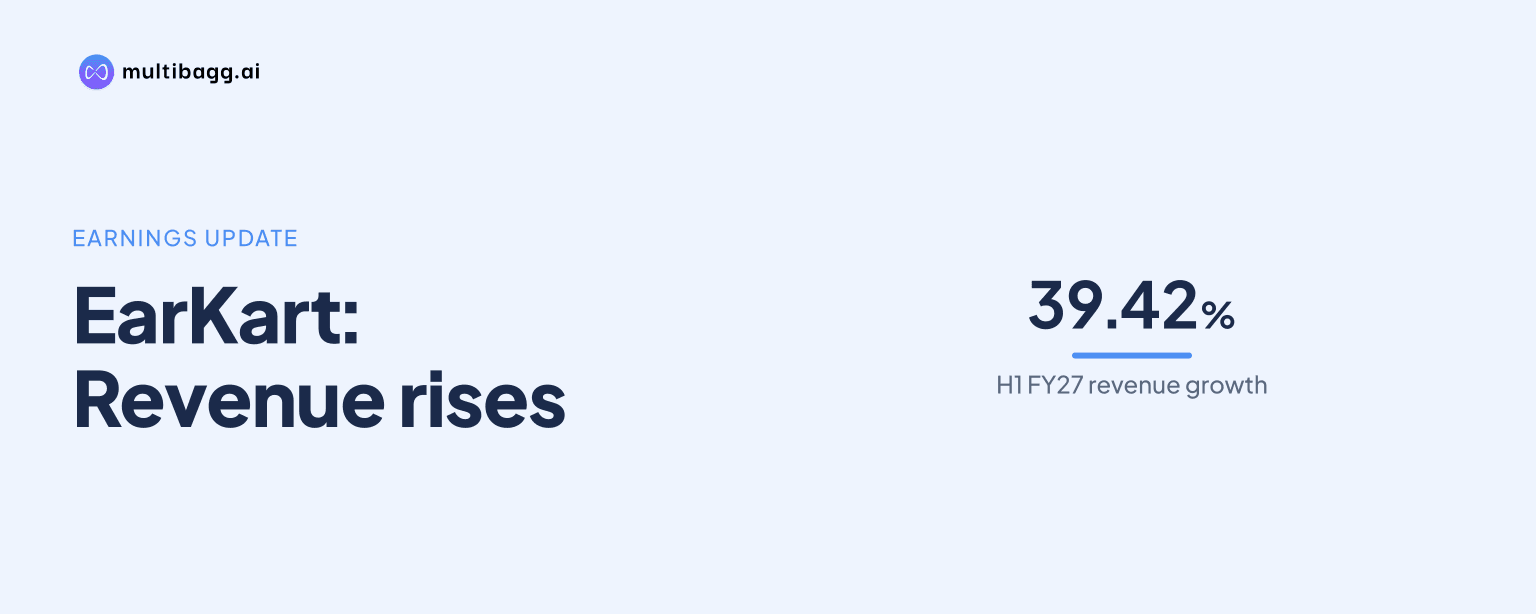
EarKart Limited reported H1 FY27 revenue from operations of Rs 31.07 crore, up 39.42% year on year, but its earnings before interest, tax, depreciation and amortisation (EBITDA) margin fell to 5.9% from 14.0% as total expenditure increased 53.60% to Rs 29.42 crore.
Know Earkart inside out
Results, valuation, peers and who's buying, in one view.
How did EarKart's H1 FY27 earnings change?
EarKart's H1 FY27 profit declined despite higher sales, with EBITDA falling 41.94% year on year to Rs 1.83 crore and profit after tax (PAT) declining 61.27% to Rs 71.77 lakh. Revenue from operations increased from Rs 22.29 crore in H1 FY26 to Rs 31.07 crore in H1 FY27, while total income rose 40.07% to Rs 31.25 crore.
The comparison with the immediately preceding half also showed lower earnings. H1 FY27 revenue was 2.14% below the Rs 31.75 crore reported in H2 FY26, while EBITDA was 65.41% lower than Rs 5.30 crore. PAT margin was 2.3%, versus 8.0% in H1 FY26 and 10.0% in H2 FY26, while earnings per share declined to Rs 0.52 from Rs 1.35 a year earlier.
PAT was Rs 71.77 lakh in H1 FY27, compared with Rs 1.85 crore in H1 FY26 and Rs 3.08 crore in H2 FY26. The presentation reported profit before tax of Rs 1.17 crore, down 54.18% year on year, showing that the EBITDA decline continued through the reported profit line despite a reduction in interest expense.
Why did EarKart's EBITDA margin fall in H1 FY27?
EarKart's EBITDA margin fell because total expenditure rose 53.60%, faster than the 40.07% increase in total income. Expenditure increased by Rs 10.27 crore from Rs 19.15 crore in H1 FY26 to Rs 29.42 crore in H1 FY27, while total income increased by Rs 8.94 crore to Rs 31.25 crore.
The difference between expenditure growth and income growth reduced EBITDA to Rs 1.83 crore from Rs 3.16 crore. Accordingly, EBITDA margin contracted by 810 basis points from 14.0% in H1 FY26 to 5.9% in H1 FY27, and was also 1,110 basis points below the 17.0% reported in H2 FY26.
Depreciation, a charge below EBITDA, increased 162.25% to Rs 59.32 lakh from Rs 22.62 lakh in H1 FY26. Interest expense moved in the opposite direction, falling 80.86% to Rs 7.39 lakh from Rs 38.61 lakh, but this reduction did not prevent profit before tax from declining by Rs 1.38 crore year on year.
Other income rose 640.57% to Rs 18.07 lakh in H1 FY27 from Rs 2.44 lakh a year earlier. However, the increase in other income was smaller than the Rs 10.27 crore increase in total expenditure, while tax declined 35.20% to Rs 44.86 lakh and PAT fell to Rs 71.77 lakh.
Got a follow-up? Ask IRIS
How concentrated was EarKart's H1 FY27 revenue?
EarKart generated 59.05% of H1 FY27 revenue from government business, worth Rs 18.35 crore, compared with 40.95%, or Rs 12.72 crore, from private business. Government revenue exceeded private revenue by Rs 5.62 crore during the half, making it the larger reported sales segment.
Uttar Pradesh was EarKart's largest geographic contributor, accounting for 63.20% of H1 FY27 revenue, or Rs 19.64 crore. Gujarat was second at 17.04%, or Rs 5.29 crore, followed by Jammu and Kashmir at 6.17%, or Rs 1.92 crore, and Delhi at 5.47%, or Rs 1.70 crore.
Maharashtra contributed Rs 1.04 crore, equal to 3.35% of H1 FY27 revenue, while EarKart UK contributed Rs 16.25 lakh, or 0.52%. Rajasthan, Madhya Pradesh and Uttarakhand together accounted for Rs 90.66 lakh, and the reported mix places both government business and Uttar Pradesh above half of revenue.
The remaining reported geography, classified as Others, generated Rs 41.34 lakh or 1.33% of H1 FY27 revenue. The presentation's revenue bifurcation is unaudited and totals Rs 31.07 crore across both its segment and geographic disclosures.
What changed on EarKart's balance sheet by September 2026?
EarKart reported total assets of Rs 71.00 crore as at 30 September 2026, compared with Rs 69.49 crore at 31 March 2026. Trade receivables increased to Rs 25.96 crore from Rs 21.07 crore, while other current assets declined to Rs 29.14 crore from Rs 40.60 crore.
Fixed assets rose to Rs 9.47 crore at 30 September 2026 from Rs 5.88 crore at 31 March 2026. Other non-current assets increased to Rs 6.42 crore from Rs 1.94 crore, meaning these two asset categories together increased by Rs 8.07 crore over the six-month period.
On the liabilities side, short-term borrowings increased to Rs 1.22 crore from Rs 24,000 at 31 March 2026, and trade payables rose to Rs 2.79 crore from Rs 1.80 crore. Other liabilities declined to Rs 2.04 crore from Rs 3.34 crore during the same period.
Total liabilities were Rs 71.00 crore at 30 September 2026, matching total assets, compared with Rs 69.49 crore at 31 March 2026. Share capital was unchanged at Rs 13.75 crore, while reserves increased to Rs 51.19 crore from Rs 50.59 crore.
Conclusion
EarKart's H1 FY27 results combine a 39.42% increase in revenue with a reduction in profitability, as total expenditure growth of 53.60% exceeded the 40.07% rise in total income. EBITDA margin of 5.9% was below both the 14.0% in H1 FY26 and the 17.0% in H2 FY26, while government business and Uttar Pradesh accounted for 59.05% and 63.20% of revenue respectively.
The next reported periods will show management's execution of its stated plan to expand OMNI-enabled SIS clinics across India, develop ENT pharmaceutical offerings through those clinics, and pursue international markets. EarKart has completed US establishment registration with active medical-device listings in four hearing-aid categories and says it is exploring US distribution partnerships across retail, online and audiology networks.