










Earkart Says OMNI Lets One Audiologist Support Up To Seven Clinics
Key highlights
- Earkart says one OMNI-enabled audiologist can support 4 to 7 clinics, while its SIS operating page cites up to 5 clinics.
- Earkart reports 105 SIS outlets, more than 20 audiologists supporting the network and presence in more than 55 cities.
- Earkart says an SIS clinic costs about Rs 3 lakh to set up using existing ENT-clinic footfall.
- Government business represented 59.05% of Earkart's H1FY27 revenue mix, versus 40.95% from private business.
powered by IRIS
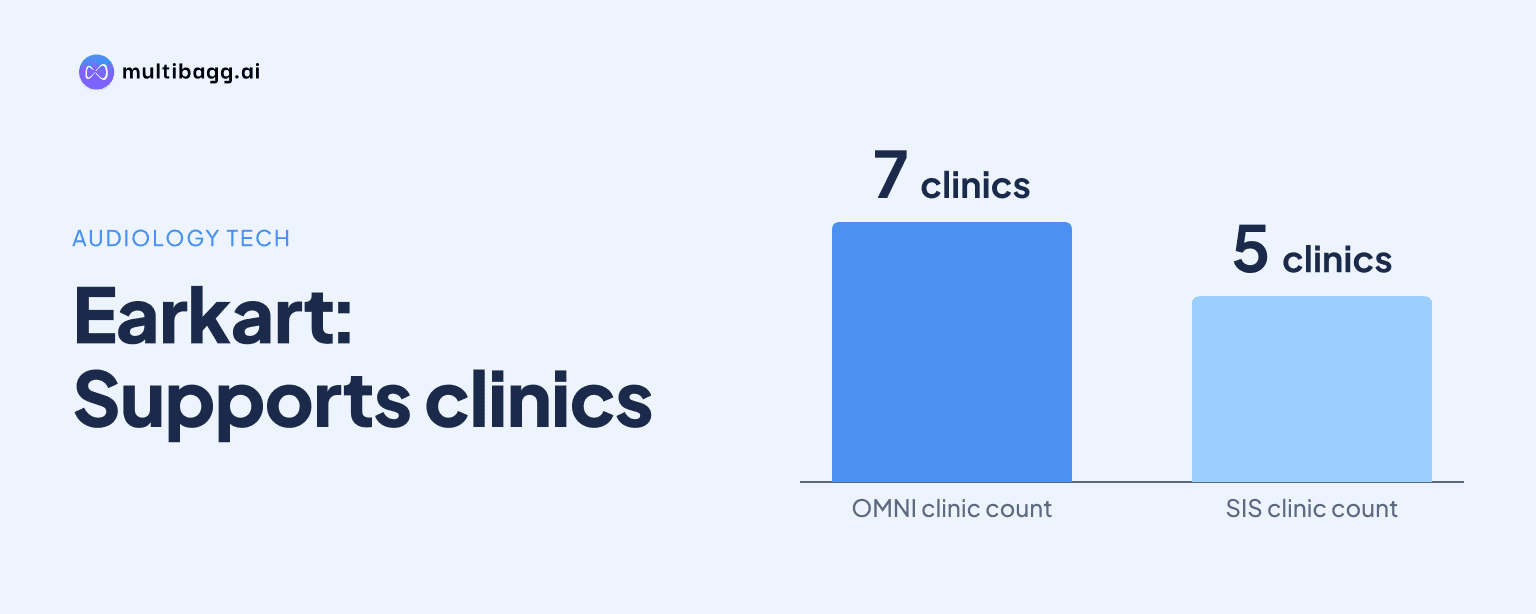
In its OMNI 2.0 presentation, Earkart Limited says one remote audiologist can support 4 to 7 clinics through live-video testing and hearing-aid fitting. Earkart reports 105 Shop-in-Shop clinics, more than 20 audiologists supporting the network and an approximate setup cost of Rs 3 lakh per clinic.
Know Earkart inside out
Results, valuation, peers and who's buying, in one view.
How does Earkart's OMNI clinic model work?
Earkart's Shop-in-Shop, or SIS, model places hearing-care services inside existing ear, nose and throat, or ENT, clinics. The company says its 105 SIS clinics have OMNI installed, allowing a trained clinic assistant to support a patient locally while an audiologist provides remote testing and hearing-aid fitting. SIS outlets offer EQFY, Fame, Radius and Tiny hearing aids, ENT pharmaceutical formulations, accessories and rehabilitation products.
OMNI 2.0 is Earkart's compact proprietary technology drive system, with an 11-inch screen, wireless connectivity and a lithium-ion battery rated for eight hours per charge. The platform performs video otoscopy, air- and bone-conduction audiometry, tympanometry and otoacoustic emissions, or OAE, including newborn screening. It can also program Bluetooth-enabled and other programmable hearing aids of any brand in real time.
The service mechanism connects the command-centre audiologist to a patient over live video while the host clinic's trained staff handle the in-person process. Earkart says an Indian patent for OMNI, titled “Smart Sound Treatment and Diagnosis System and Method Thereof”, was granted in October 2025 after a 2022 filing. The patent relates to the technology underlying the remote diagnostic and fitting platform.
How many clinics can one Earkart audiologist support remotely?
Earkart says one audiologist can serve 4 to 7 clinics through OMNI remote consultations. This is the widest capacity range in the presentation and is presented as OMNI's value proposition for towns without an audiologist. It describes the model as a way to extend specialist availability across multiple clinic locations.
Earkart gives a narrower figure on its SIS economics page, stating that one remote audiologist covers up to five clinics. The presentation therefore does not establish one fixed operating ratio: 4 to 7 clinics is the OMNI capacity range, whereas up to five clinics appears in the discussion of staff support and the approximate Rs 3 lakh clinic setup.
Earkart does not disclose consultations, tests or hearing-aid fittings completed per audiologist, per clinic or per day. It also does not state whether the more than 20 audiologists are employees, contractors or a mixed group. The disclosed figures describe the coverage mechanism, rather than reported utilisation across the 105 SIS clinics.
Why does Earkart use existing ENT clinic footfall?
Earkart says every SIS clinic operates on existing ENT footfall, with OMNI and ENT pharmaceutical formulations intended to add revenue per patient without customer-acquisition spending. The company characterises customer-acquisition cost as zero because patients already visit the host ENT clinic instead of being sourced through separately purchased leads.
The SIS rollout is focused on Tier 2 and Tier 3 cities. Earkart cites presence in more than 55 cities and more than 300 clinic applications from an ENT conference, compared with 105 operating SIS outlets disclosed elsewhere in the presentation. The source does not give the conference date, conversion rate from applications to clinics, or an outlet count for each city.
Earkart says the setup cost is about Rs 3 lakh for each SIS clinic, which uses the clinic's own trained team and remote audiology support. The presentation does not provide a cost breakdown between OMNI equipment, training, installation and other expenditure. It also does not disclose average clinic revenue, a payback period or the capital needed for future clinic additions.
The shared-specialist design means each additional SIS location can bring its own ENT patient flow while accessing the same audiologist network. Earkart does not quantify the point at which a larger clinic base would require additional audiologists. Its 2027 objective is to build the largest hearing-care clinic network, but no numerical clinic target accompanies that objective.
Got a follow-up? Ask IRIS
How do pharmaceuticals and services fit Earkart's SIS network?
Earkart has launched seven ENT pharmaceutical formulations for nasal allergy, tinnitus and earwax management, and says all seven are currently sold through SIS clinics. This uses the same clinic channel as hearing aids and OMNI services, rather than a separate pharmaceutical distribution network. The range includes nasal sprays, tablets, capsules and ear drops.
Management plans to expand pharmaceutical sales through independent channels after recurring revenue is established. The presentation does not provide a timing, recurring-revenue threshold or planned number of distributors for this step. Accordingly, independent pharmaceutical sales are a stated plan, not a reported contribution to the current business mix.
Service revenue includes audiometry diagnostic tests, conversion charges and consultancy services, according to Earkart's presentation. In H1FY27, Earkart reported revenue from operations of Rs 31.07 crore, earnings before interest, tax, depreciation and amortisation, or EBITDA, of Rs 1.83 crore, and profit after tax, or PAT, of Rs 71.77 lakh. The company does not split these measures between SIS clinics, OMNI services and pharmaceuticals.
Government business accounted for 59.05% of H1FY27 revenue mix, compared with 40.95% from private business. Government supply was therefore the larger reported channel in that half year, despite the SIS network being central to Earkart's private expansion model. The government channel includes participation on the Government e-Marketplace portal and supply association with ALIMCO.
What scale and operating limits has Earkart disclosed?
Earkart reports 105 SIS outlets across 24 states, while its geographical-presence page states coverage across 24 states and three Union Territories. The company also cites more than 55 cities and more than 20 audiologists supporting the SIS network. These figures establish reported reach but do not identify how many outlets are active in each geography.
Earkart's portfolio comprises four hearing-aid brands, one patented OMNI diagnostic platform and seven ENT pharmaceutical formulations. Its Noida facility covers 13,000 square feet, expanded from 4,500 square feet at the initial public offering, and has installed capacity of about 2,00,000 hearing-aid units a year. The company says the facility also has headroom for a second shift.
The manufacturing capacity relates to hearing aids, including digitally programmable receiver-in-canal and behind-the-ear products under EQFY, Radius and Fame. It does not indicate OMNI installation capacity or the number of clinics that can be added annually. Earkart also does not disclose the proportion of its 105 SIS clinics using OMNI, patient conversion rates or clinic-level retention.
Conclusion
Earkart presents OMNI as the shared-specialist layer of its SIS model, with one remote audiologist able to support 4 to 7 clinics in its OMNI description and up to five clinics in its operating description. The model combines existing ENT footfall, trained clinic staff, about Rs 3 lakh of setup cost per site and seven pharmaceutical formulations sold through the same channel.
The next disclosed milestones are Earkart's aim to build the largest hearing-care clinic network by 2027 and management's plan to sell pharmaceuticals independently once recurring revenue is established. Readers should watch for a numerical 2027 clinic target, conversion of the more than 300 stated clinic applications into outlets, and clinic-level utilisation or revenue disclosures.