










Effwa Files ZMD Patent to Recover Saleable Salt Products
Key highlights
- Effwa has filed a patent application for ZMD technology that it says converts residual ZLD salt waste into high-purity saleable products.
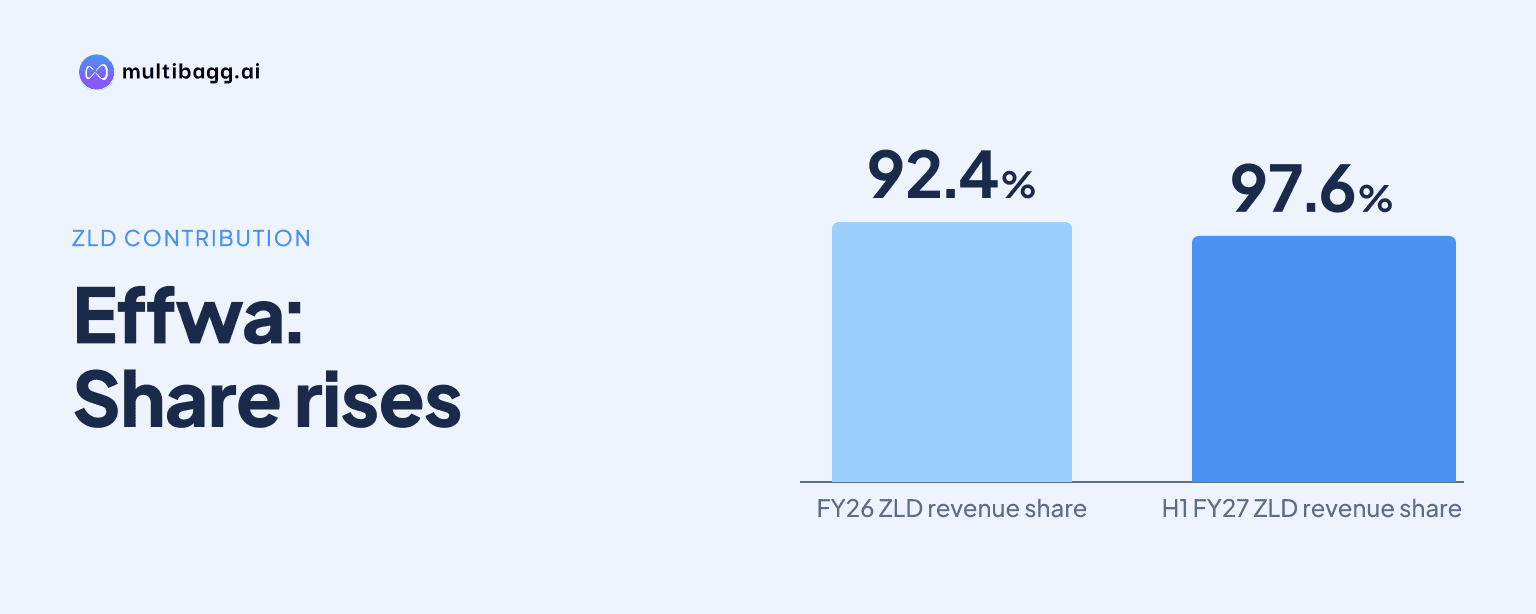
- ZLD projects contributed 97.6% of Effwa’s H1 FY27 revenue, compared with 92.4% of FY26 revenue.
- Effwa’s ZLD revenue rose to Rs 127.564 crore in H1 FY27 from Rs 81.73 crore in H1 FY26.
- Effwa reported an order book above Rs 675 crore and a bid pipeline above Rs 2,400 crore in H1 FY27.
powered by IRIS
Effwa has filed a patent application for Zero Material Discharge technology that it says converts residual salt waste from Zero Liquid Discharge processes into high-purity, commercially valuable products, as ZLD contributed 97.6% of its H1 FY27 revenue. Management says the technology is intended to eliminate landfill disposal of this residual material.
Know Effwa Infra & Research inside out
Results, valuation, peers and who's buying, in one view.
What has Effwa filed for its ZMD technology?
Effwa has filed a patent application for its Zero Material Discharge, or ZMD, technology, which management describes as a next-generation advance over conventional Zero Liquid Discharge, or ZLD, systems. The filing is disclosed in the company’s H1 FY27 management outlook, while its technology-ladder presentation states that the patent process is targeted for completion in FY27.
The filing does not mean a patent has been granted. The presentation identifies a filed application and an FY27 completion target for the process, but gives no grant date, patent number, development budget, pilot scale or commercial launch timetable. That distinction matters because ZMD remains a planned extension of Effwa’s existing ZLD operations rather than a separately reported revenue line in H1 FY27.
Effwa positions ZMD as the third stage of its treatment sequence. The first stage is an Effluent Treatment Plant, or ETP, with recycling, which treats industrial effluent and returns water for reuse. The second is ZLD, where water is recovered and no liquid leaves the site. The third stage, ZMD, is designed to recover value from material left after the ZLD process.
The existing business is concentrated in the preceding stage. ZLD generated 92.4% of Effwa’s FY26 revenue, according to the technology-ladder page, and its share increased to 97.6% in H1 FY27. ETP with recycling accounted for 1.6% of H1 FY27 revenue, while operations and maintenance, or O&M, accounted for 0.7%.
How would Effwa’s ZMD process change ZLD output?
Effwa says ZMD would convert residual salt waste from ZLD systems into high-purity products with commercial value, replacing landfill disposal with material recovery. The stated mechanism moves beyond recovering and reusing water: it seeks to use the salt residue that remains after a ZLD system has removed liquid discharge.
Management says the recovered products could have applications across diverse industries, but the presentation does not specify the products, their composition, prospective buyers, selling prices or required purity standards. It also says ZMD could lower operating costs and reduce environmental impact, yet provides no quantified cost saving, waste-volume reduction or revenue forecast for the technology.
The strategic distinction is clear in Effwa’s description, although its financial effect is not yet disclosed. ZLD prevents liquid discharge from a client site, whereas ZMD is intended to achieve zero material discharge by finding a use for the remaining salt waste. Effwa links that approach to circular-economy principles and complete resource utilisation.
This is a technology-led extension of a market where adoption is already expanding. The presentation places India’s ZLD market at USD 1.33 billion in 2025 and projects USD 2.52 billion by 2032, representing a 9.5% compound annual growth rate. It cites Central Pollution Control Board standard operating procedures issued in July 2024 to verify ZLD compliance in distilleries as one regulatory driver.
Got a follow-up? Ask IRIS
How dependent is Effwa on its current ZLD business?
Effwa remains predominantly dependent on ZLD projects, with H1 FY27 ZLD revenue of Rs 127.564 crore, up from Rs 81.73 crore in H1 FY26. The increase of Rs 45.834 crore coincided with total revenue from operations rising 44.8% year on year to Rs 130.649 crore in H1 FY27.
ETP with recycling revenue moved in the opposite direction, declining from Rs 6.119 crore in H1 FY26 to Rs 94.4 lakh in H1 FY27. O&M revenue rose from Rs 1.338 crore to Rs 2.141 crore across the same periods. The presentation describes O&M as a strategic source of stable, high-visibility and recurring revenue that management expects to grow as the installed project base expands.
The revenue mix shows why ZMD is being presented as an addition to, rather than a replacement for, ZLD. In H1 FY27, 56.0% of revenue came from public sector undertakings and 44.0% from private-sector customers. Domestic sales accounted for 99.3%, compared with 68.9% in H1 FY26, while export sales declined from 31.1% to 0.7%.
Effwa’s H1 FY27 profitability also grew alongside the expansion in ZLD execution. Earnings before interest, tax, depreciation and amortisation, or EBITDA, increased 37.1% year on year to Rs 21.154 crore, while profit after tax rose 48.8% to Rs 15.097 crore. EBITDA margin declined by 90 basis points to 16.2%, whereas profit-after-tax margin rose 40 basis points to 11.6%.
What execution base does Effwa have for ZMD development?
Effwa’s disclosed execution base includes the Rourkela Steel Plant, or RSP, TS-II project for Steel Authority of India Limited, or SAIL, which exceeded Rs 200 crore in contract value and was completed on time in H1 FY27. The company describes it as its first project above Rs 200 crore and as evidence of its ability to deliver large, complex assignments within committed timelines.
The company reported an order book above Rs 675 crore and a bid pipeline above Rs 2,400 crore in H1 FY27. Its ongoing JSW Steel project is valued at more than Rs 350 crore, and management says execution of that project is expected to support revenue growth in coming periods. These are project and pipeline indicators, not disclosed ZMD sales or confirmed ZMD customer commitments.
Effwa also cites completed large-scale ZLD projects for Tata Steel and Kutch Copper, alongside the RSP project. Its stated core end-markets include steel and mining, power, oil and gas refineries, pharmaceuticals and bulk drugs, textiles, and sugar and distilleries. The presentation lists semiconductor and solar plants as industries designing ZLD into facilities from the outset, but does not identify a ZMD project in those sectors.
Operational systems are another part of management’s stated plan. Effwa has initiated enterprise resource planning, or ERP, implementation, which it says is intended to provide real-time project monitoring, resource utilisation and cost controls. Management also plans a dedicated Innovation Centre expected to become operational over the next 12 to 14 months from the H1 FY27 commentary.
Conclusion
Effwa’s patent application places ZMD alongside its established ZLD business, which represented 97.6% of H1 FY27 revenue and increased to Rs 127.564 crore from Rs 81.73 crore a year earlier. The disclosed proposition is to turn residual ZLD salt waste into high-purity saleable products, potentially extending the company’s treatment-and-reuse model from water recovery to material recovery.
The next disclosed milestones are completion of the patent process targeted in FY27, progress on the more than Rs 350 crore JSW Steel project, and the planned Innovation Centre within 12 to 14 months. Future disclosures on ZMD product specifications, commercial deployments, customer demand, economics and any patent outcome would clarify the technology’s commercial position, none of which the H1 FY27 presentation quantifies.