










Elevate Campuses H1 income rose 29% as margins narrowed
Key highlights
- H1 FY27 total income rose 29% year on year to Rs 478 crore.
- H1 FY27 EBITDA increased 21% to Rs 343 crore, implying a margin of about 72% versus 76% a year earlier.
- Reported H1 FY27 profit after tax was Rs 67 crore, down 58% year on year.
- Elevate Campuses fully used Rs 750 crore of IPO proceeds allocated to debt repayment.
powered by IRIS
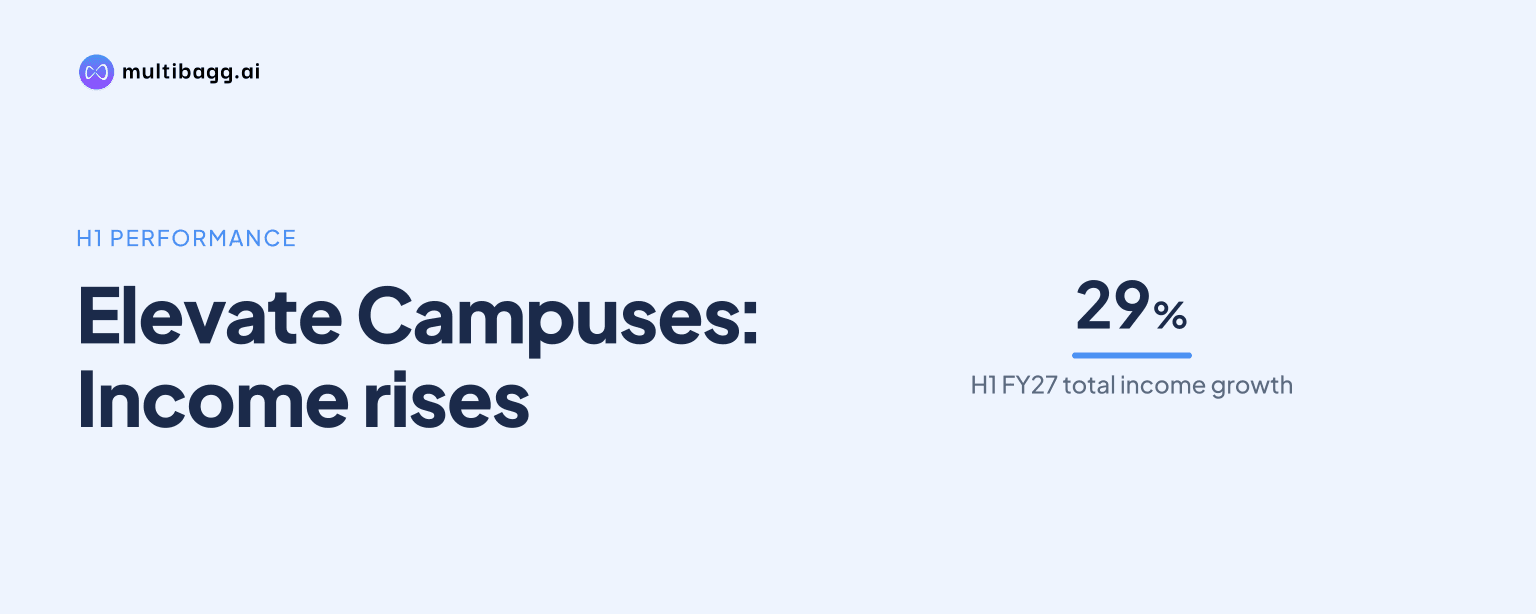
Elevate Campuses Limited reported H1 FY27 total income of Rs 478 crore, up 29% year on year, while reported profit after tax fell 58% to Rs 67 crore. The income increase was led by new assets, but seasonal maintenance, higher staffing and share-based pay, depreciation, finance costs and a prior-year exceptional gain affected earnings comparisons.
Know Elevate Campuses inside out
Results, valuation, peers and who's buying, in one view.
Why did Elevate Campuses' H1 income rise 29%?
Elevate Campuses' H1 FY27 income rose 29% to Rs 478 crore, while Q2 income increased 28% year on year to about Rs 247 crore. Management said new assets added to the portfolio contributed about Rs 51 crore, or 96%, of Q2 revenue growth. Fee escalations and renewals in existing assets contributed about Rs 4 crore, or 7%, of the increase.
The portfolio had more than 20,000 owned and managed beds as of September 30, 2026, plus more than 58,000 managed beds across 23 educational institutions. It also had 18 K-12 campuses, including 16 in India and two in the UAE. Occupancy in the owned and managed student-accommodation portfolio was approximately 95%, supporting accommodation, dining, laundry and other service income.
The quarterly split shows that additions, rather than same-asset escalations, accounted for most of the growth. Management said contracts provide embedded same-store growth of 5% to 6%, with 7% to 9% achieved at selected assets. However, the Rs 51 crore contribution from new assets was substantially higher than the Rs 4 crore contribution from escalations and renewals.
Why did Elevate Campuses' EBITDA margin decline?
Elevate Campuses' Q2 FY27 reported EBITDA margin declined to 69% from 75.3% a year earlier because the quarter included preventive planning and maintenance spending, listing costs and higher corporate employee expenses. Reported Q2 EBITDA still rose 16% year on year to about Rs 167 crore, but lagged the 28% increase in income.
Universities are generally closed in July and part of August, giving Elevate Campuses access to its rooms before the academic year. The company installed weatherproof panels, repainted rooms and added dehumidifiers during Q2. Management said this work improved student comfort and living conditions, while the timing of the upkeep reduced the quarterly margin.
The company also booked about Rs 2 crore of initial public offering-related expense through the profit and loss account. Employee expense rose by about Rs 5 crore and share-based compensation was about Rs 6 crore in Q2, following the expansion of the corporate team for listed-company requirements.
For H1 FY27, EBITDA rose 21% to Rs 343 crore, implying a margin of about 72%, versus 76% in the preceding-year period. Management said share-based expense booked in H1 was about Rs 9 crore and calculated the margin at 74% after adjusting for that expense. Its normalized EBITDA, which primarily excludes the non-cash Ind AS lease equalization reserve, was Rs 315 crore, up 20% year on year.
Why did Elevate Campuses' reported H1 profit fall 58%?
Elevate Campuses' reported H1 FY27 profit after tax fell 58% year on year to Rs 67 crore because cost increases were followed by higher depreciation and finance costs, while the comparable prior-year period included an exceptional hostel-sale gain. Management reported H1 profit after tax before exceptional items of Rs 72 crore.
In Q2, about Rs 12 crore of incremental depreciation and Rs 24 crore of finance cost reduced profit before exceptional items and tax to Rs 41 crore, down 23% year on year. The pattern explains why reported EBITDA growth did not translate proportionately into pre-tax profit, particularly during the maintenance-heavy quarter.
Management also reported pro forma cash profit after tax of Rs 78 crore for Q2 and Rs 156 crore for H1. This measure reflects normalized earnings after potential interest savings from using IPO proceeds to repay debt. It is a management-defined measure, rather than reported statutory profit.
The 58% reported-profit decline therefore does not represent recurring operating costs alone. It combines the seasonal maintenance and employee-cost effects with depreciation and interest costs, as well as the absence of the exceptional gain from a hostel undertaking sale included in the prior-year H1 comparison.
Got a follow-up? Ask IRIS
How is Elevate Campuses reducing financing costs?
Elevate Campuses fully used the Rs 750 crore of IPO proceeds earmarked for debt repayment and lowered the cost of its existing rupee debt by about 30 basis points to around 8.9% as of November 1, 2026. Management said the reduction came after the Reserve Bank of India raised the repo rate in October 2026 and banks raised marginal cost of lending rates by 15 basis points.
Management estimated interest-cost savings of around Rs 7 crore so far and said this agenda would continue in H2 FY27. The IPO raised Rs 2,100 crore, of which Rs 1,100 crore was deployed for K-12 acquisitions, Rs 750 crore for debt repayment and about Rs 128 crore for other acquisitions discussed on the call.
Post-IPO net worth stood at Rs 3,676 crore and net debt to annualized H1 EBITDA was 3.5 times. Management said it aims to keep net debt to EBITDA at around 4.5 times or below. The weighted average tenure of the loan book was about nine years, while new loans are generally raised for 12 to 15 years, according to management.
What could change Elevate Campuses' earnings trajectory next?
Management said H2 FY27 should be better than H1, while Q2 is expected to remain the main maintenance-intensive quarter. Elevate Campuses also has a smaller room-access period of roughly 20 days from mid- or late December to early January. Management said this can create limited activity in Q3 and Q4, but described any Q4 seasonality as not significant.
Six development projects are scheduled for delivery between FY28 and FY30, with estimated total project cost of around Rs 646 crore and pending capital expenditure of around Rs 350 crore. Management expects entry yield on cost of 10% to 12% and plans phased funding through debt and internal accruals as projects reach construction milestones.
Four of nearly 10 potential acquisition transactions were in diligence, and management said it expected these four to close within six months. Management also said the four transactions could support its intended late-teens-to-20% growth range, without providing individual revenue or EBITDA estimates.
After Q2, Elevate Campuses signed definitive agreements to acquire 2,450 additional beds at O.P. Jindal Global University, taking campus capacity to about 10,500 beds. The Rs 1,350 crore consideration is payable over nine years, including Rs 150 crore upfront, and remains subject to definitive documentation and required approvals.
Conclusion
Elevate Campuses increased H1 income by 29%, principally through new assets, but EBITDA grew 21% and reported profit after tax declined 58%. The difference reflects Q2 maintenance activity, expanded corporate staffing, share-based compensation, depreciation and finance costs, alongside the absence of a prior-year exceptional hostel-sale gain.
The next measures to watch are H2 performance after the maintenance cycle, interest-cost changes after the Rs 750 crore debt repayment, and execution on acquisitions and development. Management expects four diligence-stage acquisitions to potentially close within six months, while six development projects are scheduled for delivery from FY28 to FY30.