










Emcure keeps 4,100-4,200 MRs to improve domestic growth
Key highlights
- Emcure plans to keep its MR force at about 4,100 to 4,200 and add no new representatives in the near term.
- Management said productivity per representative increased in the current quarter versus the prior quarter.
- In-licensed products contribute in the high teens to Emcure's India sales, while biosimilars account for about 10%.
- Management said industry growth was around 14% to 15%, with obesity potentially contributing 4% to 5% of market activity.
powered by IRIS
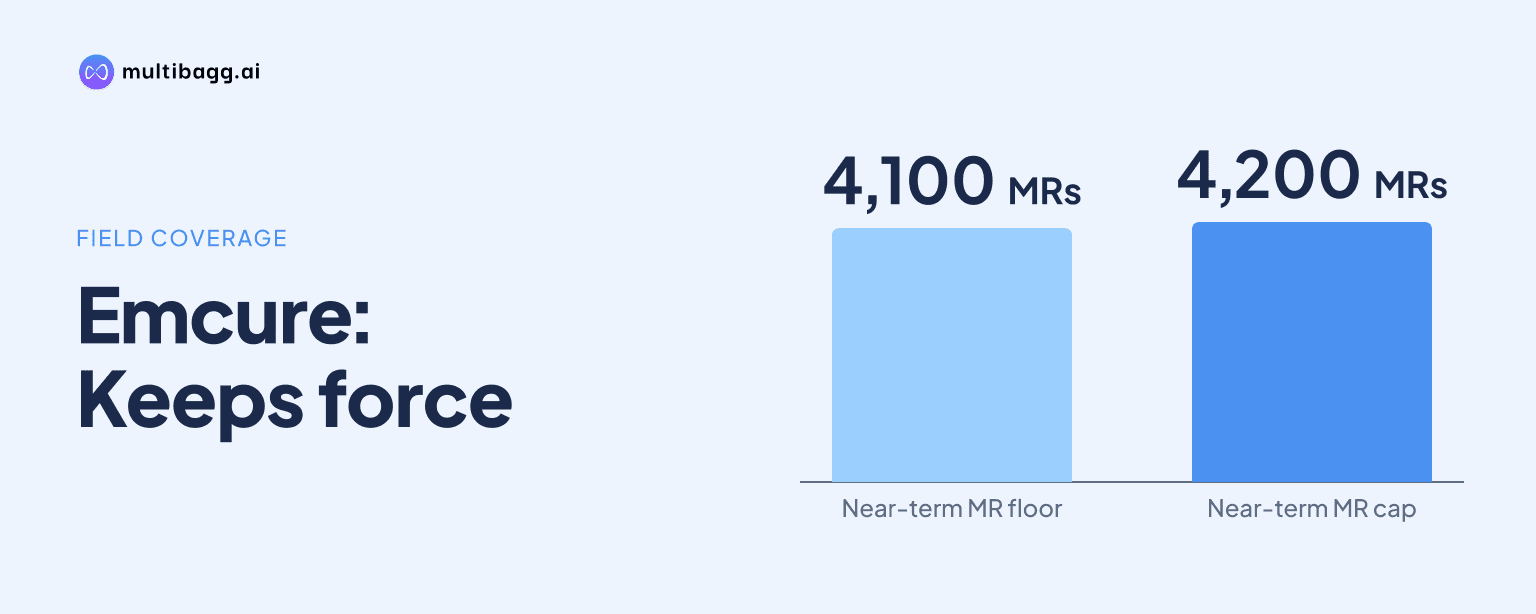
In the current quarter, Emcure Pharmaceuticals Limited (Emcure) said it will keep its 4,100-4,200 medical representatives (MRs) unchanged and seek domestic-formulation growth through doctor targeting, scientific promotion and improved field productivity. Management reported an uptick in productivity per representative from the prior quarter and no near-term hiring plan.
Know Emcure Pharmaceuticals inside out
Results, valuation, peers and who's buying, in one view.
What is Emcure's MR headcount plan?
Emcure plans to retain about 4,100 to 4,200 MRs and is not looking to add new representatives in the near term. Management gave that position when asked about the domestic-formulation sales force over the next 12 to 15 months, after an improvement in domestic formulation growth.
The company is basing the plan on output from the existing field organisation rather than a larger sales force. Management said productivity per representative rose in the current quarter versus the prior quarter, but did not disclose sales per MR, the size of the increase or a productivity target. The evidence is therefore a reported quarter-on-quarter improvement rather than a quantified operating goal.
The stable force also fits Emcure's stated approach to selling, general and administrative expenses, or SG&A. Management said SG&A should grow more slowly than revenue as operating leverage develops. It did not provide a separate cost figure for the 4,100-4,200 MR organisation, so the cost effect of maintaining that range cannot be calculated from the call.
How will Emcure improve domestic growth without new MRs?
Emcure expects to improve domestic growth by reaching the right doctors, strengthening doctor engagement and using scientific promotion. Management said these execution priorities have been its focus for the last two to three quarters, rather than a change in MR headcount or a broad redesign of field incentives.
The approach is aimed principally at prescription generation and doctor coverage rather than hospital sales. Management said the hospital business was in the single digits as a share of domestic formulation sales and was not very large, without giving an exact proportion. It added that hospital sales are typically more weighted toward injectables, while its solid-dose products are an important part of its domestic positioning.
Management linked scientific promotion to products that offer differentiated or innovative discussion points for doctors. It identified the Orofer XT anaemia franchise, Asomex and Metpure as products seeing good growth. The call did not disclose sales, market share or growth rates for those brands, so their individual contribution to the current-quarter productivity increase was not specified.
Has Emcure changed incentives for medical representatives?
Emcure said it has not made a broad change to its MR incentive scheme. Management said it makes marginal adjustments from time to time so that a greater percentage of the MR population can qualify under the incentive structure, but described execution as the principal driver of recent progress.
This distinction followed an analyst's question on whether better domestic formulation growth reflected an incentive-plan change. Management instead pointed to the last two to three quarters of work on doctor selection, engagement and scientific promotion. It said the current-quarter increase in productivity per representative supported its view that growth can continue without a significant increase in the 4,100-4,200 MR base.
Management's comments do not amount to a numerical forecast for domestic formulation growth or field-force productivity. The company did not provide a target for the percentage of MRs expected to qualify for incentives, nor did it say how frequently the marginal incentive adjustments are made. Its stated mechanism is a combination of targeted execution and periodic calibration of the existing scheme.
Got a follow-up? Ask IRIS
Which products and sales mix matter to Emcure's domestic strategy?
Emcure cited Orofer XT, Asomex and Metpure as domestic products seeing good growth, with Orofer XT identified as part of its anaemia franchise. Management said the ability to discuss differentiated or innovative product features is important to scientific promotion, which is central to getting more productivity from the current MR team.
The domestic portfolio also includes products sourced through in-licensing relationships with multinational partners. Management said in-licensed products contribute in the high teens to India sales and have a lower stand-alone margin profile, which affects the blended profitability of the India business. That mix is separate from the field-force strategy, which is directed at improving domestic execution.
Biosimilars account for about 10% of India sales, according to management. Emcure did not disclose how its 4,100-4,200 MRs are allocated among branded products, biosimilars, in-licensed products or therapy areas. It also did not provide a split of the productivity improvement among Orofer XT, Asomex, Metpure or other brands.
What Indian market conditions does management see?
Emcure management attributed recent Indian pharmaceutical-market growth to broader healthcare access, increased awareness and continued demand for quality branded generics. It said industry growth had been around 14% to 15%, compared with volume growth that appeared more anaemic about a year earlier, while cautioning that the assessment was qualitative.
Management also said obesity treatments may be adding to market activity through more diagnostics. It cited Mounjaro sales of about Rs 1,600 crore to Rs 1,800 crore, or more than Rs 130 crore per month, and combined semaglutide-brand sales of around Rs 50 crore to Rs 60 crore. Against a pharmaceutical market estimated at about Rs 25,000 crore, management said obesity could account for at least 4% to 5% of activity.
Management drew on its historical experience to say pharmaceutical industry growth has often been about 1.5 times economic growth. It gave an example in which 8% economic growth could correspond to 11% to 12% pharmaceutical growth, before adding new-product launches and the obesity category as possible contributors to 14%-15% industry growth. This was management's observation, not company guidance or a forecast for Emcure.
Conclusion
Emcure's domestic plan combines a stable force of about 4,100-4,200 MRs with more selective doctor coverage, scientific promotion and incremental incentive adjustments. The company reported better productivity per representative in the current quarter than in the prior quarter, while identifying Orofer XT, Asomex and Metpure as growing products that can support the field team's doctor discussions.
The next measure to watch is whether Emcure sustains productivity gains while maintaining the current MR range and pursuing SG&A growth below revenue growth. Management has not disclosed a domestic-growth target, a sales-per-representative target or a precise hospital-sales contribution, leaving future updates on those operating measures important to assessing execution.