










English Oven uses regional capacity mix for 20%-plus growth
Key highlights
- English Oven reported mid-teens volume growth and high-teens value growth in Q2 FY2027.
- Organised trade contributed 43%-44% of English Oven bakery sales in Q2 FY2027.
- English Oven added about 12,000 to 13,000 outlets over the past year, up roughly 20%-22%.
- Management expects North India to retain about 75%-80% of English Oven sales.
powered by IRIS
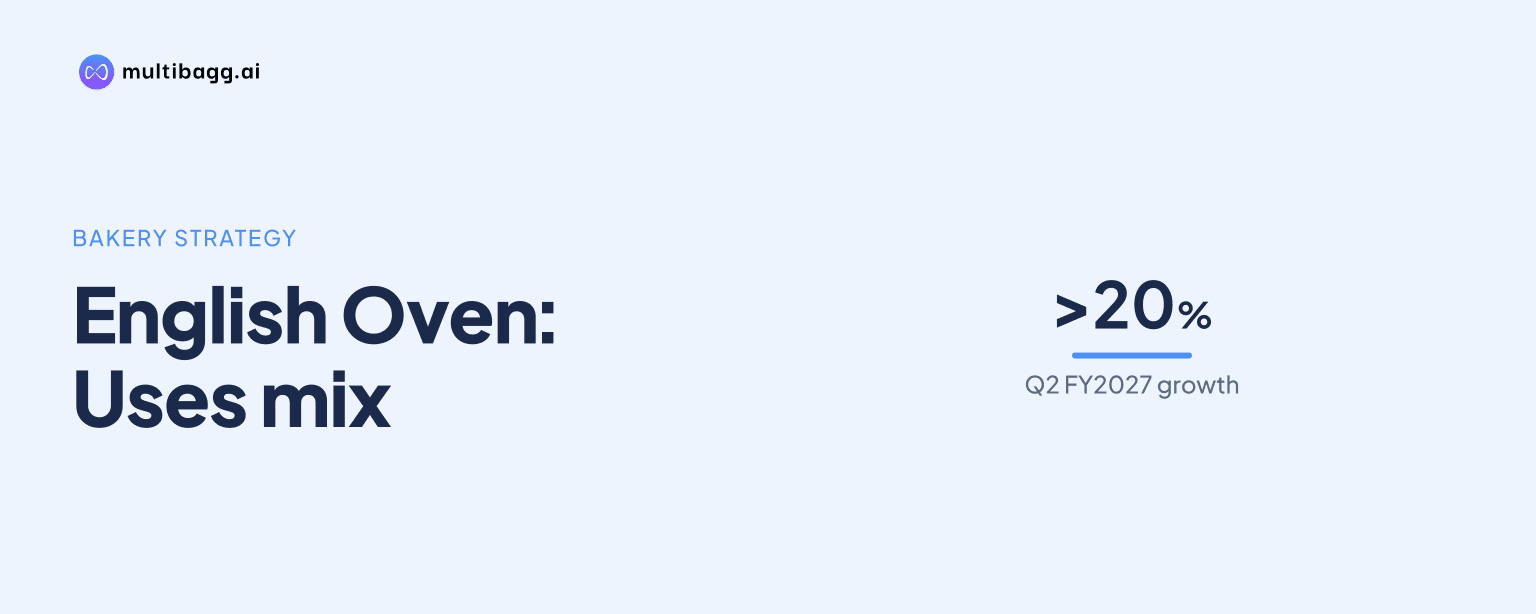
English Oven said in Q2 FY2027 that a mix of owned plants and partner units will be needed to sustain 20%-plus bakery growth, because production capacity must be close to each sales market. Management said Mumbai can support strong growth for a couple of years, while Punjab may require additional capacity in the future.
Know Mrs Bectors Food Specialities inside out
Results, valuation, peers and who's buying, in one view.
How will English Oven support 20%-plus bakery growth?
English Oven plans to combine in-house manufacturing with partner capacity to support 20%-plus growth. Management said the brand serves both business-to-business and business-to-consumer customers, requiring capacity expansion through more than one route. It prefers not to outsource core products extensively because of quality-control considerations, but said third-party capacity will remain part of the operating model.
The reason is that bakery supply is regional rather than national. Management said capacity in one market does not materially help sales in another distant market, making local production and local partner arrangements necessary. Mumbai has capacity to continue growing strongly for the next couple of years, while Punjab was identified as a market where English Oven may need to add capacity later.
English Oven has already added a partner unit in Lucknow, a market previously served by shipments from Delhi. Management said the Lucknow unit should extend coverage into surrounding areas, while the Khopoli plant commissioned in FY2027 is intended to support distribution in Maharashtra. The model therefore uses capacity additions to shorten supply routes rather than relying on a single national production base.
Which channels are expanding English Oven distribution?
Quick commerce is becoming a larger distribution channel for English Oven, while general trade remains an outlet-expansion opportunity. Management said organised trade accounted for 43%-44% of bakery-segment sales in Q2 FY2027, with the contribution rising quarter on quarter. Quick commerce represented about 22% of the combined business-to-consumer sales of bakery and biscuits.
English Oven added about 12,000 to 13,000 outlets during the past year, representing outlet growth of roughly 20%-22%. Management put bakery reach at about 45,000 to 50,000 outlets, compared with almost 7 lakh outlets for the biscuit business. That comparison shows the bakery network remains much smaller, even as quick commerce increases product availability beyond physical store additions.
Management said quick commerce currently offers better margins than general trade for English Oven because it reduces product replacement costs, improves procurement planning through technology and provides freight efficiencies. However, it also said marketing investment is higher on quick-commerce platforms than in general trade, so the channel mix does not eliminate the need for continuing brand expenditure.
Why will English Oven remain concentrated in North India?
English Oven is expected to remain North-heavy, with management estimating that North India could account for about 75%-80% of sales and the rest of India for 20%-25%. Management cited the North's higher existing base and continuing expansion potential, including Punjab and the newly added Lucknow partner unit.
The brand is nevertheless adding capacity and distribution outside its core geography. Management said Kolkata and Hyderabad were opened in the previous year, while Khopoli is now expected to drive a larger number of outlets in Maharashtra. Mumbai remains a key market, where English Oven plans to lead with premium products, but management did not provide a sales target for western or eastern India.
The expected 75%-80% North contribution means the newer markets are intended to supplement rather than replace the core region. English Oven's regional approach also reflects its product economics: transporting fresh bakery products across long distances would not provide the same benefit as building local capacity and local distribution.
Got a follow-up? Ask IRIS
How is English Oven serving value and premium demand?
English Oven is widening its price ladder from Rs 10 products to premium sourdough and frozen offerings. Management said the portfolio includes products at Rs 10, Rs 20, Rs 25 and Rs 30, along with premium variants at Rs 60 and Rs 70. It said the brand is adjusting stock-keeping unit, or SKU, availability by channel, particularly where general trade needs more value-oriented products.
At the premium end, English Oven is building NaturBaked, frozen products and sourdough. Management said NaturBaked, which it described as a clean-label brand, is generating about Rs 1 crore to Rs 1.5 crore in monthly sales. The frozen range remains small at four or five SKUs, but management said every frozen product is priced above Rs 100.
Management said sourdough may not add substantial sales value immediately because the category is still young, but it is part of positioning English Oven for future bakery demand. English Oven also entered Mumbai's pav segment with Zero Maida Pav and introduced a peanut-butter on-the-go brownie, adding products beyond conventional bread ranges.
What do English Oven's sales and margin comments indicate?
English Oven recorded mid-teens volume growth and high-teens value growth in Q2 FY2027, according to management. Institutional bakery grew in the mid-to-high teens in both volume and value over the same period. Management said English Oven's five-year compound annual growth rate, or CAGR, has been in the high teens, indicating that Q2 FY2027 continued an established growth pattern.
Management said the bakery business is about twice the size of institutional bakery and is growing faster. Its distribution expansion, rising quick-commerce presence and premium categories are the mechanisms management identified for that growth. By comparison, the domestic biscuit business recorded volume growth of about 4%-5% in Q2 FY2027, showing a slower volume trajectory than English Oven.
Cost inflation remains a constraint across the business. Management said gross margin fell from 47.2% in Q1 FY2027 to about 46% in Q2 FY2027, reflecting higher raw-material and packaging costs, while freight and fuel increased other expenses. English Oven uses maximum retail price increases to recover cost pressure, unlike the Rs 5 and Rs 10 biscuit categories where management said grammage reductions are more common.
Management said price increases during Q2 FY2027 were approximately 3% over Q1 and projected full-year increases of around 5%-6% across the business. It aimed to maintain earnings before interest, tax, depreciation and amortisation, or EBITDA, margin at 13.1% in Q3 FY2027 and target 13.5% to closer to 14% in Q4 through pricing and Project IMPACT cost actions.
Conclusion
English Oven's 20%-plus growth plan combines local capacity, partner units, outlet expansion and a broader product ladder rather than a centrally supplied national model. Q2 FY2027 mid-teens volume growth, high-teens value growth, a 43%-44% organised-trade contribution in bakery and a projected 75%-80% North India sales mix show how distribution and regional supply remain linked.
The next points to watch are management's capacity decisions in Punjab, the rollout of Khopoli-supported distribution in Maharashtra and quick-commerce growth. Management's stated near-term financial milestone is to move EBITDA margin from 13.1% in Q3 FY2027 toward 13.5% to closer to 14% in Q4 FY2027 despite commodity, packaging and freight costs.