










Mrs Bectors adds 30,000 biscuit outlets amid competition
Key highlights
- Mrs Bectors added over 30,000 biscuit outlets in H1 FY2027 against a 40,000-outlet annual target.
- Mrs Bectors had around 345,000 outlets in its Rajpura-focused geography after the H1 FY2027 expansion.
- Mrs Bectors added almost 10% to 15% more distributors to support biscuit distribution in FY2027.
- Mrs Bectors reported Q2 FY2027 revenue of Rs 630.5 crore, up 14.3% year on year.
powered by IRIS
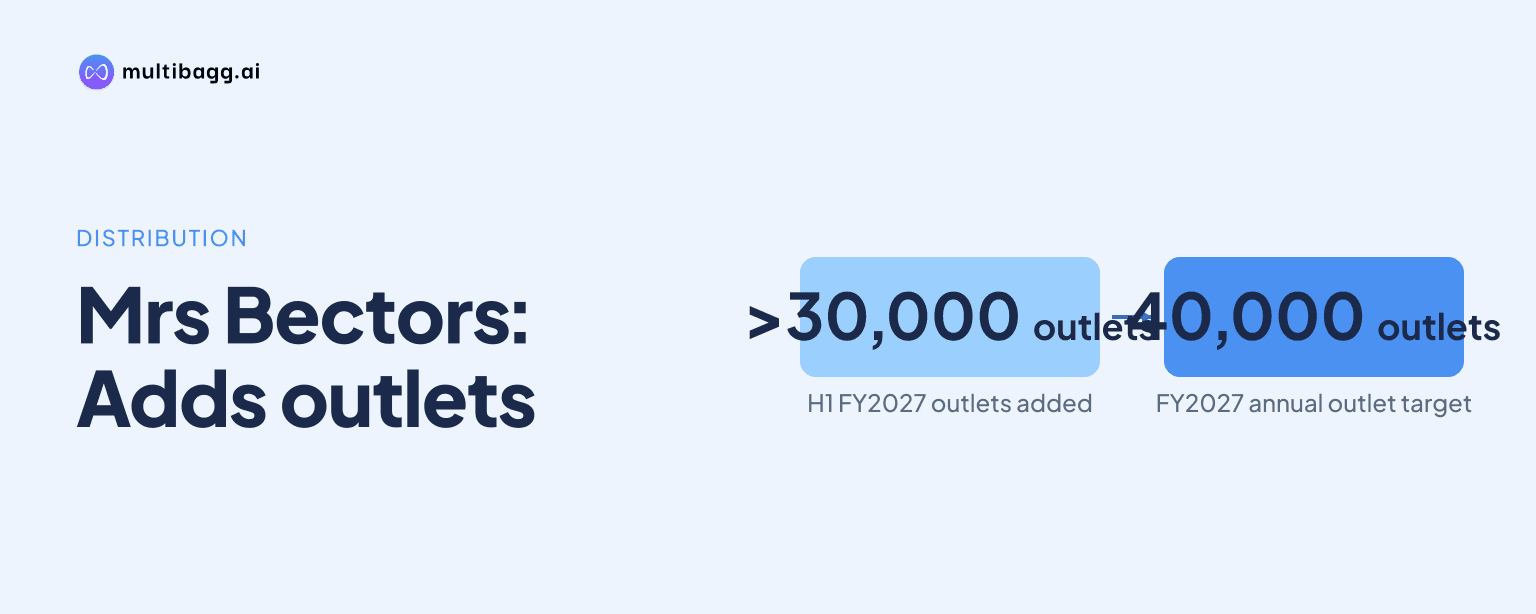
Mrs. Bectors Food Specialities Limited added over 30,000 biscuit outlets in H1 FY2027, completing almost three-quarters of its 40,000-outlet annual target despite management describing North Indian biscuit competition as high. The company also added almost 10% to 15% more distributors and expects domestic biscuit growth to move from low teens towards mid-teens.
Know Mrs Bectors Food Specialities inside out
Results, valuation, peers and who's buying, in one view.
How many biscuit outlets has Mrs Bectors added?
Mrs Bectors added over 30,000 biscuit outlets in H1 FY2027 against a full-year target of 40,000 outlets with billing of Rs 245 and above. Management said it had intended to maximise additions during the first half, putting the company at almost 75% of its annual outlet-addition objective within six months.
The expansion is concentrated within 400 km to 500 km of Mrs Bectors' Rajpura plant, a geography identified at the beginning of FY2027 for a more aggressive distribution effort. Management said the company had reached around 345,000 outlets in that defined area after the expansion activity, but did not provide the opening outlet count or a target beyond FY2027.
Mrs Bectors also added almost 10% to 15% more distributors to support the wider network in H1 FY2027. The additional distributor base is intended to improve servicing and product availability across the Rajpura-led geography, alongside the increase in retail outlets.
Why is Mrs Bectors expanding biscuit distribution in North India?
Mrs Bectors is expanding distribution because management said competition in North India's biscuit category remains high among large and regional players. Its response is to build distribution foundations close to Rajpura while seeking faster domestic biscuit growth, rather than disclosing a market-share or price-led strategy.
Domestic biscuits grew in the low teens in Q2 FY2027, excluding agencies, according to management. Mrs Bectors expects this growth trajectory to build towards the mid-teens, although this is management's stated expectation and not a precise revenue forecast for a specified period.
The distribution effort was undertaken in a difficult Q2 FY2027 consumption setting. Management said a below-normal monsoon affected rural sentiment, while headline consumer inflation rose from about 4.4% in June 2026 to 5.5% in September 2026, led by edible oils, sugar and cereals.
Management said domestic demand nevertheless remained resilient in premium and value-added products, modern trade, quick commerce and recovering institutional business during Q2 FY2027. The route-to-market programme therefore combines new outlets with products intended for premium and health-oriented demand instead of relying solely on wider retail availability.
Got a follow-up? Ask IRIS
How is Mrs Bectors using quick commerce for biscuits?
Mrs Bectors is using quick commerce to sell premium biscuit innovations, with shortbread and Zero Maida coconut biscuits its two largest contributors on the channel. The shortbread contains 25% butter and no palm oil, while the Zero Maida coconut biscuit is positioned within the company's health-focused offering.
Management said the shortbread had been a success and that the performance of the two products signalled customer demand for change within the biscuit category. Mrs Bectors plans to launch three additional quick-commerce products and two seasonal collaborations nationally for Christmas, but did not disclose the platform name, sales figures or launch dates.
The quick-commerce approach is focused on premiumisation rather than only broader distribution. Management said innovation and premiumisation were the way to succeed in the channel and described its expected growth as aggressive, though the call did not disclose quick-commerce revenue, channel growth, or its share of domestic biscuit sales.
Mrs Bectors also added premium products across other categories in Q2 FY2027. English Oven entered Mumbai's pav segment with Zero Maida Pav and added a peanut-butter on-the-go brownie, while NaturBaked introduced pre-sliced whole-wheat sourdough and Cremica launched coconut cream.
What do Mrs Bectors' Q2 FY2027 results show?
Mrs Bectors reported Q2 FY2027 revenue from operations of Rs 630.5 crore, up 14.3% from Rs 551.4 crore in Q2 FY2026 and up 14.9% sequentially. Management described this as its highest quarterly revenue, while domestic and export biscuits grew in the low teens excluding agencies and bakery grew in the high teens.
Earnings before interest, tax, depreciation and amortisation, or EBITDA, margin was 13.1% in Q2 FY2027, 50 basis points above Q2 FY2026 and unchanged from Q1 FY2027. Profit after tax was Rs 45.7 crore and its margin was 7.3%, compared with 6.6% a year earlier, despite higher freight, fuel and packaging costs.
For H1 FY2027, Mrs Bectors reported revenue of Rs 1,179.3 crore, up 15.1% from Rs 1,024.4 crore in H1 FY2026. EBITDA increased 21.2% to Rs 154.6 crore and profit after tax increased 25.4% to Rs 84.5 crore, while EBITDA margin expanded 70 basis points to 13.1% and profit-after-tax margin rose to 7.2% from 6.6%.
Bakery remained another source of growth in Q2 FY2027. English Oven volume increased in the mid-teens and value increased in the high teens, while institutional bakery volume and value both grew in the mid to high teens; management also said the bakery business was twice the size of institutional business.
Conclusion
Mrs Bectors' addition of over 30,000 outlets in H1 FY2027 was a direct response to high competition in North Indian biscuits and supports its effort to lift domestic biscuit growth from the low teens towards the mid-teens. The programme combines a denser network around Rajpura, almost 10% to 15% more distributors, and premium quick-commerce launches, while bakery and biscuits both contributed to Q2 FY2027 growth.
The next indicators are completion of the remaining roughly 10,000 outlet additions in FY2027 and progress towards management's mid-teens domestic biscuit growth expectation. Management said it aims to maintain EBITDA margin in Q3, when commodity pressure may be steepest, and then move closer to 13.5% to 14% in Q4 through calibrated pricing and Project IMPACT cost actions.