










Mrs. Bectors says quick commerce lifts bakery margins
Key highlights
- Quick commerce contributed about 22% of Mrs. Bectors' combined B2C bakery and biscuit businesses in Q2.
- Organised trade represented 43% to 44% of Mrs. Bectors' bakery segment in Q2.
- English Oven added about 12,000 to 13,000 outlets over the past year, an increase of roughly 20% to 22%.
- NaturBaked was generating about Rs 1 crore to Rs 1.5 crore in monthly sales as a new brand.
powered by IRIS
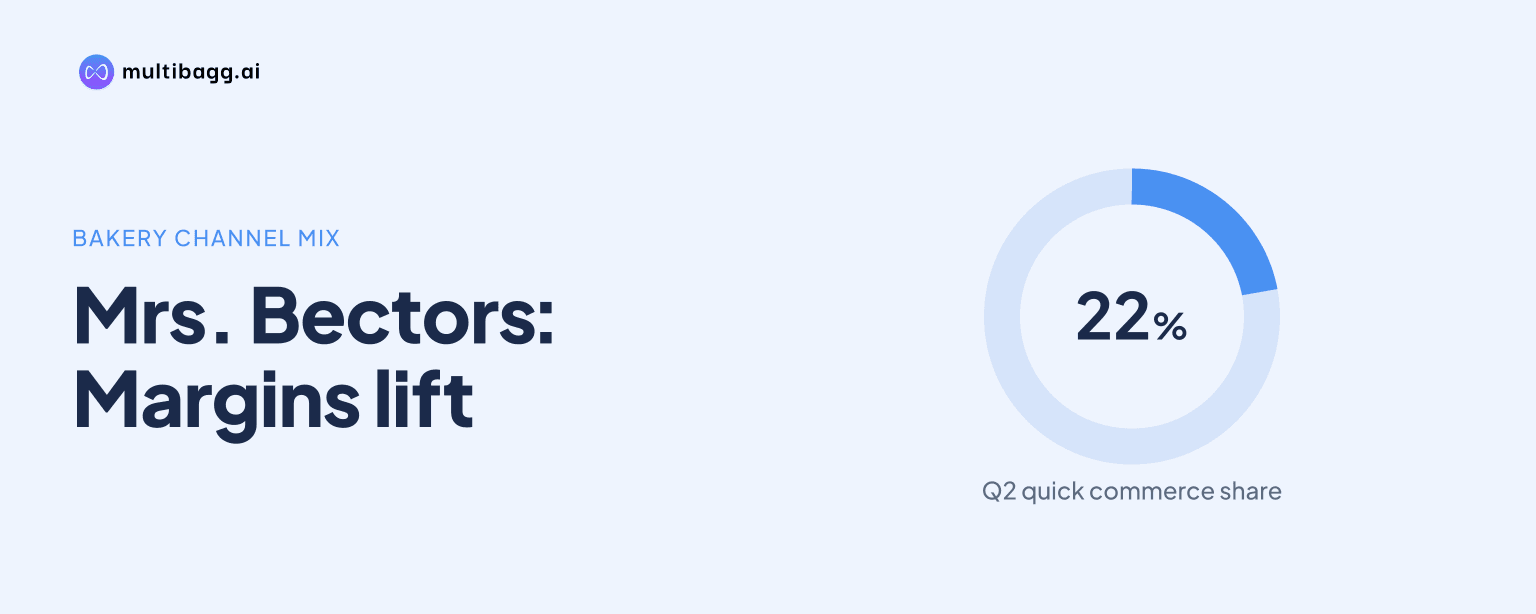
Mrs. Bectors Food Specialities Limited said quick commerce accounted for about 22% of its combined business-to-consumer bakery and biscuit portfolio in Q2 and currently delivers higher bakery margins than general trade. Management attributed the margin difference to lower product-replacement costs and better freight efficiency, although it also spends more on brand building in the channel.
Know Mrs Bectors Food Specialities inside out
Results, valuation, peers and who's buying, in one view.
How large is Mrs. Bectors' quick commerce business?
Mrs. Bectors said quick commerce, or Q-com, contributed about 22% of its combined business-to-consumer, or B2C, bakery and biscuit businesses in Q2. Management described the channel as a large driver of bakery reach, while organised trade represented 43% to 44% of the bakery segment in the quarter and had risen quarter on quarter.
The two channel figures cover different scopes. The 22% Q-com share covers both B2C businesses, whereas the 43% to 44% measure refers to organised trade within bakery alone. Management said Q-com has become the largest driver of reach for bakery products, rather than general trade, or GT, alone.
Mrs. Bectors is also expanding physical distribution. It added 30,000 GT outlets in the quarter against a target to add 40,000 outlets with monthly throughput above Rs 245 per outlet. English Oven added about 12,000 to 13,000 outlets over the past year, an increase of roughly 20% to 22%, while management said GT remains under pressure from Q-com.
Why are Mrs. Bectors' bakery margins higher in quick commerce?
Mrs. Bectors said bakery margins are currently higher in Q-com than in GT because the channel reduces replacement and freight inefficiencies. Management identified the cost of product sold into the market and subsequently returned as its largest cost, and said Q-com platforms use technology to plan procurement more effectively.
Better planning can reduce returns and therefore replacement costs, while the freight model also improves economics, management said. It did not disclose a margin percentage for Q-com or GT. The stated benefit is consequently linked to operational efficiency in bakery distribution rather than to a disclosed pricing premium.
Management cautioned that the current margin advantage may not remain unchanged because marketing investment is much higher in Q-com than in GT. Brand spending is intended to support growth in the channel, including NaturBaked, frozen products and sourdough, which makes the channel’s reported margin benefit different from a complete measure of marketing-adjusted profitability.
The comments came as overall gross margin declined to about 46% in Q2 from 47.2% in Q1. Management attributed the change to higher raw-material and packaging-material costs, saying price recovery was about 1 percentage point short of commodity-price inflation. It nevertheless said it expected gross margin to remain around Q2 levels in Q3 and Q4.
Which premium products is Mrs. Bectors selling through quick commerce?
Mrs. Bectors is using Q-com to develop NaturBaked, frozen products and sourdough within its bakery portfolio. NaturBaked, which management described as a clean-label brand, was generating about Rs 1 crore to Rs 1.5 crore of monthly sales despite being a newly launched brand.
The frozen business remains small and had four or five stock-keeping units, or SKUs, at the time of the call. Management said all frozen products were priced above Rs 100 and that it was working to expand the range. It sees Q-com as a channel through which a broader bakery-style product experience can reach consumers.
English Oven has products at Rs 10, Rs 20, Rs 25 and Rs 30 price points, alongside more premium varieties at Rs 60 and Rs 70 and sourdough products. Management said premium products are moving through Q-com, while the lower-priced mix supports GT where required.
The premium initiative accompanies growth in the established bakery business. English Oven volume grew in the mid-teens in Q2 and value growth was in the high teens, while institutional bakery volume and value each grew in the mid- to high teens. Management said bakery is now twice the size of institutional business and English Oven has delivered a high-teens compound annual growth rate over five years.
Got a follow-up? Ask IRIS
Can Mrs. Bectors continue expanding bakery distribution?
Mrs. Bectors said bakery expansion will require a mix of owned capacity, partner production and new-city distribution because bakery is a regional business. Management said capacity in one market does not necessarily serve another market, making local production and distribution relevant to the Q-com and GT expansion plan.
The Khopoli plant was commissioned during the year and is intended to drive distribution in Maharashtra. Mrs. Bectors had opened Kolkata and Hyderabad in the preceding year, while a new partner unit in Lucknow is positioned to serve markets previously supplied from Delhi and surrounding areas.
Management said Mumbai should have capacity to support strong growth for a couple of years, although Punjab could need additional capacity in the future. It also said core products are less suitable for third-party outsourcing because of quality-control considerations, limiting how much expansion can rely on partners.
For English Oven, management expects northern India to remain about 75% to 80% of business, with the rest of India contributing about 20% to 25%. In biscuits, it aims to expand numeric reach from more than 7 lakh outlets to about 9 lakh to 10 lakh outlets by 2030, but it did not disclose an equivalent bakery outlet target.
What does quick commerce mean for Mrs. Bectors' growth plans?
Mrs. Bectors said Q-com is supporting English Oven growth alongside broader distribution expansion. English Oven volume grew in the mid-teens in Q2, and management said the bakery business was growing faster than the institutional business, with the former already twice the size of the latter.
Management also linked future bakery growth to premiumisation in NaturBaked, frozen products and sourdough. It said sourdough is not expected to add substantial value immediately because the market remains young, but the range can make English Oven more future-ready within bakery.
Competition in Q-com includes startups that use the channel to address distribution constraints, management said. Mrs. Bectors said NaturBaked was a response to cleaner-label competitors and that continued product innovation in frozen, sourdough and NaturBaked is its stated approach to competing in the channel.
Management did not give a separate Q-com revenue-growth target or a channel-specific margin target. It said the broader objective is to move earnings before interest, tax, depreciation and amortisation, or EBITDA, margin from 13.1% toward 13.5% and potentially closer to 14% in Q4, despite commodity volatility and higher Q-com marketing investment.
Conclusion
Mrs. Bectors' Q2 disclosures establish Q-com as both a distribution route and a current source of better bakery channel margins. Its about 22% share of combined B2C business, combined with lower replacement and freight costs, explains why the company is using the channel to support English Oven, NaturBaked, frozen products and sourdough while still adding GT outlets.
The next developments to watch are the use of the commissioned Khopoli plant to expand Maharashtra distribution, product additions to the four- to five-SKU frozen range and any capacity requirement in Punjab. Management’s stated Q4 EBITDA-margin objective of 13.5% and potentially closer to 14% will also depend on commodity costs, pricing recovery and the level of Q-com brand investment.