










EPACK says March-end capex supports Rs 3,000 crore revenue
Key highlights
- EPACK said completed and March-end capex could support Rs 2,800 crore to Rs 3,000 crore of revenue.
- EPACK's Gujarat plant will add a 50,000-tonne first phase against total design capacity above 80,000 tonnes.
- EPACK's Mambattu sandwich-panel utilisation increased from around 35% in Q1 to 47% to 48% in Q2.
- EPACK reported Rs 867 crore of H1 revenue against a Rs 1,900 crore commitment for the current financial year.
powered by IRIS
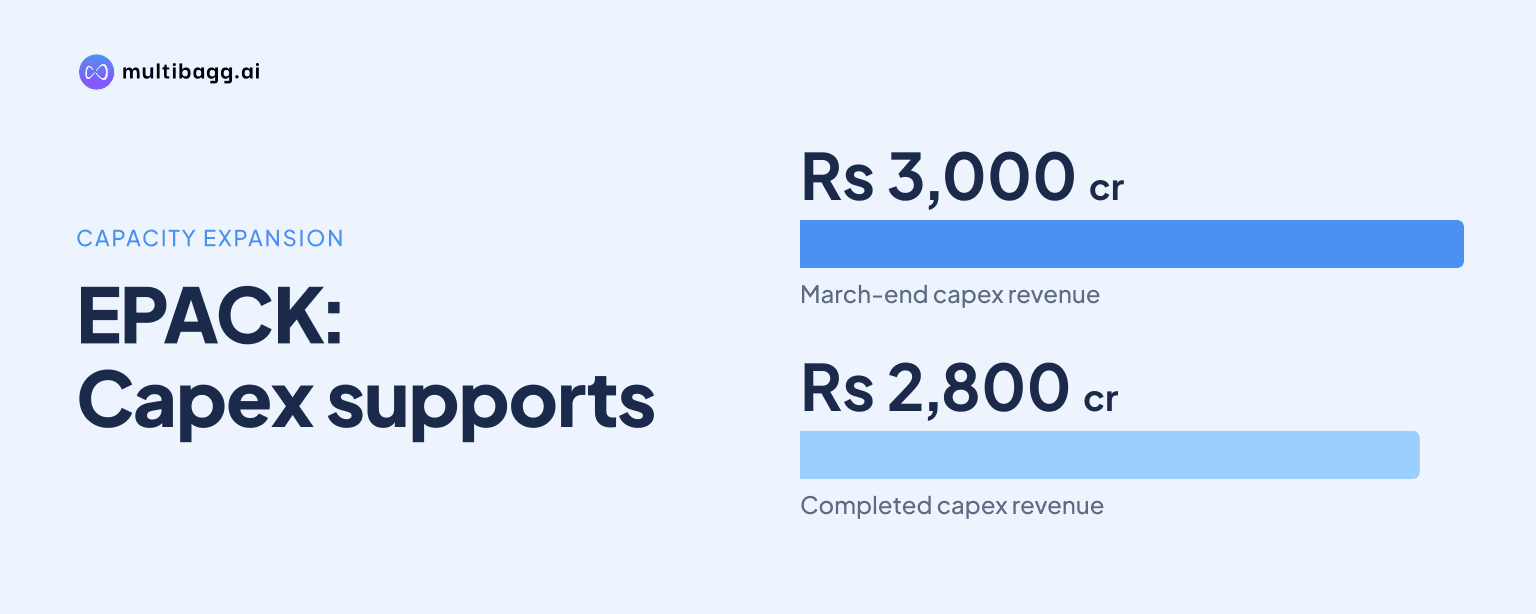
EPACK said capital expenditure completed during the current financial year and still due by March-end could support Rs 2,800 crore to Rs 3,000 crore of revenue across pre-engineered buildings and sandwich panels. Management said the resulting capacity would meet growth demand for the following year, but did not state that no further capital expenditure would be needed through FY28.
Know EPack Prefab Technologies inside out
Results, valuation, peers and who's buying, in one view.
What revenue can EPACK's current and pending capacity support?
EPACK said the combined capacity created by capital expenditure undertaken during the current year and expenditure still due by March-end could “easily” generate about Rs 2,800 crore to Rs 3,000 crore of revenue. The estimate combines pre-engineered building, or PEB, capacity with sandwich-panel capacity, rather than setting a separate revenue ceiling for either product line.
That capacity estimate exceeds management's Rs 1,900 crore revenue commitment for the current financial year. EPACK reported Rs 867 crore of revenue in H1 and said its order book could support the remaining H2 revenue required to meet that commitment. The midpoint of the capacity range, Rs 2,900 crore, is Rs 1,000 crore above the current-year commitment, although management gave no timetable for reaching that level.
The Rs 2,800 crore to Rs 3,000 crore figure is a management estimate of revenue potential at peak utilisation, not reported revenue or formal guidance for a specified fiscal year. EPACK linked the estimate to PEB and sandwich-panel capacity utilisation, meaning order intake, production ramp-up and project execution will determine the eventual revenue outcome.
Which EPACK projects are adding capacity?
EPACK identified a new sandwich-panel line at Mambattu and the Gujarat plant under construction as the principal additions. Management said Gujarat would begin manufacturing in the last quarter of the current financial year, while the Mambattu line had already been installed and was being ramped up.
The Gujarat plant has a total design capacity of more than 80,000 tonnes, but EPACK is building 50,000 tonnes in its first phase. The 50,000-tonne phase is therefore the near-term capacity addition discussed on the call; management did not disclose a construction timetable or capital-expenditure schedule for the remaining design capacity.
Mambattu utilisation increased from around 35% in Q1 to around 47% to 48% in Q2. EPACK said H2 utilisation should be better than H1, supported by more than 5 lakh square metres of pending sandwich-panel orders and its established customer base in the North market.
Got a follow-up? Ask IRIS
Does EPACK have enough capacity through FY28 without further capex?
EPACK did not explicitly say its existing and under-construction plants would eliminate the need for further capital expenditure through FY28. In response to a question about FY27 and FY28 growth, management said that by the end of the current financial year it would have enough capacity to meet growth demand for the next year.
Management also said growth of 20%, 25% to 30% for the next couple of years remained intact, based on order intake and capital expenditure occurring in the country. This outlook provides context for the Rs 2,800 crore to Rs 3,000 crore capacity estimate, but it is not an FY28 revenue target or a disclosed multi-year capital-expenditure freeze.
The distinction reflects the projects' current status. Gujarat is due to start manufacturing only in the last quarter of the current financial year, while Mambattu was operating at 47% to 48% utilisation in Q2. EPACK's closest explicit capacity assurance covers the following year, so extending that assurance through FY28 would go beyond management's comments.
What demand and margin factors affect EPACK's ramp-up?
EPACK said demand remained supportive across logistics, warehousing, automobiles, construction-material industries and data centres. Management said it was close to securing its first PEB order for a data-centre building and had already supplied and installed sandwich panels for data centres, but did not quantify revenue from these opportunities.
EPACK said its past investment can serve current data-centre heavy-structure enquiries without additional capital expenditure. Its built-up lines can manufacture web widths of up to 2 metres, while management said data-centre webs are typically up to 25 millimetres thick; the company said it would remain a prefab engineered-building provider rather than offer complete turnkey semiconductor solutions.
Steel prices remain a factor in converting higher utilisation into margins. EPACK said it covers about 48% to 50% of steel exposure and has coverage for the next three to four months against an order book spread over eight to nine months. Management said margin was 9.4% in Q1 against a 10.5% average in the previous year, then recovered to 10.1% in Q2.
Management said it had built inventory to protect against steel-price increases and expected H2 to improve over H1 in revenue and margin terms. It also said it seeks customer price increases on older orders when required, while new orders are booked at current pricing; management expected EBITDA, or earnings before interest, tax, depreciation and amortisation, margin of 10% to 10.5% by the financial year-end.
Conclusion
EPACK's central disclosure is that capital expenditure completed during the current year and due by March-end could support Rs 2,800 crore to Rs 3,000 crore of revenue across PEBs and sandwich panels, compared with its Rs 1,900 crore commitment for the current financial year. The operational indicators are Mambattu's increase from about 35% utilisation in Q1 to 47% to 48% in Q2 and Gujarat's 50,000-tonne first phase.
The next disclosed milestones are Gujarat beginning manufacturing in the last quarter of the current financial year and further sandwich-panel ramp-up in H2. Management's stated target to watch is the Rs 1,900 crore current-year revenue commitment, alongside whether capacity utilisation rises beyond the Q2 level and whether EPACK provides a more specific capital-expenditure plan after the following year.