










EPACK cash flow lagged record Q2 revenue on receivables
Key highlights
- EPACK reported record Q2 FY27 revenue of Rs 501 crore, while H1 FY27 revenue rose 19% to Rs 867 crore.
- Receivables increased by approximately Rs 144 crore and deliberate steel inventory building added approximately Rs 92 crore in H1 FY27.
- EPACK's Q2 FY27 EBITDA margin improved to 10.1% from 9.4% in Q1 FY27.
- Management maintained FY27 guidance for Rs 1,900 crore of revenue and EBITDA margin of 10% to 10.5%.
powered by IRIS
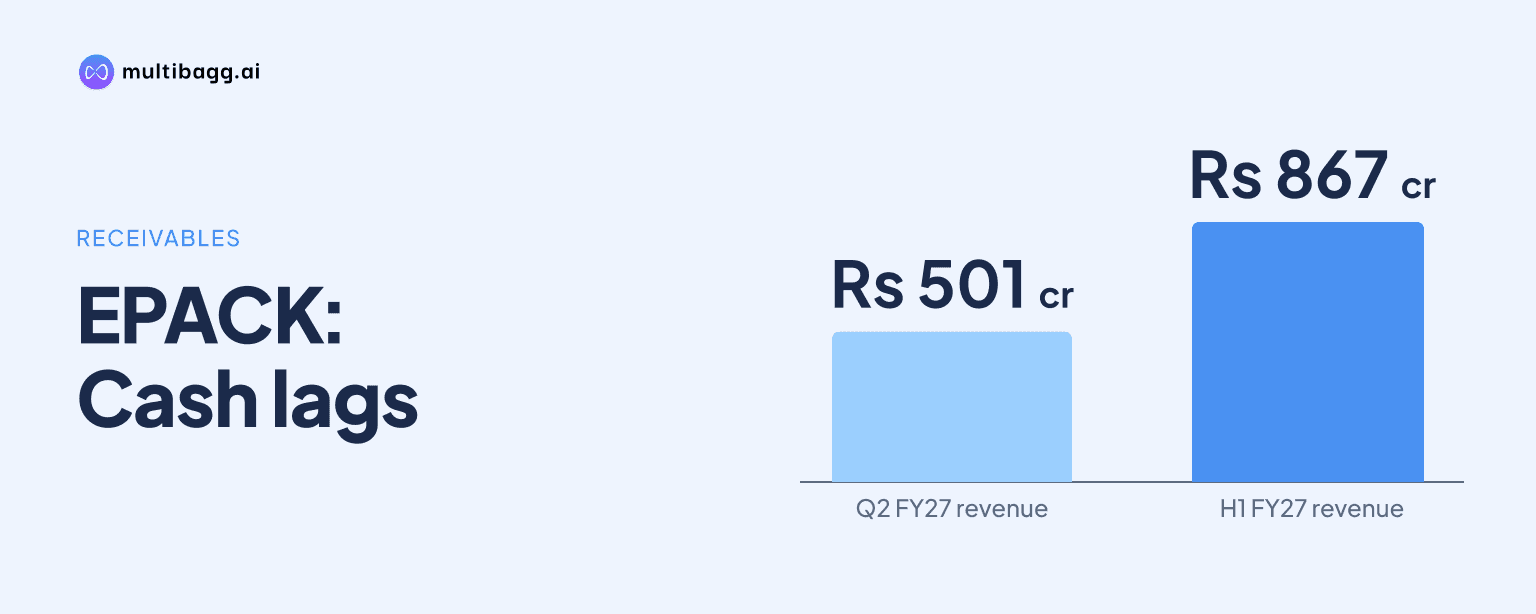
In Q2 FY27, EPACK Prefab Technologies Limited reported record revenue of Rs 501 crore, but operating cash flow was negative as receivables rose about Rs 144 crore and deliberate steel inventory building added about Rs 92 crore. H1 FY27 revenue rose 19% to Rs 867 crore, while profit increased 2%.
Know EPack Prefab Technologies inside out
Results, valuation, peers and who's buying, in one view.
Why did EPACK's record Q2 revenue not produce comparable cash?
EPACK's revenue growth did not produce comparable cash because customer collections were delayed and the company deliberately increased steel inventory. Management said working capital rose to nearly 60 days in H1 FY27, versus its usual guidance range of 40 to 55 days. This was a slippage of roughly 15 to 18 days, alongside negative operating cash flow despite record Q2 revenue of Rs 501 crore.
The approximately Rs 144 crore increase in receivables arose from large industrial and renewable projects executed over the preceding six months on milestone-based billing. Management said each receivable was backed by a letter of credit, or LC, and described the issue as one of collection timing rather than payment security. The LC process is linked to project milestones, and delays in that process postponed cash receipt after work had been executed.
The Rs 92 crore inventory addition was an intentional purchase of steel rather than only a consequence of slower operating turnover. Management said the stock secures steel availability for the entire current quarter and protects against further price increases. The decision consumed cash in H1 FY27, but management expects the inventory, along with new pricing practices, to support gross-margin improvement in the current and following quarters.
How did steel prices affect EPACK's H1 margins?
Steel and other input costs reduced EPACK's H1 gross margin by almost 2.3 percentage points because prices rose faster than the company could pass them through on orders already under execution. Management identified this as one of two reasons profit increased only 2%, despite H1 FY27 revenue increasing 19% to Rs 867 crore. The second reason cited was the increase in working capital.
EPACK's Q2 FY27 EBITDA margin, or earnings before interest, tax, depreciation and amortisation margin, improved to 10.1% from 9.4% in Q1 FY27. Management attributed the improvement partly to price increases obtained on existing orders, even as it said raw-material prices rose 17% to 18% during Q2. The quarter-on-quarter margin change indicates that price recovery improved profitability, while earlier cost increases still affected the H1 result.
Management said every new order is now priced at current input costs instead of earlier steel prices. EPACK also has long-term sourcing arrangements and is pursuing price-escalation clauses with larger customers. Some customers have agreed to those clauses, management said, but it did not say that escalation had become standard practice across contracts.
What is EPACK doing to reduce working capital?
EPACK's stated near-term action is to prioritise collections in H2 FY27 and normalise working capital during Q3 FY27. The managing director said he would report working capital each quarter until it normalises. Management expects the Rs 144 crore of LC-backed receivables to reduce in Q3 as milestone-related processing is completed, although this is an expectation rather than a reported collection outcome.
On new contracts, EPACK is seeking to move more customer payments into the first two of five typical payment stages. Management described the stages as advance, approval before dispatch, dispatch, post-dispatch and final handover. Its aim is to maximise receipts before supplies begin, and management said changes in payment terms may begin to show over the next two to three quarters.
The collection plan addresses the timing mismatch in H1 FY27, when project execution and milestone billing lifted receivables by approximately Rs 144 crore. Management said it had focused on market penetration over the past few years and had reached a scale where it could seek better payment terms. Whether this changes cash conversion depends on the payment structures achieved on subsequent industrial and renewable contracts.
Got a follow-up? Ask IRIS
Can EPACK meet its FY27 guidance after H1?
EPACK maintained its FY27 outlook for revenue of Rs 1,900 crore and an EBITDA margin of 10% to 10.5%, despite H1 FY27 revenue of Rs 867 crore and the working-capital build. Management's stated basis includes H1 order inflow rising about 71% to Rs 1,124 crore and a pending order book of Rs 1,462 crore. It said that order book provided revenue visibility for eight to nine months.
Capacity additions also form part of management's plan. On October 30, 2026, EPACK added 13,000 tonnes of steel-processing capacity at its Ghiloth greenfield Unit 5 project and commissioned a sandwich-panel line there for northern markets. Management plans to commission its Gujarat greenfield plant in Q4 FY27, and said the Ghiloth and Gujarat additions would take revenue capacity to about Rs 2,800 crore to Rs 3,000 crore.
Management said no new capital expenditure would be needed in FY27 and FY28, with the focus on using recently added plants at 80% to 85% utilisation. Gujarat will initially have two lines producing 50,000 tonnes, while the site can accommodate four or five lines with capacity of about 80,000 tonnes. Management said further capacity could be added if the FY28 order book remains sufficiently strong, including through a brownfield expansion.
What supports EPACK's margin recovery plan?
EPACK expects margins in the current quarter to be better than the H1 FY27 outcome because more orders will be priced at current input costs and the steel inventory is available for execution. Management had already recovered Q2 EBITDA margin to 10.1% from 9.4% in Q1 FY27, while saying raw-material prices rose 17% to 18% in the quarter. Its forecast is management guidance, not a reported margin result.
The company also said it obtained price increases on existing orders, which management cited as the main reason Q2 margin improved from Q1. However, management acknowledged that price-escalation clauses are not yet standard, even though some larger customers have accepted them. The margin outcome in H2 FY27 will therefore depend on current-cost pricing, the use of steel inventory and progress in securing escalation and payment terms.
EPACK's Rs 1,462 crore order book combines the revenue opportunity with an execution requirement. Management indicated a prefab run rate of close to Rs 150 crore and said the order book offers eight to nine months of visibility. It also said a large Rs 155 crore supply-and-execution project was about 95% built, with handover expected by December-end after customer-side civil-front delays pushed completion beyond the contractual October 31 date.
Conclusion
EPACK's H1 FY27 results show a gap between reported growth and cash conversion: revenue rose 19% to Rs 867 crore and Q2 revenue reached Rs 501 crore, while profit increased 2% and operating cash flow was negative. The identified Rs 236 crore working-capital increase comprised approximately Rs 144 crore of LC-backed project receivables and Rs 92 crore of deliberately accumulated steel inventory.
The next disclosed test is management's Q3 FY27 expectation that LC-linked collections will normalise working capital. Investors can also watch whether current-cost pricing, customer payment terms and the steel inventory improve margins beyond the H1 outcome, while the Gujarat plant remains scheduled for commissioning in Q4 FY27.