










EPACK wins first data-centre steel order; venture undecided
Key highlights
- EPACK said it received its first data-centre structural-steel order in the current quarter.
- EPACK's existing built-up lines can produce web widths of up to 2 metres for data-centre structures typically using webs up to 25 millimetres thick.
- Management said the separate data-centre products opportunity involves one large customer and may extend beyond the current quarter.
- EPACK reported H1 order inflow of Rs 1,124 crore and a pending order book of Rs 1,462 crore.
powered by IRIS
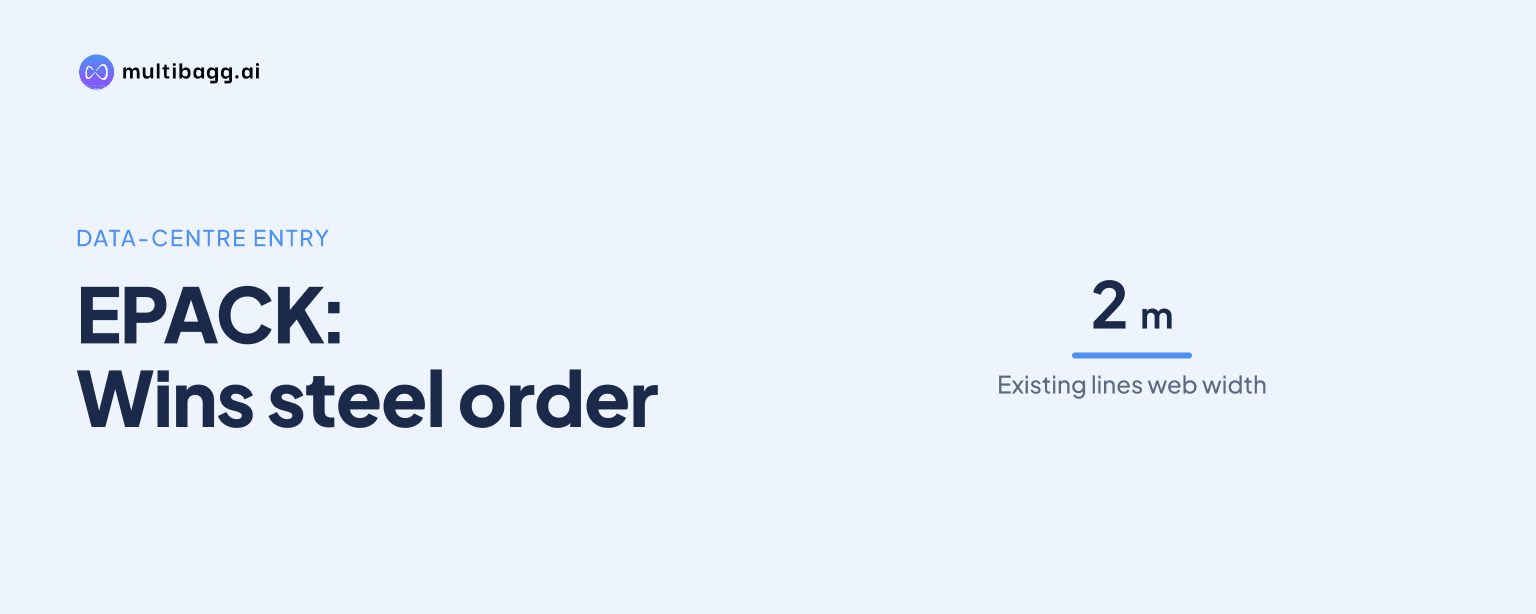
EPACK Prefab Solutions Limited won its first structural-steel supply order for a data centre in the current quarter, using existing lines capable of producing web widths up to 2 metres. The order opens a new heavy-structure application without additional capital expenditure, while a separate data-centre products opportunity with one large customer remains under discussion.
Know EPack Prefab Technologies inside out
Results, valuation, peers and who's buying, in one view.
What is EPACK supplying for its first data-centre order?
EPACK is supplying structural steel for a data-centre project in the current quarter, and management described the assignment as a heavy-structure order. It did not disclose the customer, contract value, steel tonnage, delivery schedule or expected margin from the project.
EPACK said its role remains within prefab engineered-building work rather than complete project delivery. In discussing semiconductor opportunities, management said it would not offer a full turnkey solution, indicating that civil works and broader project execution are outside the company’s disclosed approach for these specialist facilities.
The data-centre order differs from EPACK’s semiconductor pipeline because management said it has not yet built a semiconductor facility. It disclosed that semiconductor enquiries and discussions are under way, but identified the data-centre structural-steel supply order as the first confirmed order in either of these newer applications.
Can EPACK make data-centre structures without new capex?
EPACK said it does not need additional capital expenditure for the data-centre enquiries it is currently receiving. Management said investments already made in its manufacturing equipment can accommodate both heavy structures and pre-engineered buildings, or PEBs.
The company said its built-up lines can manufacture steel members with web widths of up to 2 metres at any thickness. Management added that data-centre structures typically use webs with thicknesses of up to 25 millimetres, which it cited as evidence that its current equipment can serve the requirement.
EPACK did not provide a separate data-centre production capacity, annual tonnage capability or dedicated manufacturing line. Its disclosure is therefore limited to technical compatibility: existing heavy-structure equipment can process the dimensions management expects in the data-centre enquiries now being evaluated.
What is the status of EPACK's data-centre products venture?
EPACK’s separate data-centre products venture is not yet a confirmed business because discussions with one large customer are continuing. Management said the entity was floated in the previous quarter after the opportunity emerged, but gave no committed order, customer name, investment amount or revenue estimate.
The prospective work involves products described as design for manufacture, or DFM, and design for manufacture and assembly, or DFMA, products. Management said it could not determine whether the opportunity would materialise within the current quarter or extend into the next quarter.
This remains distinct from the first structural-steel order. The steel order is being supplied through existing operations and capacity, whereas the recently floated entity is linked to a customer-specific products opportunity that has not yet converted into disclosed business.
Got a follow-up? Ask IRIS
How does the data-centre order fit EPACK's capacity plan?
EPACK’s broader plan for fiscal 2027 (FY27) and fiscal 2028 (FY28) is to raise utilisation of recently added capacity rather than undertake new capital expenditure. Management said it would seek utilisation of 80% to 85% at the new plants, with further capacity additions considered only if order-book strength warrants them.
The company added 13,000 tonnes of steel-processing capacity at its Ghiloth greenfield project on October 30 and commissioned a sandwich-panel line there for northern markets. It also plans to commission its Gujarat greenfield plant in the fourth quarter of the current financial year.
Gujarat will begin with 50,000 tonnes of capacity, while the facility’s design can accommodate more than 80,000 tonnes if four or five lines are ultimately installed. Management said the group’s installed and pending capacity across PEBs and sandwich panels could support revenue of about Rs 2,800 crore to Rs 3,000 crore.
Data-centre heavy structures could draw on that existing manufacturing base, but EPACK gave no separate data-centre revenue contribution within its Rs 2,800 crore to Rs 3,000 crore capacity estimate. The company instead linked the estimate to combined PEB and sandwich-panel capacity after the ongoing Gujarat investment is completed.
What operating indicators support EPACK's expansion plans?
EPACK reported first-half (H1) order inflow of Rs 1,124 crore, up almost 71%, and a pending order book of Rs 1,462 crore. Management said that order book provided about eight to nine months of revenue visibility, based on a prefab revenue run rate of close to Rs 150 crore.
Revenue reached Rs 867 crore in H1, while management maintained FY27 revenue guidance of Rs 1,900 crore and an earnings before interest, tax, depreciation and amortisation (EBITDA) margin target of 10% to 10.5%. These targets cover the full business and do not include separately disclosed data-centre revenue.
Sandwich-panel utilisation at Mambattu rose from about 35% in the first quarter (Q1) to about 47% to 48% in the second quarter (Q2). EPACK also reported pending sandwich-panel orders of more than 5 lakh square metres, while management expects the new Ghiloth line to ramp up over the remaining five months of the financial year.
Management said second-half (H2) revenue and margins should exceed H1 levels, supported by the order book and inventory purchased to limit the impact of steel-price increases. EBITDA margin rose from 9.4% in Q1 to 10.1% in Q2, although management said raw-material prices increased by 17% to 18% during Q2.
Conclusion
EPACK’s first data-centre structural-steel order is a defined entry into a new heavy-structure application rather than evidence of a separately reported data-centre business. Its immediate significance is that management expects to fulfil current data-centre enquiries with existing equipment, including lines capable of producing 2-metre web widths, without new capex.
The next issue to watch is whether the one-customer DFM and DFMA products discussion converts into an order in the current or following quarter, as management said its timing remains uncertain. Investors can also monitor the planned fourth-quarter Gujarat commissioning, the five-month Ghiloth ramp-up, and progress toward 80% to 85% capacity utilisation in FY27 and FY28.