










ESAF Financial Holdings Gets NCLT Nod for Share Restructuring
Key highlights
- NCLT sanctioned ESAF Financial Holdings' shareholding restructuring with September 30, 2025, as the appointed date.
- 36 identified shareholders will receive direct shares in ESAF Small Finance Bank after their holding-company shares are extinguished.
- Dia Vikas Capital will receive a 4.99% stake in ESAF Small Finance Bank and retain 19.06% of ESAF Financial Holdings' diluted equity.
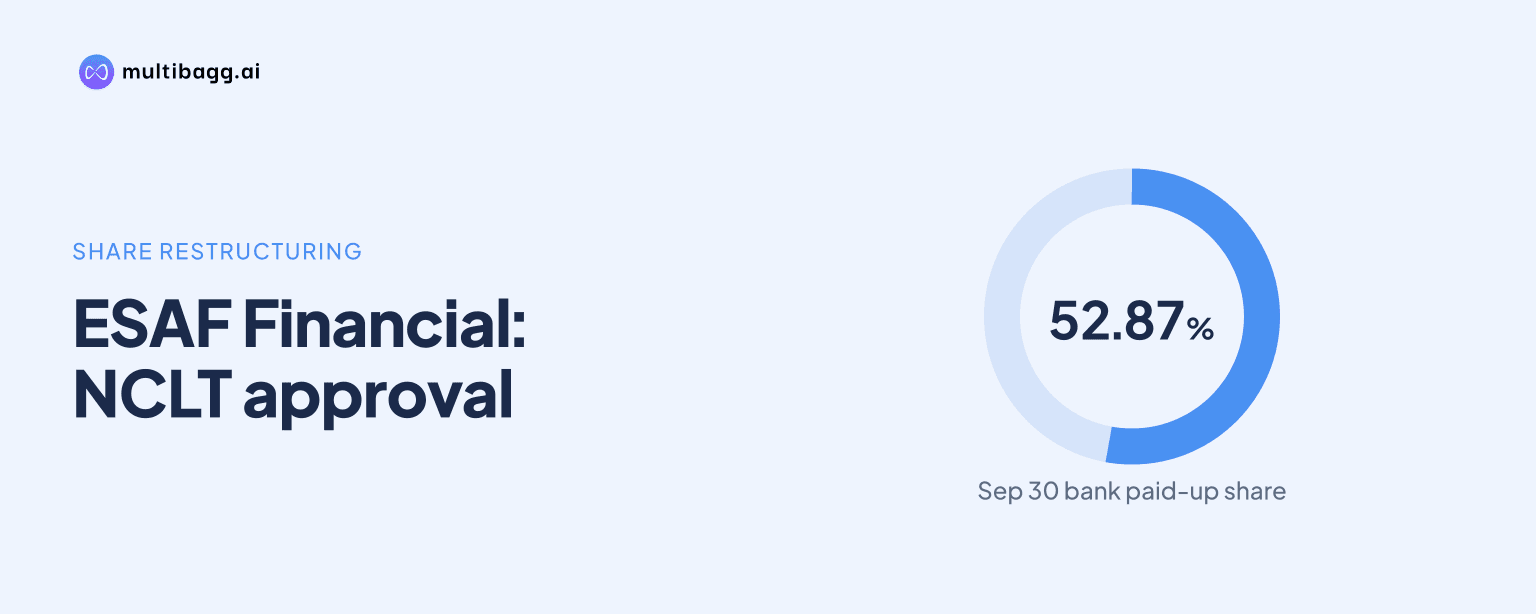
- ESAF Financial Holdings held 52.87% of ESAF Small Finance Bank's paid-up share capital as of September 30, 2025.
powered by IRIS
ESAF Financial Holdings Private Limited has received National Company Law Tribunal approval for a shareholding restructuring that will give 36 identified shareholders direct ownership in ESAF Small Finance Bank Limited, while Dia Vikas Capital Private Limited will receive shares equal to 4.99% of the bank's share capital. The order matters because it implements an RBI-aligned change in the promoter group's ownership structure.
Know ESAF Small Finance Bank inside out
Results, valuation, peers and who's buying, in one view.
What did the NCLT approve for ESAF Financial Holdings?
The National Company Law Tribunal's Kochi Bench sanctioned the scheme of arrangement proposed by ESAF Financial Holdings under Section 230 of the Companies Act, 2013. The scheme restructures the holding company's ownership and transfers part of its holding in ESAF Small Finance Bank directly to selected shareholders.
ESAF Financial Holdings held 52.87% of the bank's paid-up share capital as of September 30, 2025. Under the approved arrangement, shares held by 36 identified shareholders in ESAF Financial Holdings will be cancelled and extinguished. In return, those shareholders will receive proportionate shares of ESAF Small Finance Bank held by the promoter company, along with cash wherever applicable under the consideration mechanism.
The tribunal fixed September 30, 2025, as the appointed date for the scheme. Its order treats the transaction as a shareholding restructuring under Section 230 rather than a buy-back of securities under Section 68 of the Companies Act.
How does the scheme address RBI requirements for Dia Vikas Capital?
The scheme allows Dia Vikas Capital Private Limited to receive shares representing 4.99% of ESAF Small Finance Bank's share capital. At the same time, Dia Vikas Capital's holding in ESAF Financial Holdings will reduce to 19.06% of the holding company's diluted equity share capital.
The restructuring was designed around RBI directions requiring Dia Vikas Capital, described in the proceedings as a foreign-owned and controlled entity, to reduce its ownership below 5% in the bank and below 20% in the holding company. ESAF Financial Holdings revised its proposed arrangement in line with those directions.
The bank had earlier disclosed that its board noted the proposed scheme on December 20, 2024. The revised arrangement was approved by the board of ESAF Financial Holdings and was acknowledged and cleared by the RBI, subject to compliance with applicable laws and regulations.
How will the share transfer and cash consideration work?
The arrangement uses a selective reduction of share capital at ESAF Financial Holdings. The shares held by the identified shareholders in the holding company will be cancelled, and the consideration will be provided through a corresponding transfer of ESAF Small Finance Bank shares owned by ESAF Financial Holdings.
The consideration is based on fair market value as of the appointed date, according to the earlier first-motion proceedings. The scheme also provides for a cash component for certain shareholders, where applicable. The source does not specify the number of bank shares to be transferred, the exchange ratio, or the total cash amount.
The tribunal stated that sanctioning the scheme does not remove any requirement to comply with Section 68 or another applicable legal provision if the implementation or substance of a transaction attracts those provisions. It also clarified that the order does not extinguish existing tax liabilities, leaving the Income Tax Department free to pursue legally enforceable demands.
Got a follow-up? Ask IRIS
What does the order mean for ESAF Small Finance Bank investors?
The approval changes the route through which 36 identified shareholders own part of ESAF Small Finance Bank, from an indirect interest through ESAF Financial Holdings to direct ownership in the listed bank. It also facilitates the specified reduction in Dia Vikas Capital's ownership position under RBI requirements.
For investors, the key disclosed fact is that ESAF Financial Holdings remains the promoter company and held 52.87% of the bank's paid-up share capital on the stated date. The source does not disclose the promoter company's revised final stake after all transfers, the number of shares that will enter direct public ownership, or any market-price movement linked to the order.
The order concerns ownership structure rather than the bank's lending operations, deposits, customer services, or branch network. ESAF Small Finance Bank is headquartered in Thrissur, Kerala, received its small finance bank licence from the RBI on November 18, 2016, and began banking operations on March 10, 2017.
Why is the regulatory context important?
The scheme shows how ownership structures in regulated banks can require changes when an investor's classification or ownership limits trigger RBI conditions. In this case, the restructuring is specifically linked to the requirement that Dia Vikas Capital stay below the stated thresholds in both the bank and its holding company.
During the first-motion stage, the NCLT found the classification of members proper and said there was no legal impediment to proceeding, while making clear that the order was not an opinion on the scheme's merits. It dispensed with meetings of equity shareholders, preference shareholders and creditors, noting that no creditors required a meeting, and directed notice to authorities including the RBI, SEBI, BSE and NSE.
Conclusion
The NCLT sanction gives ESAF Financial Holdings a legal route to restructure its investment in ESAF Small Finance Bank and to meet the ownership changes required for Dia Vikas Capital. The central outcomes are direct bank-share ownership for 36 identified shareholders, a 4.99% bank stake for Dia Vikas Capital, and its reduced 19.06% diluted stake in the holding company.
The next point to watch is implementation of the share transfers and any related regulatory, tax and statutory compliance. Investors will also need to monitor future disclosures for the final post-scheme shareholding pattern, the number of shares transferred and any cash consideration paid.