








Eureka Forbes Wins Quashing of ₹12.59 Crore GST Demand
Max Plan at ₹4,999/yr₹8,999

Find your next multibaggerBe a Pro Investor
Research stocks and track your picks on the go. Download the app.
Key highlights
- Eureka Forbes said the Karnataka High Court quashed the entire ₹12.59 crore GST demand.
- The demand related to transitional service tax credit for FY 2017-18.
- The High Court allowed Eureka Forbes’ writ petition, according to the 26 November 2026 filing.
- The Karnataka matter is separate from Eureka Forbes’ revised ₹4.50 crore Uttar Pradesh GST dispute for FY 2022-23.
powered by IRIS
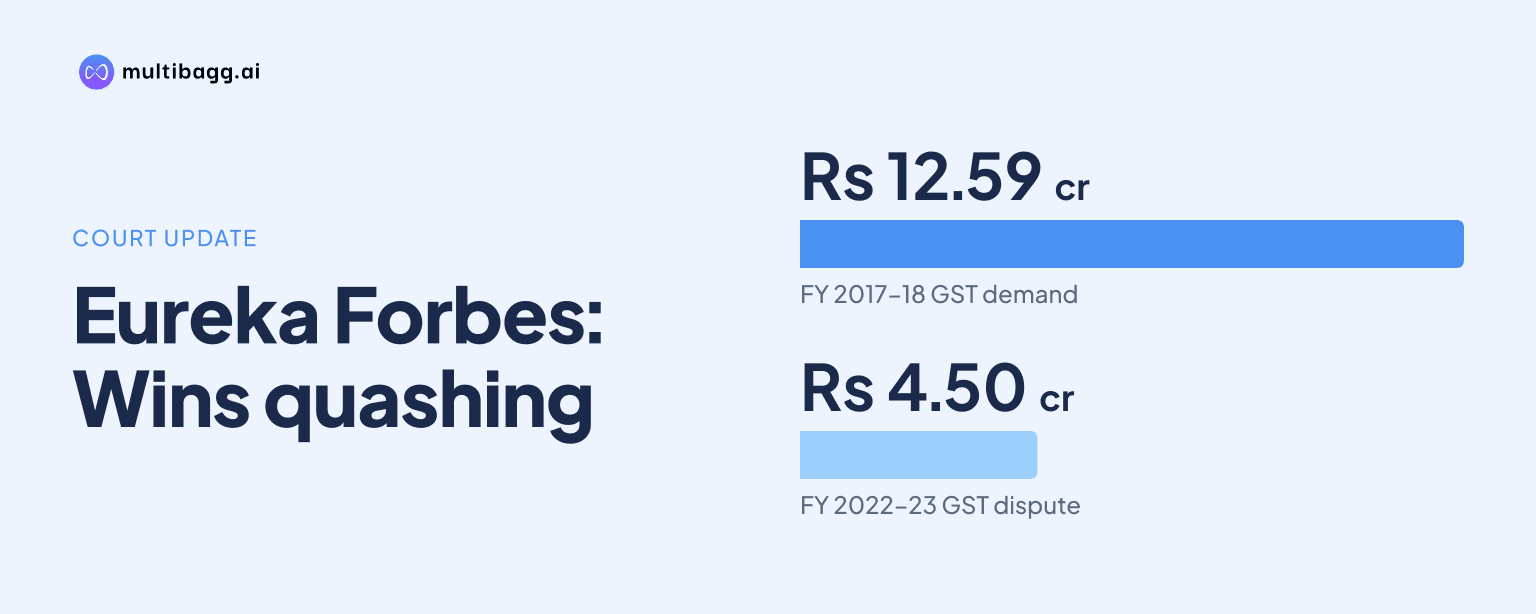
Eureka Forbes Limited said the Karnataka High Court allowed its writ petition and quashed the full ₹12.59 crore GST demand concerning transitional service tax credit for FY 2017-18. The order removes the demand cited in the company’s 26 November 2026 filing, marking a favourable judicial outcome in this specific tax matter.
Know Eureka Forbes inside out
Results, valuation, peers and who's buying, in one view.
What did the Karnataka High Court decide for Eureka Forbes?
The Karnataka High Court allowed Eureka Forbes’ writ petition and quashed the entire ₹12.59 crore GST demand, according to the company’s filing. The demand concerned transitional service tax credit relating to FY 2017-18. A writ petition is a legal remedy through which a party can challenge an administrative or statutory action before a High Court.
The filing identifies the court outcome and the amount involved but does not provide the detailed reasoning adopted by the High Court. It also does not specify the date of the order, the precise tax provisions considered, or whether any party has further legal options. The disclosed outcome is limited to the quashing of the full demand in this matter.
For Eureka Forbes, the ruling is important because the entire amount cited in the filing has been quashed rather than reduced. The disclosure does not state any additional payment requirement, provision reversal, or operational restriction arising from this particular demand.
What was the ₹12.59 crore GST dispute about?
The ₹12.59 crore demand related to transitional service tax credit for FY 2017-18, as stated by Eureka Forbes. Transitional credit issues arose during the shift to the Goods and Services Tax regime, when businesses sought to carry eligible credits from the earlier indirect-tax framework into GST.
Such disputes can involve the eligibility, documentation, timing, or method of claiming credits during the transition. However, the company’s filing does not describe the department’s specific objection to Eureka Forbes’ credit claim. It also does not disclose a breakup between tax, interest, and penalty within the ₹12.59 crore amount.
FY 2017-18 included the initial months after GST was introduced on 1 July 2017. The transition involved new return processes and statutory requirements for registered businesses. The Karnataka High Court’s decision, as disclosed by Eureka Forbes, addresses the company’s demand connected with that period.
How does this case differ from Eureka Forbes’ other GST matters?
This Karnataka High Court matter concerns a ₹12.59 crore demand for transitional service tax credit in FY 2017-18 and should be assessed separately from other GST proceedings involving Eureka Forbes. Tax disputes can arise from different financial years, state registrations, tax provisions, and factual records.
In September 2026, Eureka Forbes disclosed a separate Uttar Pradesh GST show-cause notice for FY 2022-23 that initially aggregated to ₹273.40 crore. The company later said a rectification order reduced that proposed liability to ₹4.50 crore, comprising ₹3.19 crore of tax, ₹0.99 crore of interest and ₹0.32 crore of penalty.
Eureka Forbes has stated that it intends to contest the rectified Uttar Pradesh matter. That proceeding is distinct from the Karnataka High Court case, both in the period involved and in the nature of the disclosed issue. The High Court order quashing ₹12.59 crore does not, on the information disclosed, resolve the Uttar Pradesh proceeding.
Got a follow-up? Ask IRIS
What does the order mean for investors and operations?
The order means the ₹12.59 crore demand identified by Eureka Forbes is no longer payable under the quashed demand, based on the company’s disclosure. It removes a stated tax claim linked to the FY 2017-18 transitional-credit issue and provides clarity on that specific litigation.
The filing does not quantify any impact on profit, cash flow, tax provisions, or financial statements. Investors should therefore avoid assigning a financial accounting impact beyond the amount and outcome explicitly disclosed. The company also did not provide any operational impact statement in connection with the Karnataka order.
From an industry perspective, transitional-credit litigation remains relevant because GST implementation brought together taxes and credits previously governed by different rules. Court decisions can clarify individual disputes, but the outcome in Eureka Forbes’ case should not be treated as a ruling on the facts of every taxpayer’s claim.
What should investors monitor after the GST demand was quashed?
Investors should monitor whether Eureka Forbes makes any further disclosure on the Karnataka High Court order, including the detailed order, any departmental response, or its accounting treatment. The present filing confirms the writ petition was allowed and the ₹12.59 crore demand was fully quashed, but provides no further procedural details.
They should also track the company’s separate Uttar Pradesh GST proceedings, where the revised ₹4.50 crore proposed liability remains under challenge according to prior disclosures. The matters concern different periods and issues, so their legal and financial implications should be evaluated independently.
Conclusion
Eureka Forbes has disclosed a clear legal outcome in the Karnataka GST matter: the High Court allowed its writ petition and quashed the entire ₹12.59 crore demand related to transitional service tax credit for FY 2017-18. The decision closes the demand described in this filing, subject to any subsequent information the company may disclose.
The next disclosure to watch is any update on the order’s detailed basis or on further proceedings, if any. Separately, investors should follow Eureka Forbes’ planned challenge to the rectified Uttar Pradesh GST demand of ₹4.50 crore, which remains a different and unresolved tax matter.

