










Evonile builds direct distribution through 2,000-plus stockists
Key highlights
- Evonile has onboarded more than 20 CFAs and more than 2,000 stockists for direct distribution.
- Evonile reported revenue from operations of Rs 56.1 crore in Q2 FY27, down 38% year on year.
- Evonile reported six brands with revenue above Rs 30 crore each in IQVIA September 2026 data.
- H1 FY27 included Rs 15.4 crore of one-time expenses and Rs 68.3 crore of exceptional items.
powered by IRIS
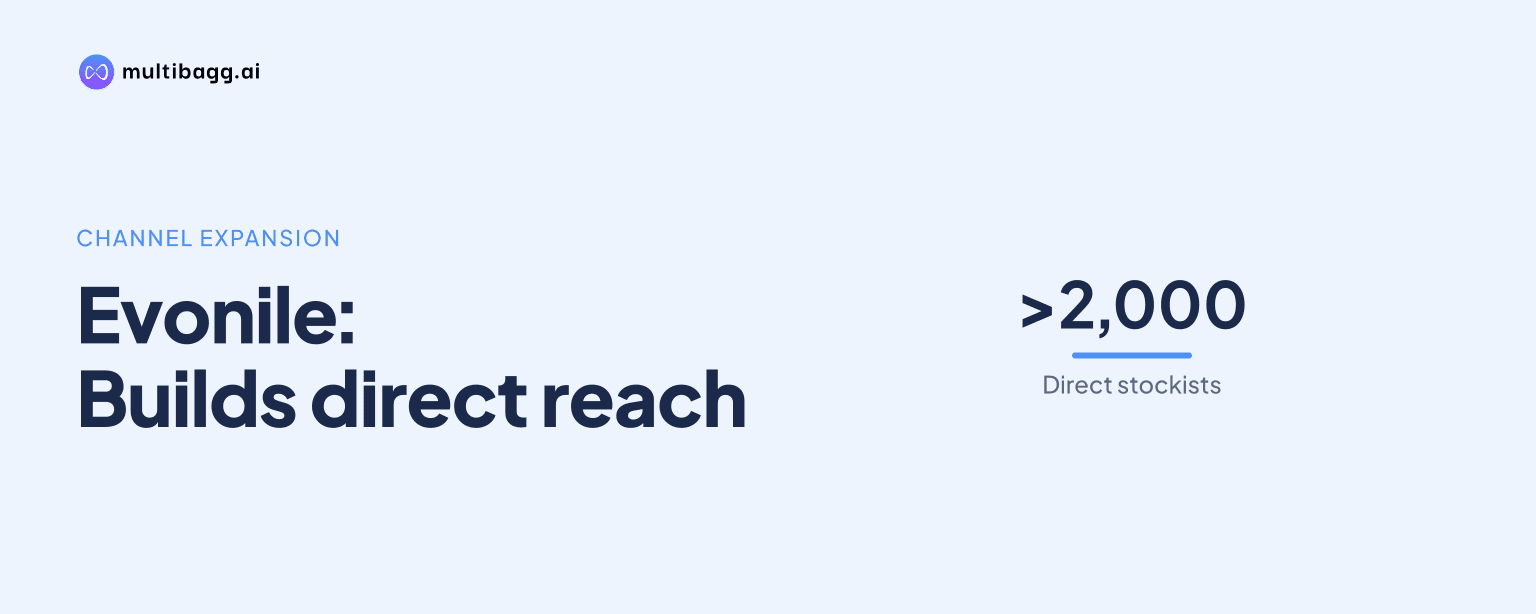
Evonile Pharma Limited is replacing its single-customer-dependent model with direct sales through more than 20 clearing and forwarding agents, or CFAs, and more than 2,000 stockists in Q2 and H1 FY27. Evonile says the nationwide network supports last-mile coverage as it builds in-house sales, marketing and operating capabilities.
Know Evonile Pharma inside out
Results, valuation, peers and who's buying, in one view.
Why is Evonile replacing its single-customer model?
Evonile is replacing the earlier model because the majority of sales had been concentrated with a single customer, while its legacy brands were taken to market through partner-led, outsourced distribution. The current model shifts to direct sales to stockists across the market, which Evonile says is intended to unlock the potential of brands including Voveran, Methergin and Calcium-Sandoz.
The commercial change also addresses limited promotion behind the portfolio. Evonile says it had no dedicated field force for these brands, although demand had continued through legacy prescriber loyalty and minimal recent promotion. The company describes re-establishing focused in-house promotion as its single largest value-unlock opportunity, making the transition a change in both distribution and brand activation.
Managing Director and Chief Executive Officer Dr. Vikas Gupta said on November 3, 2026 that Evonile was moving from a single-customer-dependent business to an independent pharmaceutical company with its own distribution, sales and marketing capabilities. Management said the H2 FY27 focus would be completing the organisational build-out, setting an appropriate cost structure and bringing together a leadership and operating team.
How large is Evonile’s direct distribution network?
Evonile has onboarded more than 20 CFAs and more than 2,000 stockists under its current model. The company says this infrastructure is a nationwide distribution network designed to support the direct channel and ensure last-mile coverage, replacing the earlier limited distribution channel.
The presentation distinguishes the two routes to market clearly: the earlier model concentrated most sales with one customer, while the current model sells directly to stockists across the market. Evonile does not disclose the number of cities, retail outlets, orders or stockist-level sales covered, so the reported scale is limited to the 20-plus CFA and 2,000-plus stockist thresholds.
Evonile is strengthening its field force alongside the channel build, but it does not disclose the force’s headcount or rollout schedule. The company says it is building an in-house sales and marketing team to drive revenue growth, while setting up standalone systems for accounting, human-resources management systems and field reporting after operating as part of global systems and processes.
Which Evonile brands will the direct model support?
Evonile says its portfolio has decades of heritage, with several brands having set a reference standard in their categories and retaining familiarity among prescribers and chemists. Awareness extends across metro, Tier 1 and Tier 2 markets, according to the presentation, while prescription pull has been sustained despite minimal promotion.
The company reported six brands with revenue above Rs 30 crore each, based on IQVIA moving annual total data for September 2026. Its priority portfolio includes Minipress XL in cardiology, Voveran in pain management, Methergin in gynaecology, Calcium-Sandoz and Macalvit in wellness, Tegrital in neuro, and Myfortic and Simulect in transplant.
Evonile assigns a number-one covered-market rank to each named brand in its listed therapy area. The represented market for Minipress XL was more than Rs 11,398 crore, compared with Rs 1,696 crore for Voveran’s pain-management market and Rs 155 crore for Methergin’s gynaecology market, based on IQVIA data for September 2026.
Minipress XL was added during the quarter through an acquisition, according to management’s Q2 and H1 FY27 update. Dr. Gupta also said Evonile completed an ophthalmology in-licensing agreement during the quarter; management said the two transactions strengthen the portfolio and create new platforms for sustainable growth, without disclosing product-level acquisition costs, revenue forecasts or ophthalmology launch dates.
Got a follow-up? Ask IRIS
What happened to Evonile’s revenue during the transition?
Evonile reported revenue from operations of Rs 56.1 crore in Q2 FY27, down 38% from Rs 90.3 crore in Q2 FY26. For H1 FY27, revenue from operations was Rs 159.9 crore, down 10% from Rs 177.9 crore in H1 FY26; Evonile says the Q2 comparison is not comparable because the business-model change caused a one-time correction.
The Q2 FY27 sales bridge identifies Rs 41 crore of sales to the erstwhile partner in FY26 and Rs 7 crore of incremental sales from the in-house division. This moved reported quarterly sales from Rs 90 crore in Q2 FY26 to Rs 56 crore in Q2 FY27, showing that the sales-channel change affected the reported comparison as direct operations were being established.
The current transition follows a mixed four-year revenue pattern. Revenue from operations fell from Rs 379 crore in FY23 to Rs 335 crore in FY24, rose to Rs 356 crore in FY25 and declined to Rs 354 crore in FY26, producing the reported negative 2% compound annual growth rate for FY23 to FY26.
What costs has Evonile reported from the new model?
Evonile reported adjusted operating earnings before interest, tax, depreciation and amortisation, or EBITDA, of a loss of Rs 16.4 crore in Q2 FY27, compared with positive Rs 23.9 crore in Q2 FY26. For H1 FY27, adjusted operating EBITDA was Rs 18.5 crore, versus Rs 51.1 crore in H1 FY26, as employee benefit expenses rose to Rs 19.1 crore from Rs 10.6 crore.
The company reported a loss after tax of Rs 77.5 crore in Q2 FY27 and Rs 45.3 crore in H1 FY27, compared with profits after tax of Rs 24.2 crore and Rs 51.8 crore respectively a year earlier. Evonile says FY27 operating EBITDA and profit after tax are not comparable with the prior-year periods, primarily because of the business-model change, transition costs, one-time expenses and higher operational expenses.
H1 FY27 results included Rs 15.4 crore of one-time expenses related to transition activities and the Minipress acquisition. Exceptional items totalled Rs 68.3 crore, including Rs 61 crore from terminating one customer’s exclusive promotion rights and related inventory purchase arrangements, plus Rs 7 crore for unamortised import licences.
Evonile also reported depreciation and amortisation of Rs 4.3 crore in H1 FY27 versus Rs 1.1 crore in H1 FY26, primarily due to amortisation of acquired brands. Finance costs increased to Rs 4.9 crore from Rs 0.2 crore, while management said Q4 FY27 or Q1 FY28 would reflect the actual cost structure following the transition.
Conclusion
Evonile’s commercial reset moves sales away from concentration with one customer towards direct distribution through more than 20 CFAs and more than 2,000 stockists. The strategy combines nationwide channel infrastructure, a field force under construction and increased promotion of legacy brands, alongside Minipress XL and an ophthalmology in-licensing agreement.
The next point to watch is management’s stated H2 FY27 plan to complete the organisational build-out, establish an appropriate cost structure and form the leadership and operating team. Management has said Q4 FY27 or Q1 FY28 should reflect the actual cost structure, while the presentation provides no revenue, margin or field-force target for the direct model.