










Evonile posts Rs 77.5 crore Q2 loss amid transition costs
Key highlights
- Evonile reported a Rs 77.5 crore loss after tax in Q2 FY27, versus Rs 24.2 crore profit in Q2 FY26.
- Q2 FY27 revenue declined 38% year on year to Rs 56.1 crore from Rs 90.3 crore.
- Exceptional items totalled Rs 68.3 crore, including Rs 61 crore linked to ending promotion rights and inventory arrangements.
- Employee benefit expenses rose 171% year on year to Rs 14.4 crore in Q2 FY27.
powered by IRIS
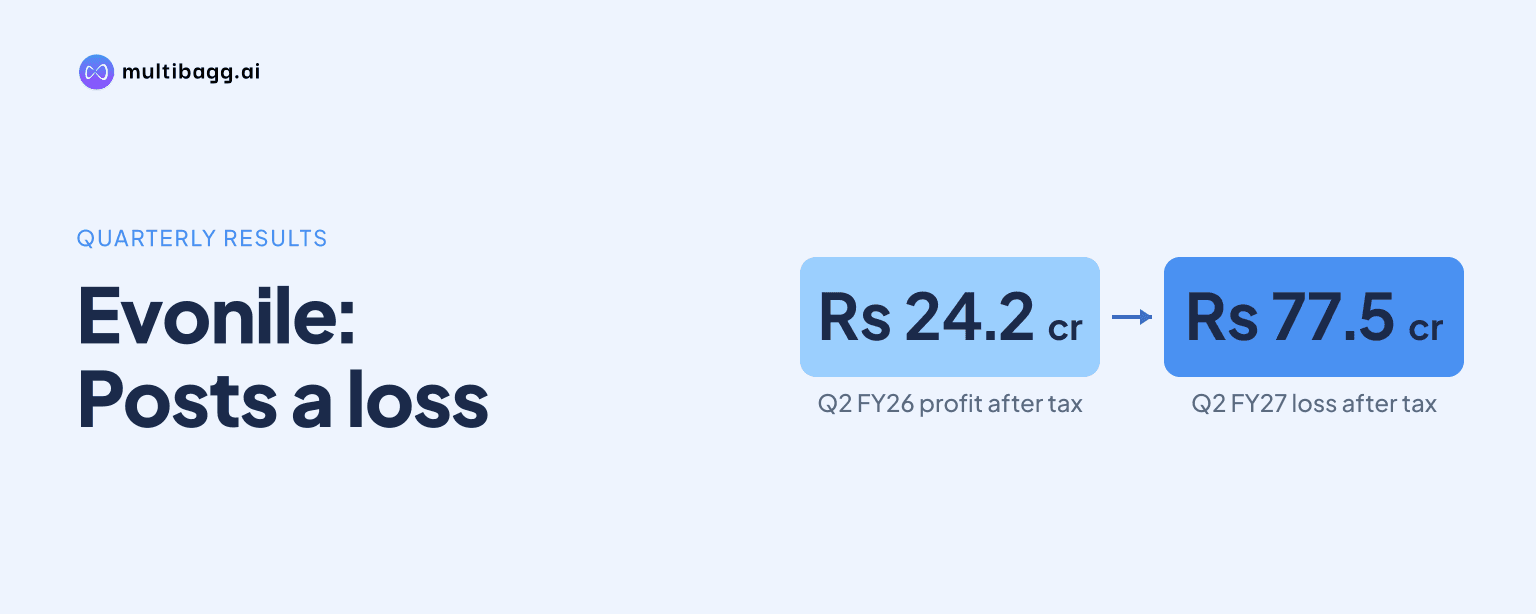
Evonile Pharma Limited reported a Rs 77.5 crore loss after tax in the second quarter of financial year (FY) 27, or Q2 FY27, versus a Rs 24.2 crore profit a year earlier, as Rs 68.3 crore of exceptional items, Rs 15.4 crore of one-time expenses and a 38% revenue decline accompanied its shift to an in-house distribution and sales model.
Know Evonile Pharma inside out
Results, valuation, peers and who's buying, in one view.
Why did Evonile report a Rs 77.5 crore Q2 FY27 loss?
Evonile reported the Q2 FY27 loss because the change in its business model added transition costs, exceptional charges and higher operating expenses to a smaller revenue base. Profit before tax was a Rs 101.1 crore loss, compared with a Rs 32.7 crore profit in Q2 FY26. A tax credit of Rs 23.6 crore reduced the reported loss after tax to Rs 77.5 crore; the presentation attributes this credit to a reversal of current tax and recognition of a deferred tax asset.
The quarterly outcome differed materially from Q2 FY26, when Evonile reported Rs 24.2 crore profit after tax on Rs 90.3 crore revenue. In Q2 FY27, revenue was Rs 56.1 crore, adjusted operating earnings before interest, tax, depreciation and amortisation, or EBITDA, were a Rs 16.4 crore loss, and operating EBITDA after one-time expenses was a Rs 31.8 crore loss. Management says FY27 operating EBITDA and profit after tax are not comparable with the prior year because of transition, one-time and higher operating costs.
How did Evonile’s revenue and operating result change?
Evonile’s Q2 FY27 revenue declined 38% year on year to Rs 56.1 crore from Rs 90.3 crore, while first-half, or H1, FY27 revenue fell 10% to Rs 159.9 crore from Rs 177.9 crore. The company says the Q2 comparison is affected by a one-time correction resulting from the business-model change. Its sales bridge identifies Rs 41 crore of Q2 FY26 sales to the erstwhile partner, partly offset by Rs 7 crore of incremental sales from the in-house division.
The margin and expense mix also changed in Q2 FY27. Cost of goods sold fell 7% to Rs 47.1 crore, less than the revenue decline, while employee benefit expenses rose 171% to Rs 14.4 crore from Rs 5.3 crore. Other expenses increased 4% to Rs 11 crore. Consequently, the operating EBITDA margin moved to negative 57% from positive 26% in Q2 FY26; for H1, it was 2% versus 29% a year earlier.
For H1 FY27, adjusted operating EBITDA declined to Rs 18.5 crore from Rs 51.1 crore. Employee benefit expenses rose 80% to Rs 19.1 crore, while cost of goods sold rose 6% to Rs 102.8 crore, even as revenue declined to Rs 159.9 crore. The presentation links the higher employee cost to the organisational build-out required to support Evonile’s independent sales, marketing and distribution operation.
Got a follow-up? Ask IRIS
Which charges and expenses drove Evonile’s Q2 FY27 result?
Evonile recorded Rs 68.3 crore of exceptional items in Q2 and H1 FY27, compared with nil in the corresponding FY26 periods. The presentation identifies Rs 61 crore from terminating exclusive promotion rights of one customer and related inventory purchase arrangements. It identifies a further Rs 7 crore relating to unamortised import licences. These exceptional items moved Q2 EBITDA after exceptional items to a Rs 100.1 crore loss from a Rs 23.9 crore profit a year earlier.
One-time expenses were Rs 15.4 crore in Q2 FY27 and were reported in other expenses, according to the presentation. Management attributes about Rs 15 crore of this impact to transition activities and the acquisition of Minipress XL. Separately, depreciation and amortisation rose to Rs 3.9 crore from Rs 0.5 crore in Q2 FY26, with the presentation citing amortisation of acquired brands in H1 FY27 as the primary reason for the increase.
Finance costs reached Rs 4.8 crore in Q2 FY27, against Rs 0.1 crore in Q2 FY26. The presentation says about Rs 5 crore of Q2 finance cost related to interest on borrowings for the brand acquisition in September 2026. Other income fell to Rs 7.7 crore from Rs 9.4 crore, adding to the difference between the Rs 101.1 crore loss before tax in Q2 FY27 and the Rs 32.7 crore profit before tax a year earlier.
What is Evonile building after its business-model shift?
Evonile is replacing a model in which most sales were concentrated with a single customer with direct sales to stockists across the market. The company says it has onboarded more than 20 carrying and forwarding agents, or CFAs, and more than 2,000 stockists. It is also building an in-house field force and standalone systems for functions including accounting, human-resources management and field reporting, each of which the presentation identifies as part of the transition.
The portfolio build-out includes the acquisition of Minipress XL and an ophthalmology in-licensing agreement completed during the quarter, according to the managing director and chief executive officer. The company describes its established brands as including Voveran, Methergin and Calcium-Sandoz, and says the newer transactions add cardiology and ophthalmology platforms. These additions are part of a plan to move from a stable legacy book towards deeper geographic penetration, specialty products, in-licensed products and new launches.
Management says employee and sales-and-marketing expenses will be increased in phases, with the full organisational build-out planned by Q4 FY27. Its FY27 imperatives are to re-establish market availability through its CFA and stockist network, return Minipress to growth, re-ignite growth across the brand portfolio and reduce debt significantly through capital infusion. The presentation also states that Q4 FY27 or Q1 FY28 should reflect Evonile’s actual cost structure.
Conclusion
Taken together, the H1 FY27 loss after tax of Rs 45.3 crore, compared with a Rs 51.8 crore profit in H1 FY26, and the operating EBITDA margin of 2%, versus 29%, show the financial effect of building an independent commercial organisation while sales were being transferred from the earlier model. The disclosed charges and higher employee costs occurred alongside a lower H1 revenue base of Rs 159.9 crore.
The next disclosed markers are the full organisational build-out by Q4 FY27 and management’s indication that Q4 FY27 or Q1 FY28 should show the actual cost structure. Progress in converting a network of more than 20 CFAs and more than 2,000 stockists, the expanded field force, Minipress XL and the ophthalmology arrangement into sales will be relevant, as will the planned debt reduction through capital infusion.