










Excelsoft says AI revenue may matter within two quarters
Key highlights
- Excelsoft said AI-specific revenue could have a significant impact within two quarters.
- Excelsoft reported 98.6% automated-marking accuracy on several thousand handwritten AQA answer scripts.
- Q2 FY27 revenue rose 25.2% year on year to Rs 80.9 crore, while EBITDA margin was 16.35%.
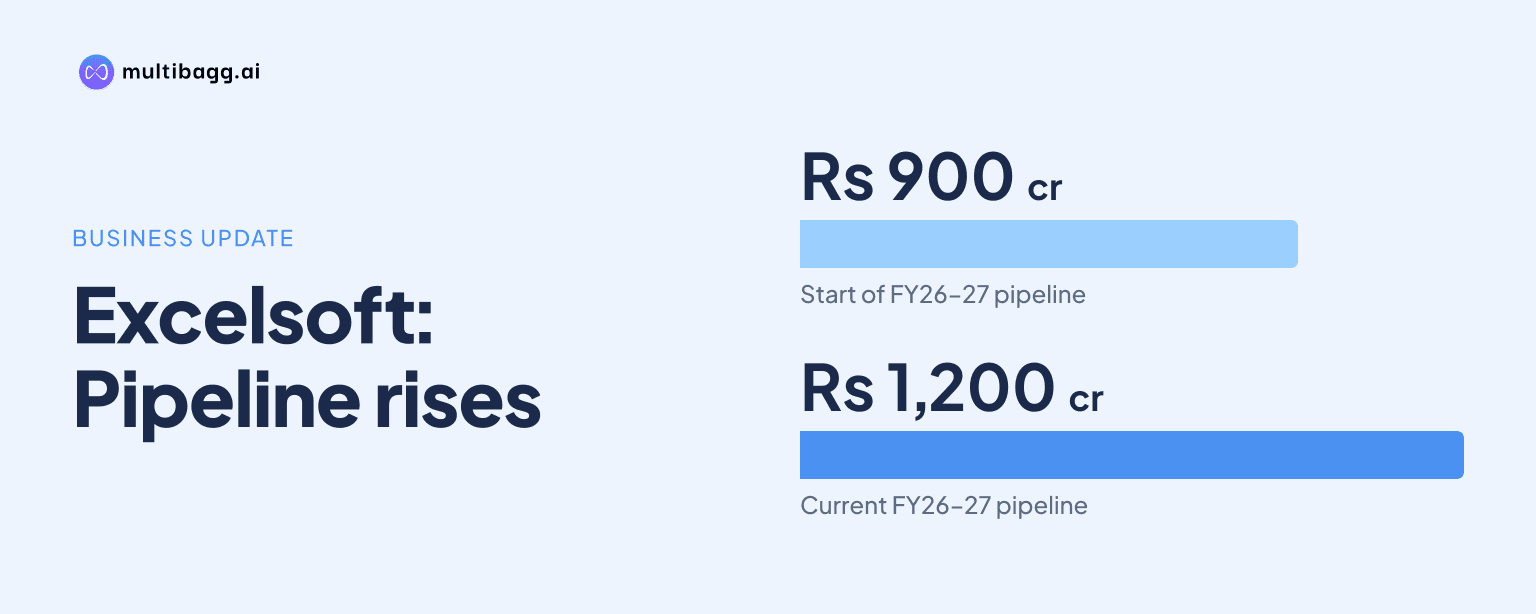
- Excelsoft's pipeline increased to about Rs 1,200 crore from about Rs 900 crore at the start of FY26-27.
powered by IRIS
Excelsoft Technologies Limited said AI-specific revenue could have a significant effect on its revenue mix within two quarters, after customer-centric AI work began in the current quarter and automated marking for AQA reached 98.6% accuracy on several thousand handwritten answer scripts. The company did not disclose a separate AI revenue target.
Know Excelsoft Technologies inside out
Results, valuation, peers and who's buying, in one view.
When will Excelsoft see meaningful AI revenue?
Excelsoft said a significant AI-specific revenue impact should emerge one quarter after the current quarter, indicating a two-quarter timeframe from the earnings call. Management said customer-centric AI work is already under way in the quarter being run, which should increase AI revenue as a percentage of total revenue before a more significant effect in the following quarter.
The timetable is an expectation about commercialisation rather than evidence of a completed broad rollout. Excelsoft is working on AI-enabled assessment, item banking, content generation and learning solutions, while also exploring AI-powered offerings for the mid-market. Management said these initiatives require continued product engineering, specialised talent and customer pilots, and that commercial success depends on turning pilots into deployments and repeatable products.
How advanced is Excelsoft's AQA automation work?
Excelsoft said its automated marking achieved 98.6% accuracy on several thousand handwritten AQA answer scripts. Management described e-marking as an important advance because marking in the AQA engagement needs to be largely automated. It did not disclose the exact number of scripts, the subjects tested or the revenue associated with the automated-marking work.
Excelsoft is now focused on extracting handwriting into machine-readable text, which management called the second phase of the AQA work. The company said the effort spans subjects and languages and that it had held several workshops with AQA's examinations team in the United Kingdom. Management added that 14 AQA team members had recently visited to examine the technology, while transcription remains the next stated operational step.
What financial capacity does Excelsoft have for development?
Excelsoft reported Q2 FY27 revenue from operations of Rs 80.9 crore, up 25.2% from Rs 64.6 crore in Q2 FY26, while earnings before interest, tax, depreciation and amortisation, or EBITDA, fell to Rs 13.2 crore from Rs 18.8 crore. The EBITDA margin declined to 16.35% from 29.3% as the company increased spending on sales, leadership, talent and product development.
For H1 FY27, revenue rose 33.9% to Rs 161.2 crore, but EBITDA declined to Rs 26.3 crore from Rs 28.9 crore; profit after tax increased 6.2% to Rs 17.5 crore from Rs 16.5 crore. Excelsoft said FY27 strategic investment was about Rs 20.3 crore across sales expansion, leadership, talent development and product development. It also reported about Rs 407 crore of cash and bank balances and H1 operating cash flow of Rs 34.7 crore.
Got a follow-up? Ask IRIS
Why did Excelsoft's EBITDA margin decline?
Excelsoft attributed the Q2 FY27 margin movement to investment in sales teams, training, international expansion and delivery capacity, rather than to a stated demand shortfall. Employee costs included international sales hires, leadership appointments, specialised talent, annual salary increases and statutory contributions after labour-law changes. Other expenses included consultants supporting project delivery in the United States and United Kingdom, plus provisions for expected credit losses.
Management said it was reviewing resource utilisation, consultant deployment and project-level profitability to improve operating efficiency. It expects EBITDA margin to reach 22% to 25% after investments begin producing results and said this could happen over the next couple of quarters. This is management's expectation, while the reported Q2 FY27 margin was 16.35%; it also said UK and US hiring targets, including consultants, were largely complete.
What must Excelsoft convert to generate AI growth?
Excelsoft must convert AI pilots and new-product development into signed orders, deployments and repeatable products. Management listed this conversion as a priority alongside improving implementation readiness, user acceptance testing, or UAT, coordination and customer sign-off. It said revenue recognition had been deferred in some cases because of customer-side delays, security clearances, implementation readiness, acceptance and delivery milestones.
Excelsoft said its overall pipeline rose to about Rs 1,200 crore after six months from about Rs 900 crore at the start of FY26-27. Management said some opportunities remained in final negotiations, meaning the pipeline should not be regarded as contracted revenue. It expects the United Kingdom and Europe, the United States and Southeast Asia to contribute growth this year, while Middle East growth was lower over the previous year.
How do other deployments support Excelsoft's plan?
Excelsoft said its VTCT engagement went live in September with about 500 tests, followed by roughly 25,000 tests in October. Management expects about 30,000 assessments a month, so October volume was nearing that operational level. The VTCT deployment is separate from the AQA automation programme but illustrates the company's wider assessment and testing activity.
Excelsoft also sent assessment-in-a-box devices for proof-of-concept testing to customers in Africa, the United Kingdom and Scotland. Management said orders could follow after testing and integration, but did not identify customers or give an order value. The palm-sized devices can host the assessment software stack, connect to 200 devices concurrently and deliver examinations, according to management.
Conclusion
Excelsoft's AI commercialisation case is based on customer-specific work already under way and measurable progress in one AQA assessment workflow. The 98.6% result on several thousand handwritten scripts indicates advancement in automated marking, while management's two-quarter timeframe signals when it expects AI revenue to become more visible within the total revenue mix. Revenue grew 25.2% in Q2 FY27, although EBITDA margin fell to 16.35% as investment costs increased.
The next disclosures to watch are whether AI pilots convert into deployable products, whether AQA handwriting extraction progresses, and whether UAT and customer sign-off reduce billing delays. Management said it remains on track for a Rs 350 crore FY27 top line and expects EBITDA margin of 22% to 25% in the next couple of quarters. The Rs 1,200 crore pipeline provides potential demand, but management said it includes opportunities that are not contracted revenue.