










Excelsoft Targets Below 25%-30% Concentration in Five Years
Key highlights
- Excelsoft said its top five customers account for about 75% of business.
- Management aims to reduce customer concentration below 25%-30% over five years.
- Q2 FY27 revenue rose 25.2% year on year to Rs 80.9 crore.
- Excelsoft's pipeline rose from about Rs 900 crore to about Rs 1,200 crore in six months.
powered by IRIS
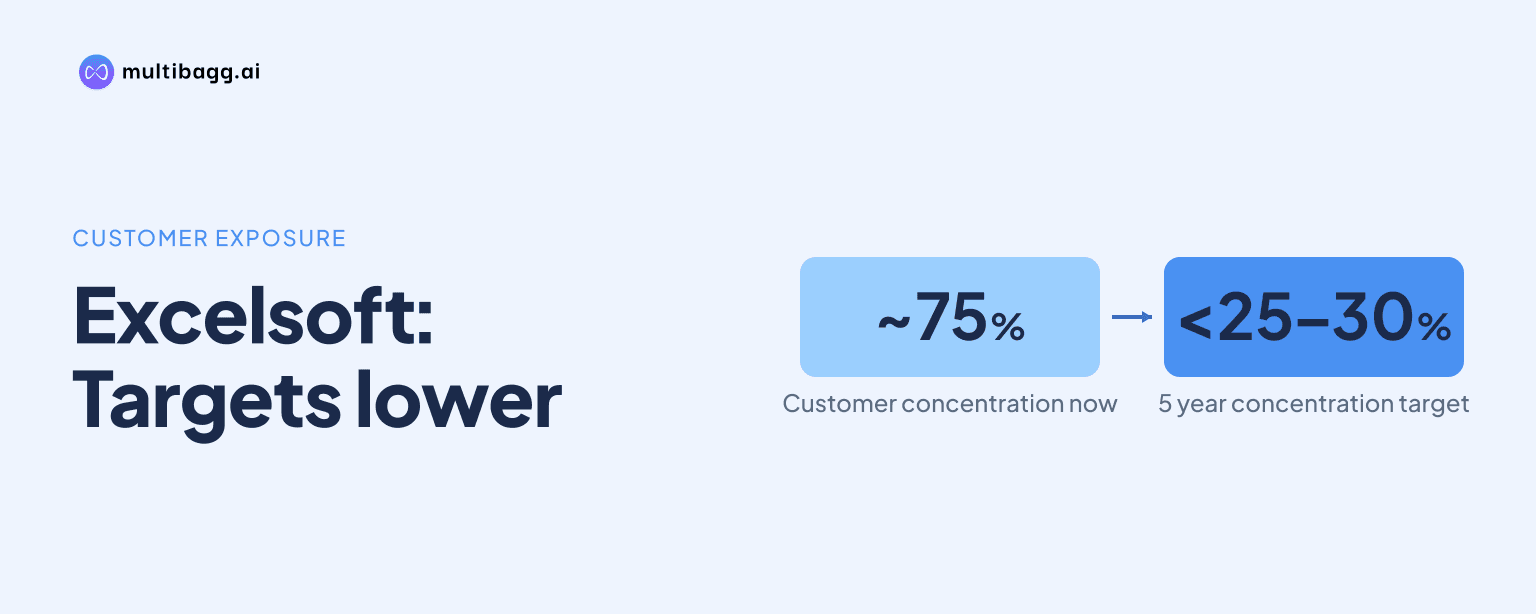
In its FY27 earnings call, Excelsoft Technologies said management plans within five years to reduce the customer-concentration measure it discussed to below 25%-30%, from about 75% of business currently generated by its top five customers. The plan relies on new accounts, geographic expansion and growth in smaller customer relationships.
Know Excelsoft Technologies inside out
Results, valuation, peers and who's buying, in one view.
What is Excelsoft's customer concentration target?
Excelsoft's stated plan is to reduce customer concentration to less than 25%-30% over five years after acknowledging that its top five customers contribute about 75% of business. Management said it is adding customers and expanding across geographies beyond the US, and hoped that some movement in the concentration profile could be visible in the coming year. It did not provide a numerical target for the first year.
Excelsoft's chairman separately said the company would not want any one customer to represent more than about 20% of revenue. Management did not specify whether the five-year 25%-30% objective applies to the top-five group, an individual customer or another measure. The only current concentration figure disclosed on the call was the approximately 75% contribution from the top five customers.
Why does Excelsoft view its largest-customer risk differently?
Excelsoft said one large customer consists of multiple business divisions, each with its own managing director and profit-and-loss responsibility. The company works with several divisions, and management said decisions are taken division by division rather than centrally across the whole group. Management therefore described the prospect of losing all, or a significant number, of those divisions as remote.
That operating structure does not alter the reported 75% top-five concentration, which management accepted requires action. Excelsoft said its work on customers' core products can make it a preferred participant in later product development or system-integration work. This was management's view of account stickiness, not a disclosed renewal rate or contractual protection against pricing negotiations.
How will Excelsoft diversify its customer base?
Excelsoft plans to add accounts, widen geographic coverage and develop customers that currently contribute relatively little revenue. Management identified AQA as a large win and also named British Council and Ascentis among customers, while saying other new accounts were coming up. It said some smaller customers could generate 10 times to 20 times their current business, but did not name all of them during the call.
The geographic programme prioritises the US and UK, where Excelsoft said it is investing disproportionately. Management expects higher FY27 growth from the UK and Europe, followed by the US and Southeast Asia, while saying the Middle East had not been a favourable growth market over the prior year. The company has hired sales teams in the UK and US and said target hiring there was largely complete.
Excelsoft is also pursuing institutional channels and product integrations. Its proctoring business won a University of Memphis contract, which management called an important entry point in the US, and it has integrated with D2L, Blackboard and Canvas learning-management systems. In Tennessee, it started with one college and was engaged with three more in a system with 43 colleges, although management did not treat those opportunities as contracted revenue.
Got a follow-up? Ask IRIS
What do Excelsoft's FY27 results show about diversification?
Excelsoft reported Q2 FY27 revenue from operations of Rs 80.9 crore, up 25.2% from Rs 64.6 crore in Q2 FY26. Education technology services provided 60.75% of Q2 revenue and grew 41.9% year on year, while product business contributed the remaining 39.25%. The faster-growing services segment was therefore also the larger part of quarterly revenue.
For H1 FY27, revenue rose 33.9% to Rs 161.2 crore, while profit after tax increased 6.2% to Rs 17.5 crore. Earnings before interest, tax, depreciation and amortisation, or EBITDA, fell to Rs 26.3 crore from Rs 28.9 crore. Management attributed the cost increase to international sales teams, leadership and specialist hiring, delivery consultants, US and UK expansion, and expected-credit-loss provisions.
Excelsoft said it had invested about Rs 20.3 crore during FY27 in sales expansion, leadership, talent and product development. Management expects EBITDA margin to reach 22%-25% when these investments begin to yield results, compared with 16.35% in Q2 FY27 and 29.3% a year earlier. That expectation is management guidance rather than a reported outcome.
What could delay Excelsoft's concentration plan?
Excelsoft said its pipeline increased from about Rs 900 crore at the start of FY26-27 to about Rs 1,200 crore after six months. Management tracks the pipeline over roughly five years and said some opportunities remain in final negotiations. A broader pipeline may support customer additions across markets, but it is not the same as signed orders, delivered work or recognised revenue.
Management confirmed that Excelsoft remains on track for Rs 350 crore of revenue by the end of FY27 and said 20%-25% of growth should come from existing contracts where its teams have been deployed. That existing-contract contribution can support the revenue target, but the call did not disclose the revenue share of each top-five customer or a schedule for reducing their combined 75% contribution.
Billing timing is another execution factor. Excelsoft said some revenue recognition was deferred because of customer-side delays, user acceptance testing, security clearances, implementation readiness, acceptance and delivery milestones. It reported H1 FY27 operating cash flow of Rs 34.7 crore and cash and bank balances of about Rs 407 crore, with no borrowings, while saying it is improving project governance and customer coordination.
Conclusion
Excelsoft has acknowledged that its top five customers account for about 75% of business and set a five-year ambition to lower concentration below 25%-30%. The route combines new customer wins, overseas sales investment, institutional proctoring channels and products that could be deployed across a wider customer base, while FY27 revenue reached Rs 161.2 crore in the first half.
The next disclosures to watch are whether concentration changes emerge in the coming year, progress toward the Rs 350 crore FY27 revenue target, and conversion of the Rs 1,200 crore pipeline into signed business and billing. Management also expects AI-specific revenue to become a larger portion of total revenue over two quarters, subject to customer work, pilots and commercial deployments.