










Excelsoft targets 22%-25% EBITDA margin after expansion
Key highlights
- Q2 FY27 revenue rose 25.2% year on year to Rs 80.9 crore, while EBITDA margin fell to 16.35% from 29.3%.
- Excelsoft management targets a sustainable EBITDA margin of 22%-25% within the next couple of quarters.
- FY27 strategic investment in sales expansion, leadership, talent and product development totals about Rs 20.3 crore.
- Excelsoft's pipeline increased to about Rs 1,200 crore from about Rs 900 crore at the start of FY27.
powered by IRIS
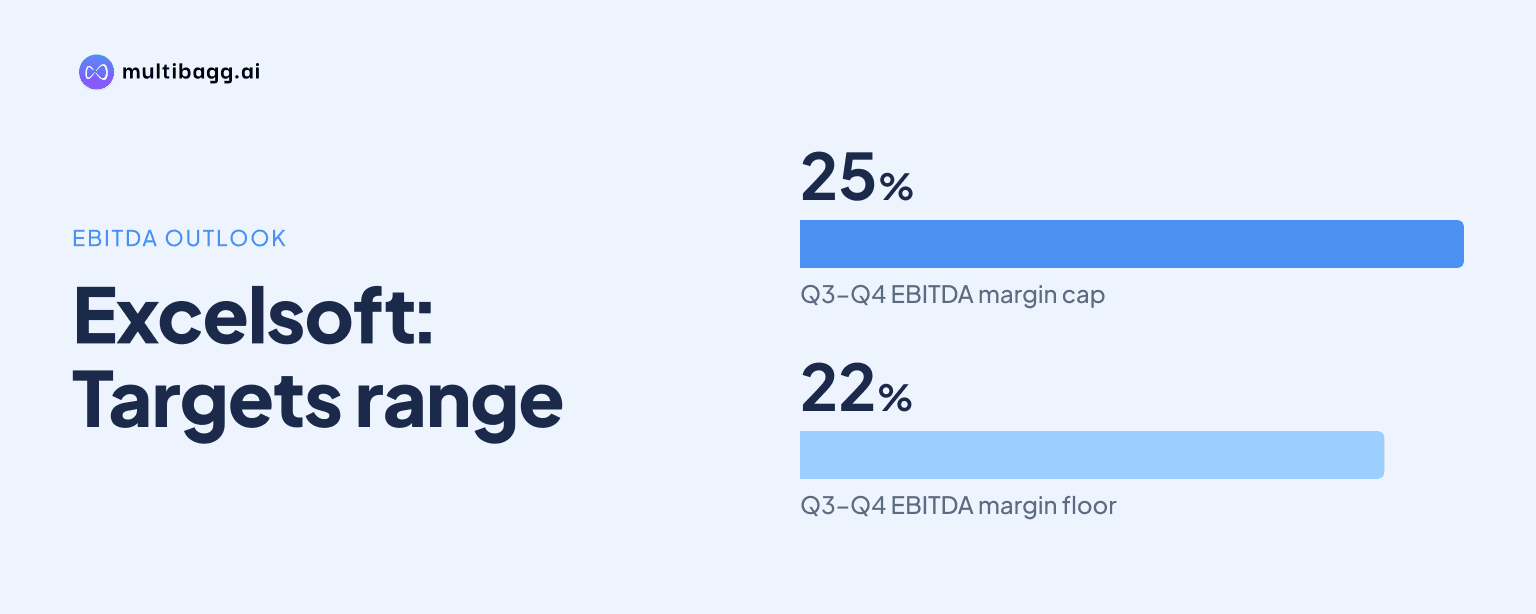
Excelsoft Technologies Limited said it expects EBITDA margin to recover to a sustainable 22%-25% within the next couple of quarters, after Q2 FY27 margin fell to 16.35% from 29.3% a year earlier as it spent Rs 20.3 crore on sales expansion, leadership, talent and product development.
Know Excelsoft Technologies inside out
Results, valuation, peers and who's buying, in one view.
Why did Excelsoft's EBITDA margin fall in Q2 FY27?
Excelsoft's EBITDA margin fell because international sales, leadership and specialist hiring costs were charged immediately while the related revenue is expected to build over time. Earnings before interest, tax, depreciation and amortisation, or EBITDA, declined to Rs 13.2 crore in Q2 FY27 from Rs 18.8 crore in Q2 FY26, even as revenue from operations rose 25.2% to Rs 80.9 crore.
Management said the additional employee expense included international sales teams, leadership, specialised talent, recruitment, annual salary increases and statutory contributions following labour-law changes. Consultant expenses also increased to support project delivery and business expansion in the US and UK, while the company recorded some provisions for expected credit losses. Management attributed the decline to investment and said there was no structural change in the margin profile.
The comparison shows that revenue increased by Rs 16.3 crore year on year, but EBITDA decreased by Rs 5.6 crore and profit after tax fell by Rs 2.3 crore. Management also cited customer-side user acceptance testing, security clearances, implementation readiness and delivery milestones that deferred revenue recognition in some cases, creating a timing mismatch between incurred costs and billing.
What margin does Excelsoft expect after its expansion spending?
Excelsoft expects EBITDA margin of 22%-25% once the investments begin to yield revenue, and management said this range could be reached in the next couple of quarters. In response to investor questions, management described 22%-25% as the sustainable margin range rather than a one-quarter outcome, while noting that expansion spending would continue in selected markets.
The company said it has made about Rs 20.3 crore of FY27 strategic investment in sales expansion, leadership, talent development and product development. This spending supports its effort to strengthen US and UK customer engagement, where management sees larger technology programmes, government-related assessment projects, university platforms and longer-term customer relationships.
Management said most targeted UK and US hiring, including consultants, was largely complete, although it still expects hiring in the Middle East and has already hired in Singapore. It also said it has no intention of adding more people in India, while consultant costs added over the prior two to three quarters are expected to remain constant. Those comments indicate that the company expects the present cost step-up to moderate, although management did not provide quarterly expense guidance.
Excelsoft reported Rs 407 crore in cash and bank balances with no borrowings, and half-year operating cash flow of Rs 34.7 crore. Management said this financial position gives it flexibility to fund the expansion, but the margin target depends on sales teams converting opportunities and projects moving through acceptance and billing.
Got a follow-up? Ask IRIS
Which revenue and pipeline trends could support Excelsoft's margin recovery?
Excelsoft's revenue growth and enlarged pipeline are the principal operating factors management expects to support margin recovery. H1 FY27 revenue increased 33.9% to Rs 161.2 crore from Rs 120.3 crore in H1 FY26, while EBITDA was Rs 26.3 crore compared with Rs 28.9 crore, showing that the first-half revenue gain did not yet offset the cost of expansion.
Education technology services contributed 60.75% of Q2 FY27 revenue and grew 41.9% year on year, with the product business accounting for the remaining 39.25%. Management said it is pursuing platform-led work in assessment and examination systems, e-marking, digital evaluation, online proctoring, learning management, student success and AI-enabled solutions, with the aim of creating recurring or repeat business where contract structures permit.
The pipeline rose to about Rs 1,200 crore in the first six months of FY27 from about Rs 900 crore at the start of the year, a rise of about Rs 300 crore. Management said the company tracks its pipeline over roughly five years and that some opportunities remain in final negotiations, so the pipeline is not the same as contracted revenue. It attributed a meaningful part of pipeline growth and wider geographic diversity to local sales and account-management teams.
Management said 20%-25% of future growth should come from existing contracts where near-shore, global-sales and AI capabilities have been deployed. It also reaffirmed that Excelsoft remains on track for Rs 350 crore of revenue by the end of FY27, a management target that will require continued conversion of the pipeline into delivery and recognised revenue.
What could delay Excelsoft's margin recovery?
Excelsoft's margin recovery could be delayed if customer acceptance and enterprise-sales conversion take longer than management expects. The AQA e-marking programme is progressing in phases, but customer-side user acceptance testing has delayed elements of implementation, and the company said revenue can be deferred until acceptance, security clearance, readiness and delivery milestones are met.
Management said enterprise sales typically require three to four months for conversion, followed by another three to six months, or in some cases up to eight months, for deployment. That cycle means costs of sales teams appear before revenue contribution, particularly in the US and UK where Excelsoft is investing disproportionately. The company is responding by improving project governance, customer coordination, implementation readiness and sign-off processes.
Customer concentration remains another execution issue. Management acknowledged that roughly 75% of revenue comes from its top five customers and said it has a five-year plan to bring concentration below 25%-30%, while also expressing an aspiration that no customer account for more than about 20% of revenue. Management added that one major customer contains multiple independently managed business divisions, but the concentration measure remains relevant to diversification plans.
New offerings are also not yet assured revenue contributors. Excelsoft has shipped a few assessment-in-a-box devices for proof-of-concept testing in locations including Africa, the UK and Scotland, while AI offerings require pilots to convert into deployments and repeatable products. Management said significant AI revenue impact could take one more quarter after the quarter under way, rather than treating prototypes and pilots as booked revenue.
Conclusion
Excelsoft's Q2 FY27 margin compression occurred alongside revenue growth, not a reported fall in demand: revenue rose to Rs 80.9 crore while EBITDA margin declined to 16.35% from 29.3%. Management links the difference to upfront international sales, leadership, specialist-talent and consultant costs, plus deferred revenue caused by customer acceptance and readiness processes. Its stated 22%-25% sustainable EBITDA margin range depends on those investments producing recognised revenue.
The next indicators are conversion of the Rs 1,200 crore pipeline, progress in AQA implementation and reduction of delays between delivery, acceptance and billing. Investors can also watch management's FY27 Rs 350 crore revenue target, its expectation that UK, Europe, the US and Southeast Asia will contribute growth, and its plan to reduce top-five customer concentration below 25%-30% over five years.