








Fidel Softech Limited approves Softenger deal adding ₹200 crore revenue
MAX Plan at ₹4,999/yr

Find your next multibaggerBe a Pro Investor
Research stocks and track your picks on the go. Download the app.
Key highlights
- Fidel Softech approved a proposed Softenger transaction that management said could add about ₹200 crore of annual revenue.
- Softenger brings more than 60 enterprise customers and around 1,200 skilled professionals.
- Management said the combined group could have indicated annualised revenue exceeding ₹350 crore, subject to completion.
- Management put Softenger’s current operating margin at around 5.5%.
powered by IRIS
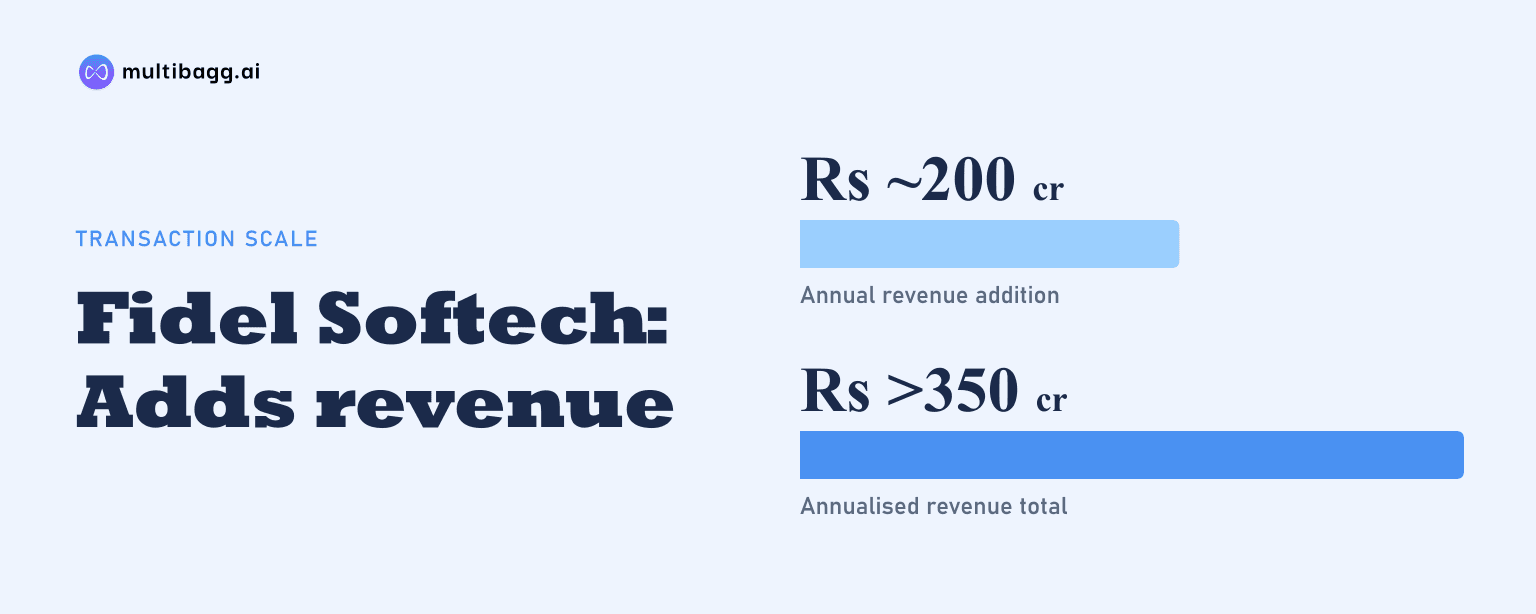
Fidel Softech Limited has approved a proposed acquisition of Softenger that, subject to completion conditions, could add about ₹200 crore of annual revenue, more than 60 enterprise customers and around 1,200 professionals. Management said the combination could lift Fidel Softech’s indicated annualised revenue above ₹350 crore and establish operations in Singapore, Malaysia and Dubai.
Know Fidel Softech inside out
Results, valuation, peers and who's buying, in one view.
What has Fidel Softech approved?
Fidel Softech has approved the proposed acquisition of Softenger Private Limited, its subsidiaries and a related company, subject to applicable requirements and completion conditions. Chairman and Chief Executive Officer Sunil Kulkarni described Softenger as a managed IT infrastructure and technology services business with about 27 years of operating history, spanning India, Singapore, Malaysia and Dubai.
Management said Softenger brings approximately ₹200 crore of annual revenue, more than 60 enterprise customer relationships and around 1,200 skilled professionals. Its customers include Japanese enterprises, banks, financial institutions, capital-market organisations, telecommunications companies, system integrators and insurers, while Fidel Softech’s existing managed IT unit generated about ₹10 crore to ₹15 crore of revenue.
How would Softenger change Fidel Softech’s scale?
Softenger would move Fidel Softech closer to management’s aspiration of ₹500 crore in annual revenue within five years. Management said Fidel Softech had annual revenue of about ₹25 crore four years ago and crossed ₹100 crore for the first time in the previous financial year; the proposed combination could take the group’s indicated annualised revenue beyond ₹350 crore.
Fidel Softech’s reported first-half revenue was ₹75.91 crore, compared with Softenger’s approximately ₹200 crore in the latest full year discussed on the call. Management also said Softenger recorded unaudited revenue of around ₹120 crore to ₹125 crore in H1, after about ₹157 crore to ₹160 crore in the preceding year, indicating a higher current revenue run rate.
Management said Softenger had previously projected revenue of about ₹300 crore in three to four years. It also cited a plan to move Softenger’s earnings before interest, tax, depreciation and amortisation, or EBITDA, margin from around 10% to 11% to around 14% to 15%, while cautioning that these were plans rather than forecasts.
Why does Fidel Softech want Softenger’s overseas operations?
Fidel Softech wants Softenger for its enterprise access, managed IT capabilities and operating presence across ASEAN, or the Association of Southeast Asian Nations, and the Middle East. Management said Fidel Softech had a long-established Japan presence and Indian delivery base but lacked local operations in ASEAN, despite requests from Japanese customers for support in the region.
Management plans to introduce Fidel Softech’s artificial intelligence, data analytics and language technology services to Softenger customers, while offering Softenger’s infrastructure, cybersecurity and managed operations to selected Japanese customers. It said Softenger’s Singapore and Malaysia customers include Japanese-linked organisations, where Fidel Softech’s Japanese-speaking engineers could support cross-selling.
Softenger adds managed infrastructure, cybersecurity, data-centre operations and enterprise IT support to Fidel Softech’s service portfolio. Management cited more than 100 subject-matter experts and over 500 certified engineers, and said many managed IT contracts run for one to three years even though several customer relationships have continued for more than 10 years.
Got a follow-up? Ask IRIS
Will the Softenger deal affect Fidel Softech’s margins?
Yes, management said Softenger’s managed IT operations have lower margins than some of Fidel Softech’s language technology and specialised consulting activities. Management put Softenger’s current operating margin at around 5.5% and said it does not expect that margin to immediately match the group’s higher-margin businesses.
Fidel Softech’s plan is to improve profitability through offshore and hybrid delivery, staff utilisation, automation and cross-selling higher-value services rather than an immediate price reset. Management illustrated that a 1 percentage-point operating-margin improvement on revenue of ₹300 crore to ₹400 crore would add roughly ₹3 crore to ₹4 crore of annual profit, but explicitly said this was not a forecast.
The company cited two existing efficiency measures during Q2 FY27: IM Corporation moved into Fidel Softech’s Japan office, and Fidel Softech replaced a third-party localisation enterprise resource planning system costing about ₹30 lakh annually with an internally developed, AI-assisted system. Management said these actions demonstrate the types of operational changes it expects to pursue across a larger group.
How will Fidel Softech fund and integrate Softenger?
Fidel Softech plans to preserve customer continuity and retain key Softenger management, with performance-linked incentives tied to future business results. Management identified employee retention, financial discipline, governance, financial reporting, working-capital control and operational improvement as priorities, given Softenger’s workforce of around 1,200 people compared with the roughly 300 people cited for Fidel Softech during the call.
An analyst referred to a proposed transaction value of about ₹38.5 crore, while management said the structure could combine cash and a share swap, with around ₹8 crore potentially settled through shares. Management said the remaining funding structure was under review during November and December and stressed that Fidel Softech did not want to overextend itself through additional debt.
Management described Softenger as having zero debt, apart from an overdraft facility of up to about ₹4 crore that was not utilised when discussed. Fidel Softech reported consolidated net cash of about ₹14 crore, while management said group debt following prior acquisitions appeared to be about ₹30 crore to ₹40 crore, with part of it serviced from IM Corporation’s cash flows.
Conclusion
The proposed Softenger transaction would substantially increase Fidel Softech’s scale, adding about ₹200 crore of annual revenue and a 1,200-person managed IT organisation to a business that reported ₹75.91 crore of revenue in H1 FY27. The trade-off is that the acquired operations have a lower current operating margin, making cross-selling, automation, utilisation and delivery integration central to management’s rationale.
The next development is the transaction’s completion and final funding structure, including the cash component and share swap. Management said it will develop its next financial-year business plan after progressing the deal, while Softenger’s own three-to-four-year plan envisaged about ₹300 crore of revenue and EBITDA margins of around 14% to 15%.

