








Fino targets Rs 2,000 crore first-year SFB disbursals

Find your next multibaggerBe a Pro Investor
Research stocks and track your picks on the go. Download the app.
Key highlights
- Fino targets about Rs 2,000 crore of loan disbursals in its first 12 months as a small finance bank.
- Fino's loan-referral disbursals reached Rs 1,390 crore in H1 FY27, up 2.5 times year on year.
- Fino reported Rs 2,794 crore of deposits in Q2 FY27, with CASA contributing about 52% of total revenue.
- Fino expects Rs 120 crore to Rs 150 crore of transition capital expenditure over the next 12 to 15 months.
powered by IRIS
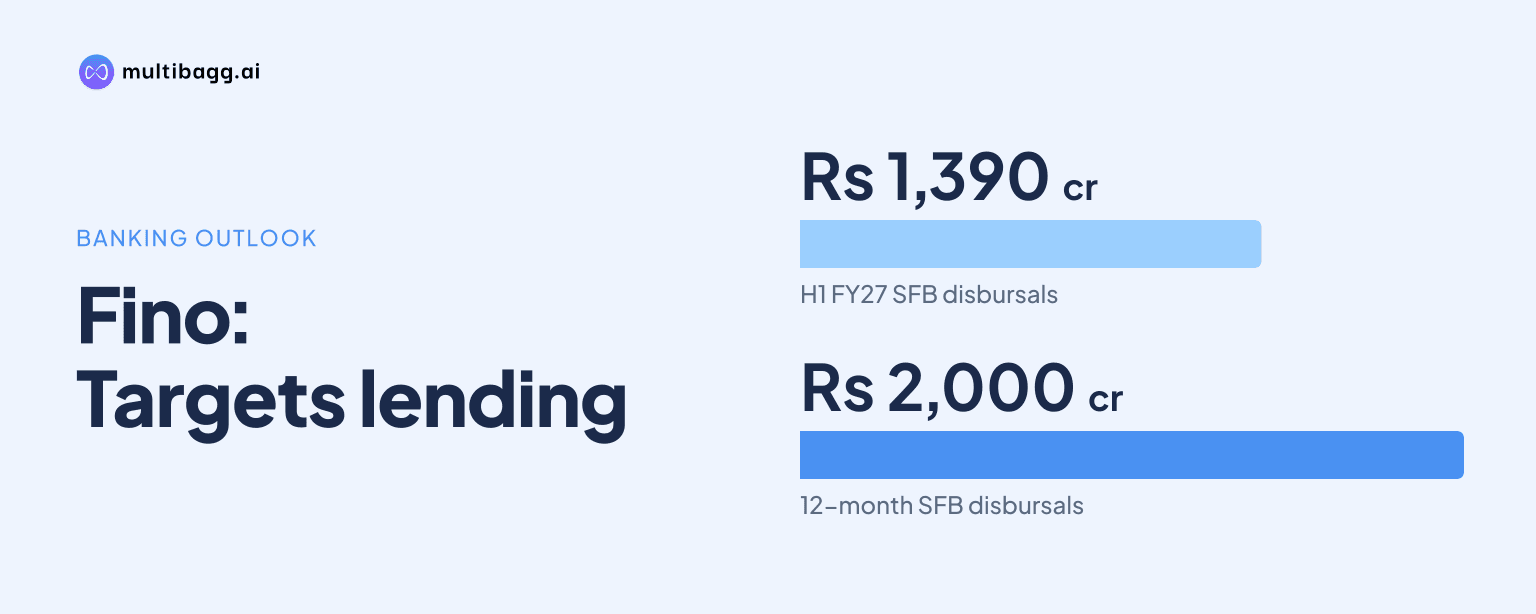
Fino is targeting about Rs 2,000 crore of predominantly secured loan disbursals in its first 12 months as a small finance bank, following Rs 1,390 crore of loan-referral disbursals in H1 FY27. Management said the initial target is intended to test underwriting guardrails, processes and sourcing before it seeks to scale the loan book.
Know Fino Payments Bank inside out
Results, valuation, peers and who's buying, in one view.
What is Fino's first-year SFB lending target?
Fino is targeting about Rs 2,000 crore of loan disbursals in its first 12 months of small finance bank operations, which management is tracking for Q1 FY28 subject to the Reserve Bank of India process. Management described this as a realistic initial target because own lending will require the bank to test the controls and processes it has built.
The target follows Rs 1,390 crore of loan-referral disbursals in H1 FY27, up 2.5 times from a year earlier. Management said referrals were running at about Rs 250 crore a month and that three more quarters of referral activity will help determine whether the first-year target should be adjusted before launch.
The Rs 2,000 crore figure is a disbursal target, whereas the Rs 8,000 crore to Rs 10,000 crore figure is management's longer-term loan-book ambition over three to four years. The distinction matters because disbursals are loans originated during a period, while the loan book is the outstanding portfolio built over time.
Fino did not provide profitability guidance for FY27, which management called a transition year. In Q2 FY27, revenue was Rs 333.6 crore, up 9% sequentially but down 17% year on year, while earnings before interest, tax, depreciation and amortisation (EBITDA) were Rs 35.1 crore, compared with Rs 43.1 crore in Q1 FY27 and Rs 61.6 crore a year earlier.
How will Fino source and manage its secured loans?
Fino plans to focus on gold loans, affordable housing, loans against property and secured micro, small and medium enterprise lending. Management said lending during the initial three years will target its own customers and merchants, for whom it has three to four years of transaction behaviour and cash-flow history.
Fino currently refers borrowers to lending partners, which perform the underwriting. Management therefore said it could not assess reports of stress in gold loans from its own credit experience, although it said current growth in its target geographies had not produced scepticism from referral partners' underwriters.
The merchant network will remain a credit-sourcing channel after the transition, rather than Fino relying solely on branches. Management said the network that mobilises deposits can also source assets, while planned branches and asset centres will create additional physical infrastructure for lending.
Fino also plans to use its cash-management infrastructure in collections. Its cash-management system collects more than Rs 6,500 crore each month, and 60% of those collections are for non-banking financial companies, banks or microfinance institutions in rural India, where instalments are collected through merchant points.
Got a follow-up? Ask IRIS
What branch and technology investment is Fino planning?
Fino has about 125 branches and contact service points across India that management expects to convert into small finance bank branches. It also plans to open about 40 liability branches and 25 to 30 asset centres in the first year, with locations, geographies and districts identified and a branch plan expected by Q4 FY27.
Fino expects capital expenditure of Rs 120 crore to Rs 150 crore over the next 12 to 15 months, including the transition and first operating year as a small finance bank. Management said most spending will be on lending technology, including loan-origination, lending-management, collateral-management and non-performing asset systems, rather than branch infrastructure.
Fino plans to use its existing workforce of about 3,000 people and add staff for the asset vertical after receiving the final regulatory approval. Management also said it will exit the corporate business correspondent business as part of the transition plan before applying to the Reserve Bank of India, without disclosing a headcount addition or exit value.
The branch plan is also intended to broaden the liability franchise. Management said small finance bank status would remove the payments-bank Rs 2 lakh deposit limit and permit fixed and recurring deposits, although it did not quantify the additional deposits it expects from those products.
What funding base and operating trends support the transition?
Fino reported deposits of Rs 2,794 crore in Q2 FY27, up about 12%, while current and savings account (CASA) income contributed about 52% of total revenue. Management said 90% of deposit balances remained core balances and about 99% of those balances were savings-account deposits.
Management reported a 1.4% cost of funds on average deposits of about Rs 2,794 crore. It said its objective is to maintain a 250 to 300 basis-point difference versus peer banks, an aim that will depend on deposit behaviour as Fino expands its products and branch footprint.
The transaction business remains relevant to the planned asset-light model. Q2 FY27 net revenue was Rs 127.1 crore, up 3% sequentially but down 14% year on year, while net revenue margin was 38.1%, 100 basis points above the prior-year quarter but 450 basis points below Q1 FY27.
Throughput increased 4% sequentially to Rs 1.15 lakh crore in Q2 FY27, while cash-management-services throughput rose 12% year on year to about Rs 20,500 crore. Management said pricing competition in business-to-business alliances was reducing take rates, even as it sought to regain volumes and planned to resume its business-to-business person-to-merchant Unified Payments Interface service by Q4 FY27.
Conclusion
Fino's Rs 2,000 crore first-year disbursal target sets out a measured shift from loan referrals to own underwriting. The plan combines secured products, customer and merchant transaction data, merchant-led sourcing and existing collection infrastructure, while the Rs 1,390 crore of H1 FY27 referrals provides management with a current test of credit demand in its target segments.
The next points to watch are the Q4 FY27 branch-plan finalisation, the planned Q4 FY27 restart of the business-to-business person-to-merchant Unified Payments Interface service, and progress toward the targeted Q1 FY28 small finance bank launch. Management has also identified Rs 120 crore to Rs 150 crore of transition capital expenditure and three more quarters of referral data as inputs to its lending rollout.

