








Fino revenue falls 17% as B2B recalibration offsets recovery

Find your next multibaggerBe a Pro Investor
Research stocks and track your picks on the go. Download the app.
Key highlights
- Fino’s Q2 FY27 revenue was Rs 333.6 crore, down 17% year on year and up 9% sequentially.
- Fino reported Q2 FY27 EBITDA of Rs 35.1 crore, versus Rs 61.6 crore a year earlier and Rs 43.1 crore in Q1 FY27.
- Fino’s CMS throughput reached Rs 20,511 crore, up 13% sequentially and 12% year on year.
- Fino’s CASA segment generated Rs 174 crore, or 52% of Q2 FY27 revenue, while average deposits rose 12% to Rs 2,794 crore.
powered by IRIS
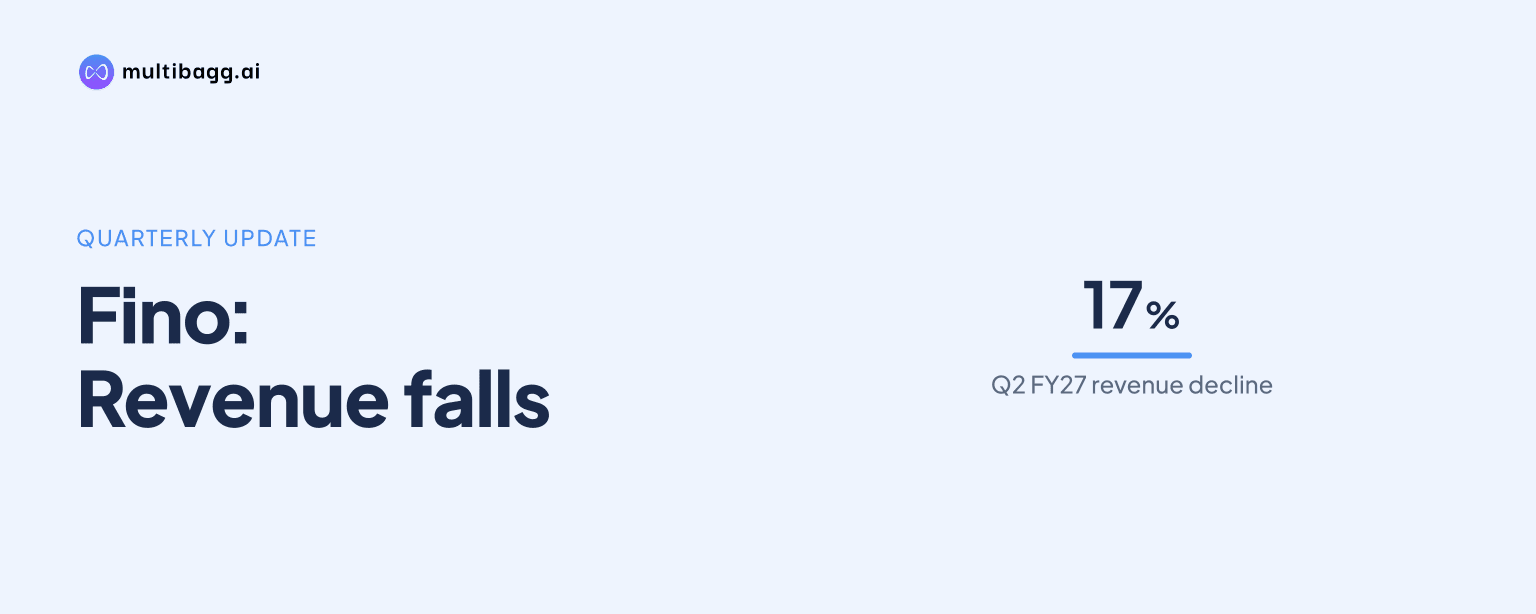
Fino Payments Bank Limited reported Q2 FY27 revenue of Rs 333.6 crore, down 17% year on year, because recalibration of its business-to-business person-to-merchant, or B2B P2M, activity outweighed recovery elsewhere. Revenue rose 9% sequentially, led by transaction, cash management services and current account savings account income, but EBITDA remained below both Q1 FY27 and the prior year.
Know Fino Payments Bank inside out
Results, valuation, peers and who's buying, in one view.
Why did Fino’s Q2 FY27 revenue fall year on year?
Fino’s Q2 FY27 revenue fell 17% year on year because of the B2B P2M recalibration, management said. Quarterly revenue was Rs 333.6 crore, while H1 FY27 revenue was about Rs 640 crore, down 25% year on year. Management said sequential growth across revenue verticals in Q2 reflected renewed engagement from merchants, business alliances and other associates.
The recovery followed reduced B2B and alliance activity in Q1 FY27, when management cited skepticism following an event. In Q2, Fino said it focused on regaining share in alliances and B2B operations. Total throughput increased 4% sequentially to Rs 1.15 lakh crore despite ecosystem changes, additional daily inquiries and competition in B2B alliances.
Fino plans to resume its Unified Payments Interface, or UPI, B2B P2M service in Q4 FY27. Management said it had prepared for the relaunch and was speaking with potential partners, but it would not provide guidance before there was clarity on merchant discount rate, or MDR, implementation.
How did Fino’s transaction and CMS businesses perform?
Fino’s traditional transaction and cash management services, or CMS, businesses regained volumes in Q2 FY27, although CMS pricing competition affected take rates. CMS throughput was Rs 20,511 crore, up 13% sequentially and 12% year on year. Management attributed the increase to relationships with non-banking financial companies, fintech companies, e-commerce businesses and other partners.
Aadhaar Enabled Payment System, or AEPS, activity recovered 50% sequentially and remittance activity rose 18%, supported by higher direct benefit transfer activity. Management said UPI continues to move small-ticket payments away from cash and cards. Fino introduced Cash@UPI, which allows cash withdrawals at a merchant point through a UPI-generated quick-response code.
The National Payments Corporation of India, or NPCI, also launched a three-party cash-deposit product with partner banks, including Fino, at the Global Fintech Festival 2026. The AEPS-backed service allows a customer to deposit cash into another person’s beneficiary account after know-your-customer verification and authentication. Management said Cash@UPI is fee-based and not linked to MDR, while the deposit product could support transaction volumes.
Did Fino’s CASA business improve revenue mix?
Fino’s current account savings account, or CASA, business contributed Rs 174 crore, or 52%, of Q2 FY27 revenue and included record renewal income of Rs 74.6 crore. This mix supported a net revenue margin of 38.1%, which was 100 basis points above the year-earlier level. Net revenue was Rs 127.1 crore, down 14% year on year but up 3% from Q1 FY27.
The margin was nevertheless 450 basis points below Q1 FY27, showing that the quarter’s revenue recovery did not produce a higher sequential net revenue margin. For H1 FY27, net revenue margin was 40.3%, compared with 35.2% a year earlier, a 500-basis-point increase that management linked to a higher CASA contribution.
Average total deposits increased 12% year on year to Rs 2,794 crore, and the CASA base reached 1.91 crore accounts in September 2026. Fino opened 8.2 lakh accounts during Q2 FY27. Digitally active customers numbered 64.9 lakh in September 2026 and 87.9 lakh during the full quarter.
Fino’s daily deposit plan is designed to build float balances rather than generate fees, management said. The product lets small vendors deposit daily amounts after business hours. Fino also plans a value savings account with non-banking financial companies and other CMS partners to acquire customers through a business-to-business-to-consumer model.
Got a follow-up? Ask IRIS
What happened to Fino’s profitability and costs?
Fino’s Q2 FY27 EBITDA, or earnings before interest, tax, depreciation and amortisation, was Rs 35.1 crore, compared with Rs 61.6 crore a year earlier and Rs 43.1 crore in Q1 FY27. EBITDA margin was 10.5%. The sequential decline in EBITDA came despite 9% sequential revenue growth as the company continued to invest in its Small Finance Bank transition.
Operating costs rose 5.8% year on year and 4.5% sequentially in Q2 FY27. H1 FY27 operating costs were about Rs 180 crore, up 1.6% year on year. The cost-to-income ratio improved to 27.6% in Q2 from 28.7% in Q1, while management said it was balancing cost control with spending on technology, talent, processes and governance.
Management said Q2 FY27 cost of funds was 1.4% and expects it to be around 4% after Small Finance Bank conversion. It also said 90% of deposits were core balances and that about 99% of current balances were savings-account deposits. Fino has more than 20 lakh merchants in its asset-light network, which it intends to use for liability gathering and future lending.
What is Fino’s plan for Small Finance Bank conversion?
Fino is tracking its stated plan to submit final readiness to the Reserve Bank of India and go live as a Small Finance Bank in Q1 FY28, although management said the regulator determines its own timelines. During Q2 FY27, Fino added four senior executives covering branch banking, liabilities, credit risk and micro, small and medium enterprise lending.
PricewaterhouseCoopers continues to support programme and operational readiness, according to management. Fino is developing technology, governance, risk and compliance capabilities for the transition. It already has about 125 branches and contact service points, and management plans approximately 40 liability branches and 25 to 30 asset centres in the first year of Small Finance Bank operations.
The planned lending model is secured and merchant-led. Loan-referral disbursals were Rs 762 crore in Q2 FY27, up 286% year on year, and Rs 1,390 crore in H1 FY27, exceeding Rs 1,285 crore for all of FY26. The referral pipeline covers gold loans, affordable housing, loans against property and secured MSME lending, while partner institutions currently conduct underwriting.
Conclusion
Fino’s Q2 FY27 results show that the sequential recovery in CMS, AEPS, remittances and CASA income did not yet offset the year-on-year effect of B2B P2M recalibration. Revenue increased 9% from Q1 to Rs 333.6 crore, but EBITDA declined to Rs 35.1 crore from Rs 43.1 crore in Q1 and Rs 61.6 crore a year earlier as the company absorbed transition-related investment.
The next disclosed operating milestone is the planned Q4 FY27 resumption of UPI B2B P2M services, subject to the broader MDR position. Management is also targeting Q1 FY28 for Small Finance Bank go-live, with a first-year plan for about 40 liability branches, 25 to 30 asset centres and approximately Rs 2,000 crore of secured disbursals over the first 12 to 15 months.

