










Finolex keeps production running despite Middle East disruption
Key highlights
- Finolex said production was not impacted after it re-established supply lines affected by Middle East disruption.
- Finolex said EDC and VCM are 100% imported into India.
- Finolex said its Q3 raw-material requirements were covered at costs broadly in line with existing inventory.
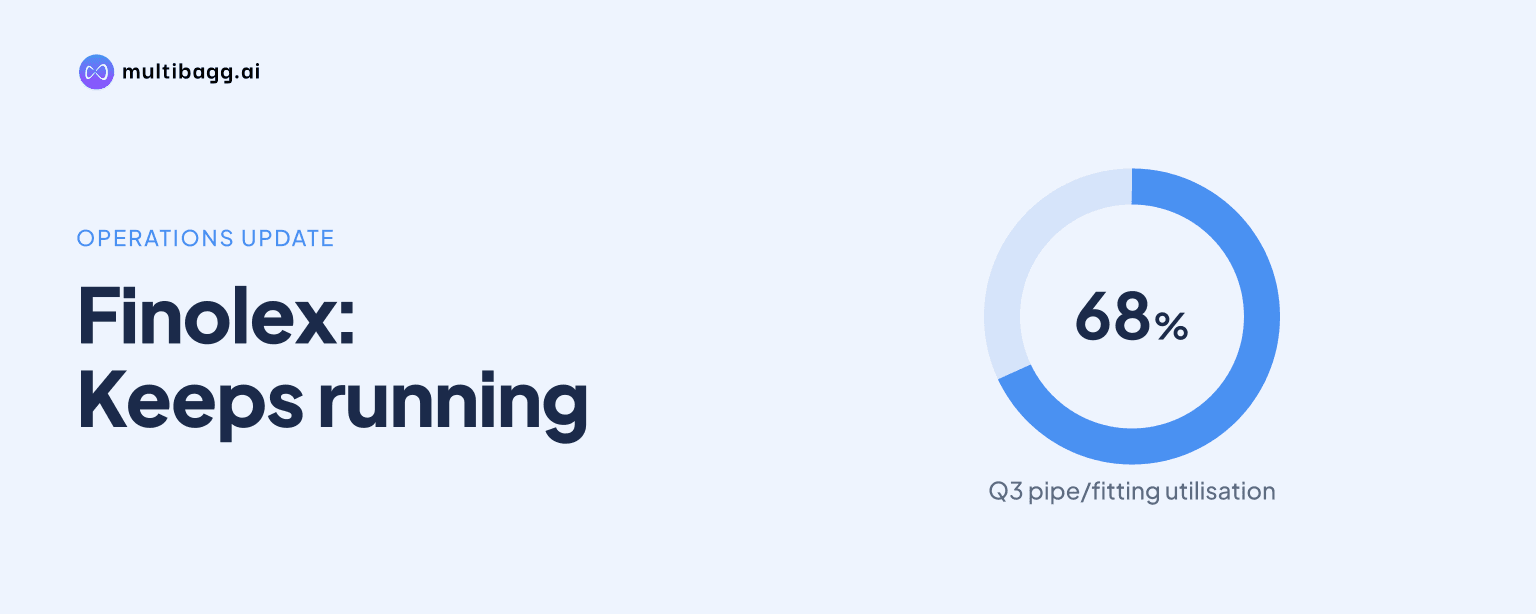
- Finolex reported 68% pipes and fittings utilisation during the quarter, while resin utilisation was otherwise full.
powered by IRIS
Finolex Industries Limited said its production was unaffected after Middle East disruption forced it to re-establish raw-material supply lines, and it had covered Q3 requirements; the company said EDC and VCM are 100% imported into India, making resin operations dependent on overseas availability, bookings and shipments.
Know Finolex Industries inside out
Results, valuation, peers and who's buying, in one view.
Has Finolex's production been affected by Middle East disruption?
No. Finolex said the Middle East situation had affected supply chains for crude oil, petrochemicals and downstream products, but its teams re-established supply lines from other parts so that production was not impacted. Management did not identify the replacement supply locations, the volume shifted, or any change in supplier mix.
The disclosure separates a supply-chain disruption from an operating interruption. Finolex confirmed that the regional situation had required action on raw-material procurement, while stating that factories continued to run. It did not disclose any lost production, shipment delay, additional freight expense, inventory days or plant shutdown linked to the Middle East disruption.
The company reported 68% overall utilisation in pipes and fittings during the quarter, while management said resin utilisation was otherwise full. This comparison indicates that the supply response was particularly relevant to the resin business, which uses ethylene dichloride, or EDC, and vinyl chloride monomer, or VCM, in its production lines.
Finolex also said the VCM resin-production line is traditionally non-operational during the monsoon because raw material is unavailable. Management described that seasonal pattern as structural and recurring each year, rather than a new consequence of the Middle East disruption. The distinction matters because the company attributed the current supply-chain response to geopolitical conditions but treated the monsoon VCM interruption separately.
Why does Finolex rely on overseas EDC and VCM supplies?
Finolex relies on overseas supply because management said EDC and VCM are 100% imported into India. The company did not disclose its sourcing split by country, supplier, shipping lane or contract duration, but the absence of domestic sourcing makes overseas availability and vessel execution material to resin operations.
Management said the geopolitical situation had changed shipping rates dramatically over time. It also said EDC, VCM and ethylene pricing depends on the region, availability, booking date and the ability to obtain shipments. This means Finolex's procurement exposure includes both the commodity quotation and the logistics needed to deliver the material.
Finolex said the United States looked more competitive for India despite its longer distance. Management presented that as an assessment of prevailing market conditions, rather than confirming a change in Finolex's own sourcing geography. The observation nevertheless shows that delivered cost and material availability can outweigh distance when the company evaluates imported EDC and VCM supplies.
In Q2, management cited an average PVC-EDC spread of USD 455 and a PVC-VCM spread of USD 171, based on ICIS international prices in Southeast Asia. Those separate spreads show that the economics can differ between EDC- and VCM-linked routes. Finolex did not disclose how much output came from each route during Q2 or the direct effect of the disruption on either spread.
Got a follow-up? Ask IRIS
Are Finolex's Q3 raw-material requirements covered?
Yes. Finolex said it was covered for its Q3 raw-material requirements, providing a disclosed near-term safeguard against an immediate production interruption. Management did not quantify Q3 volumes, specify the inventory cover behind that statement, or provide the duration of supply arrangements after the quarter.
Finolex did not say that its Q3 procurement cost would be lower than spot prices. Instead, management said the cost of booked material would be more or less in line with existing inventory pricing. It added that it had not seen much of a price spike at that point, although prices were slightly increasing.
This comparison is important because coverage and a cost advantage are different claims. Finolex described its latest booked consignment as broadly aligned with inventory cost rather than below it, while acknowledging that EDC, VCM and ethylene prices had moved up over the preceding weeks. The Q3 cover therefore addresses availability more directly than it establishes an improvement in input costs.
The disclosure does not resolve the position after Q3. Finolex did not provide a target for alternate-vendor capacity, a permanent sourcing shift, safety-stock levels or contracted freight rates. As a result, the company has reported continuity through Q3, but not longer-term insulation from overseas petrochemical or shipping disruption.
How could imported raw materials affect Finolex's costs and margins?
Finolex said its earnings before interest, tax, depreciation and amortisation, or EBITDA, margin for the first 6 months was in line with the prior-year period, with raw-material prices being the main factor in the discussion. An analyst referred to a 400-basis-point decline in Q2 margin, and management responded by emphasising the half-year comparison. One basis point equals one-hundredth of a percentage point.
The Q2 and first-6-month views therefore differed. Management did not provide a separate quantified explanation for the Q2 margin movement beyond raw-material prices, nor did it attribute the 400-basis-point figure specifically to freight. Its comments indicate that the cost of imported inputs remained central to profitability even as the half-year margin comparison was described as in line with the previous year.
Finolex also described a pricing and mix effect in pipes and fittings during Q2. Management said volume growth and revenue growth were both about 27% year on year despite higher PVC prices, citing product mix and market schemes or discounts. It said agricultural products accounted for 56% of the mix and non-agricultural products 44%.
Management said competitive schemes were used in both Q1 and Q2. That mechanism can limit the extent to which higher PVC or imported raw-material costs appear in revenue growth, because discounts can offset selling-price increases. Alongside the 68% pipes and fittings utilisation rate, the Q2 mix and scheme disclosures show that margins depend on selling conditions as well as the availability and cost of EDC and VCM.
Conclusion
Finolex has disclosed a clear import dependency: EDC and VCM are 100% imported into India, and Middle East disruption required the company to rebuild supply lines. Its immediate operating result was continuity, with no reported production impact and Q3 raw-material requirements covered, but the company did not quantify rerouted supply, freight costs or protection beyond the quarter.
The next scheduled disclosure is Finolex's Q3 results, which management said it expected to present in the next quarter. Readers should watch for updates on raw-material cover after Q3, overseas sourcing and shipping conditions, and whether input costs, competitive schemes and the 68% pipes and fittings utilisation rate affect volumes or margins.