










Finolex Industries Q2 volumes rise 28%, PBT slips to Rs 153 crore
Key highlights
- Finolex Industries' Q2 FY27 sales volume increased 28% year on year to 83,407 metric tons.
- Q2 FY27 revenue rose 27% to Rs 1,094 crore, while profit before tax declined to Rs 153 crore from Rs 158 crore.
- First-half FY27 volume fell 4% to 151,106 metric tons, but profit before tax rose 6% to Rs 300 crore.
- Finolex Industries reported net free cash flow of about Rs 2,584 crore as of September 30, 2026.
powered by IRIS
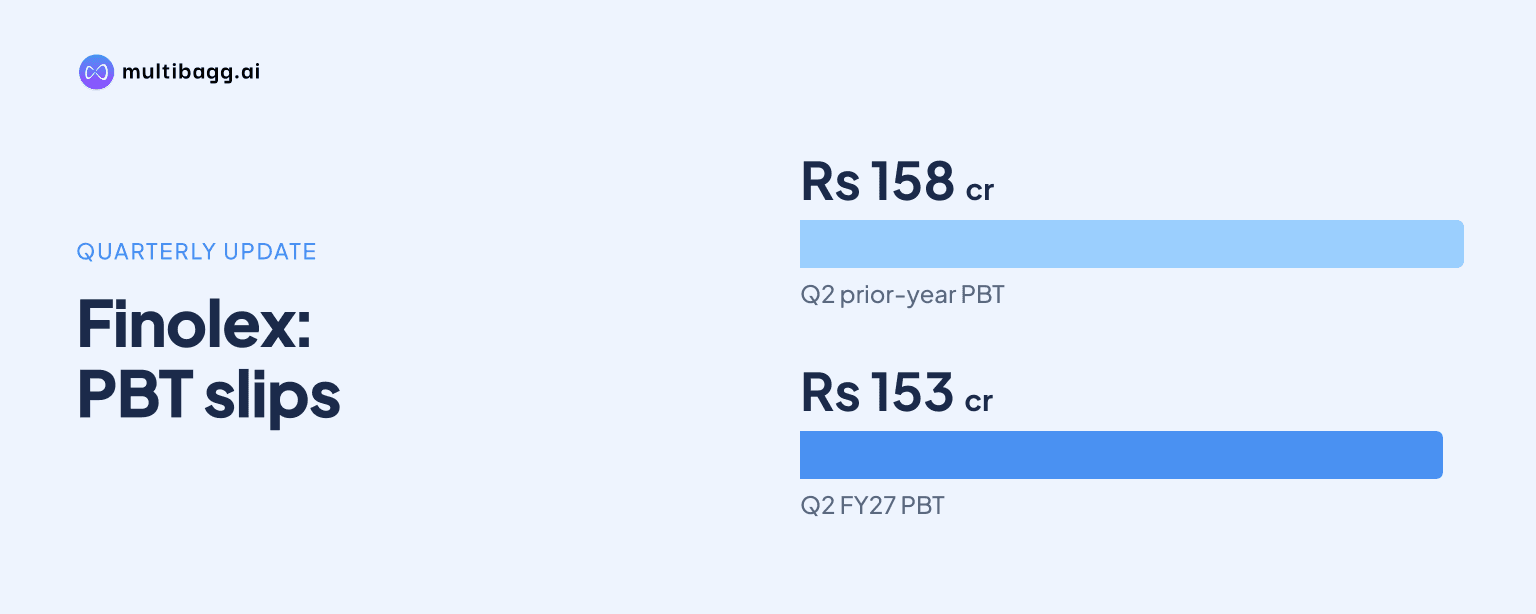
Finolex Industries Limited increased sales volume 28% year on year to 83,407 metric tons in Q2 FY27, but profit before tax was Rs 153 crore, below Rs 158 crore a year earlier, because higher-cost raw-material inventory bought in Q1 was consumed in the quarter. Revenue rose 27% to Rs 1,094 crore.
Know Finolex Industries inside out
Results, valuation, peers and who's buying, in one view.
Why did Finolex Industries' profit not rise with Q2 volumes?
Finolex Industries' Q2 profit before tax fell by Rs 5 crore year on year because sales-price changes were immediate while the effect of raw-material purchases reached production later. Management said raw-material prices began rising at the start of Q1 FY27, when lower-cost inventory was still being used. Inventory subsequently procured at higher prices in Q1 was consumed during Q2, putting pressure on margins.
The timing difference meant that the 28% sales-volume increase to 83,407 metric tons did not translate into higher quarterly profit. Revenue from operations rose 27% to Rs 1,094 crore, broadly matching volume growth, while profit before tax was Rs 153 crore against Rs 158 crore in Q2 FY26. Management described quarterly profitability as more or less flat despite the lower reported comparison.
What caused Finolex Industries' Q2 volume recovery?
Finolex Industries said easing channel destocking and a steadier polyvinyl chloride, or PVC, pricing environment drove the Q2 recovery. The company said price-led destocking had disrupted demand in Q1 FY27, while restocking occurred across the organised pipe industry in Q2. The rebound came in a quarter that management described as seasonally softer for PVC pipes because agricultural demand moderates during monsoon months.
PVC prices rose in Q2 FY27, but management said volatility was lower than in Q1. It cited the introduction of a minimum import price for suspension-grade PVC resin as one reason prices stabilised at a somewhat better level. Management also said geopolitical developments in West Asia remained uncertain and could affect raw-material and PVC supplies.
The Q2 increase did not fully offset the first-quarter decline. First-half FY27 volume was 151,106 metric tons, down 4% from 157,465 metric tons in the prior-year first half. Management said the stronger second quarter had largely made up for the weak first quarter, but not to the full extent.
How did Finolex Industries perform in the first half?
Finolex Industries reported first-half FY27 revenue from operations of Rs 1,978 crore, up 4% year on year, while profit before tax rose 6% to Rs 300 crore from Rs 284 crore. Management attributed revenue growth mainly to Q2 volume recovery and slightly better realisations in Q2. All figures discussed on the call were standalone unless management stated otherwise.
The first-half comparison differed from the Q2 comparison: profit before tax rose Rs 16 crore in the half year even though it declined Rs 5 crore in the second quarter. The difference reflects a period that included Q1 and Q2, while management specifically identified consumption of higher-cost Q1 inventory as a Q2 margin issue. Volume nevertheless remained 4% lower for the half year.
Finolex Industries reported net free cash flow of about Rs 2,584 crore as of September 30, 2026. Management said planned FY27 capital expenditure was roughly Rs 150 crore, including routine maintenance and debottlenecking work. It said first-half capital expenditure had been about Rs 36 crore to Rs 37 crore.
Got a follow-up? Ask IRIS
What is Finolex Industries' outlook for demand and margins?
Finolex Industries said October was relatively good compared with prior years and that, after including October, year-on-year volume growth was slightly positive. Management did not give a full-year volume forecast, citing geopolitical developments, movements in crude prices and uncertainty in demand conditions. It said January to May is its seasonally strongest window for volumes.
Management said it entered the second half with more normalised channel inventory and a steadier pricing environment. It also said it did not see a reason for a major decline in PVC prices during Q3 FY27, based on the minimum import price running until mid-January or the third week of January and constrained domestic demand-supply conditions. This was management's assessment on November 2, 2026, rather than formal guidance.
The chief financial officer reiterated a full-year expectation of roughly Rs 14 to Rs 15 per kilogram of earnings before interest, tax, depreciation and amortisation, or EBITDA. Management also discussed a full-year EBITDA margin of around 14% to 15%, while saying the percentage depends on resin prices and costs. It identified a higher share of non-agricultural products as a mechanism for improving realisation and per-kilogram margin.
What are Finolex Industries' product mix and capacity plans?
Finolex Industries said agricultural products accounted for about 60% of Q2 volume and non-agricultural products about 40%. Chlorinated polyvinyl chloride, or CPVC, represented 8% of Q2 volume. Management also said pipe and fittings together accounted for 12% of overall local volume during Q2 FY27.
The company reported total pipe and fitting capacity of 520,000 tonnes and utilisation of about 67% to 68%. Management said this provided sufficient headroom for the current year and next year. It said in-house fitting production was roughly 40,000 tonnes a year, with about 60,000 tonnes sourced from third parties.
Finolex Industries said its FY27 capital plan includes replacing lower-capacity extruders with higher-capacity equipment as part of debottlenecking, alongside maintenance spending. Management said any additional capacity from this work would come only toward the end of the next year. It also said it had no current plan to monetise land parcels at Ratnagiri, Masar and Urse.
Conclusion
Finolex Industries' Q2 FY27 results show that a 28% rebound in sales volume and 27% revenue growth were insufficient to lift quarterly profit before tax, as the lagged consumption of higher-cost Q1 inventory reduced the benefit of immediate selling-price changes. The first-half outcome was different, with profit before tax rising 6% to Rs 300 crore despite a 4% volume decline.
The next measures to watch are demand through the January-to-May pre-monsoon period, PVC pricing after the minimum import price expires in January, and delivery against management's roughly Rs 14 to Rs 15 per kilogram FY27 EBITDA expectation. Management also flagged West Asia developments, crude-price changes, water availability and farmer income as unresolved factors affecting supply, costs and agricultural demand.