










Fredun targets profitable Vetcare pet-care chain expansion
Key highlights
- Fredun said its 26% Vetcare stake is designed to expand Pet Care without a cash-burn retail model.
- Management said Vetcare has operated in pet retail for almost four decades and is currently profitable.
- Fredun said Pet Care is growing at almost 70% to 80%, versus 15% to 25% for its vintage business.
- Fredun said it has almost 2,400 products and an order book extending seven to eight months.
powered by IRIS
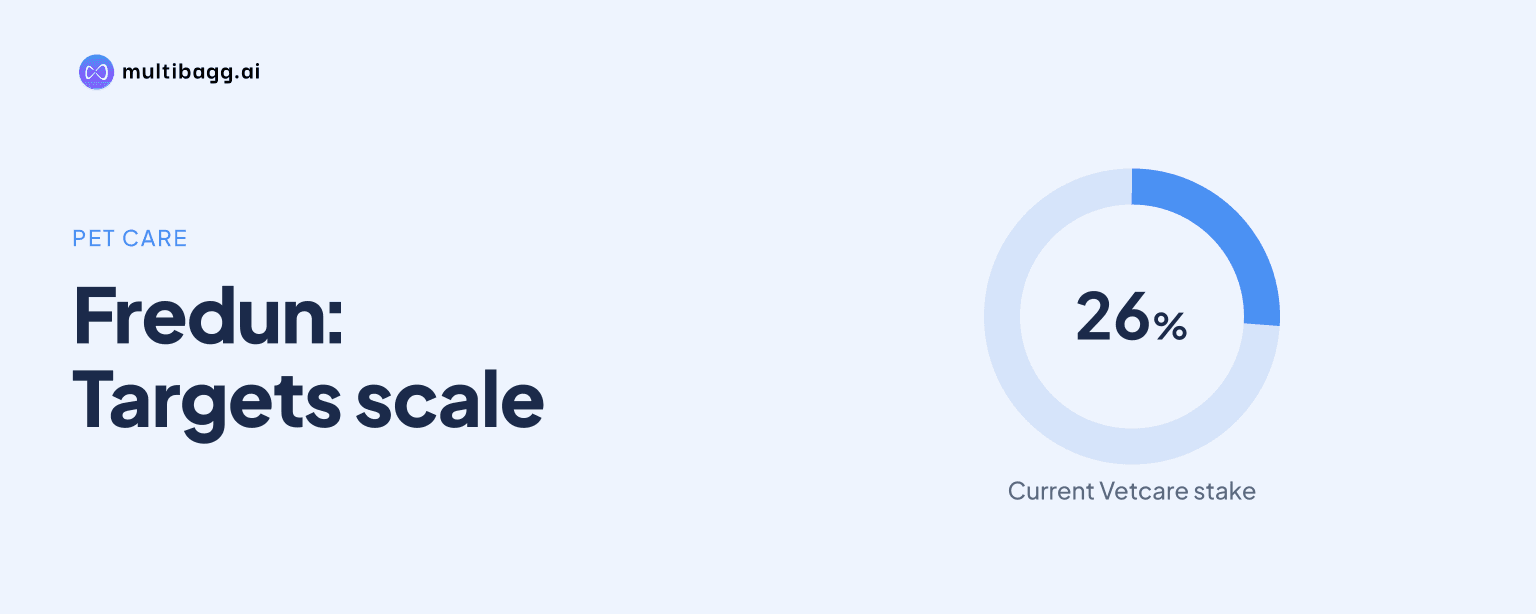
Fredun said its 26% Vetcare stake is intended to scale a profitable pet-care chain by combining Vetcare’s almost four decades of pet retail and institutional supplies with Fredun’s doctor and pet-care network, rather than relying on a cash-burn store-expansion model. Management said Vetcare is already profitable and supplies institutions including national parks, zoos and Vantara.
Know Fredun Pharmaceuticals inside out
Results, valuation, peers and who's buying, in one view.
Why did Fredun take a 26% stake in Vetcare?
Fredun took the 26% stake because management sees Vetcare as an established pet-retail platform with almost four decades of operating experience. Fredun Medhora described Vetcare as one of the country’s pioneer pet retailers and said its long presence means it understands the market. The plan is to combine that retail experience with Fredun’s existing Pet Care activity.
Vetcare also brings an institutional business alongside consumer retail. Management said the company is among the larger suppliers to national parks and zoos and is a supplier to Vantara. This business-to-business, or B2B, supply component is part of Fredun’s rationale because Vetcare is profitable already, according to management. Fredun did not disclose the stake’s purchase price, Vetcare’s revenue, profit or a schedule for raising its ownership.
How will Fredun expand Vetcare without cash burn?
Fredun’s stated strategy is to pursue long-term profitability rather than finance a large retail rollout through continuing losses. Management contrasted its approach with unnamed retail chains that it said were focused on spending heavily on stores. It said the Vetcare plan is not a burn model and that the combined business is intended to grow profitably over the next few years.
Management based that position on Vetcare’s existing profitability, almost 40-year retail record and B2B institutional supplies. This differs from a model dependent only on consumer-store openings, where new locations may require funding before demand develops. However, Fredun gave no target for Vetcare outlets, no city-expansion plan, no revenue objective and no operating-margin forecast for the chain.
Fredun indicated that profitable growth can still involve initial spending. In discussing new-age businesses, management said entering a new state may require investment in one quarter, with results potentially emerging over the following three quarters. That comment was not a disclosed Vetcare rollout timetable, but it shows that management expects investment and returns to occur in different reporting periods.
What does Fredun add to the Vetcare platform?
Fredun said it brings one of the country’s larger doctor reaches and established relationships with doctors, breeders, groomers and trainers in Pet Care. Management plans to integrate those connections with Vetcare’s retail capability. The proposed combination links Fredun’s veterinary ecosystem with Vetcare’s retail and institutional-supply operations.
Fredun said its Pet Care business is growing at almost 70% to 80%, although management noted that new-age divisions are growing from smaller bases. By comparison, its vintage business is growing 15% to 25% year on year from a higher base. That difference positions Pet Care as a faster-growing activity while Vetcare contributes an established retail and B2B operating base.
Fredun also described education as part of its Pet Care approach. Management said it conducted programmes across the country, including tier-two and tier-three cities, rather than beginning with door-to-door selling or a celebrity-led launch. It said groomers and trainers were among the first-line Pet Care influencers it connected with, but it did not quantify the number of professionals, cities or customers reached.
Got a follow-up? Ask IRIS
How does Vetcare fit Fredun’s wider growth strategy?
Fredun placed Vetcare within its move from pharmaceutical manufacturing towards consumer products. Management said Pet Care, mobility, mass-market cosmetics, dermaceutics and nutraceuticals are new-age businesses with intrinsically higher profitability. It put mobility and mass-market cosmetics growth at about 65% to 70%, compared with almost 70% to 80% in Pet Care.
Management described seven verticals as the basis for diversification rather than dependence on one category. Using an illustrative Rs 400 crore growth figure, it said this would represent roughly Rs 65 crore to Rs 70 crore per vertical when spread across seven businesses. This was a company-wide illustration, not a revenue forecast for Vetcare, but it explains management’s focus on several growth engines rather than one chain’s store count.
Margin improvement is part of management’s broader case, although Fredun did not provide future margin guidance. Management referred to a Q2 earnings before interest, taxes, depreciation and amortisation, or EBITDA, margin of 15.92%, while an analyst referred to profit after tax, or PAT, margin of about 7%. Management said new-age products, operating efficiencies and cost efficiencies could support improvement, while cautioning that business cycles and reporting quarters do not always coincide.
Fredun said it has almost 2,400 products in its portfolio and an order book extending seven to eight months into the future. Management said that breadth enables it to reject low-yielding products when costs do not meet its expectations. The product portfolio relates to Fredun’s wider operations rather than Vetcare specifically, but it provides context for management’s planned allocation of resources across legacy and newer businesses.
Conclusion
Fredun’s 26% Vetcare stake combines a profitable, almost four-decade pet retailer and institutional supplier with Fredun’s doctor and Pet Care relationships. Management’s central proposition is that this can create a larger pet-care chain without using a cash-burn retail model. The call supports the stated strategy and Vetcare’s claimed operating base, but does not provide a valuation, outlet target, revenue forecast or margin target for Vetcare.
The next disclosed measure to watch is whether integration produces profitable growth over the next few years, rather than only a wider retail presence. Management said Pet Care annual recurring revenue, or ARR, is in line with its earlier projection and that Pet Care and mobility could overachieve projections; it also said overall trends could exceed earlier expectations by 15% to 20% in FY27, without disclosing absolute ARR figures.