








Fujiyama Power Systems Ltd: Shares Fall 40.27% From High
Max Plan at ₹4,999/yr₹8,999

Find your next multibaggerBe a Pro Investor
Research stocks and track your picks on the go. Download the app.
Key highlights
- Fujiyama Power Systems was reported to be 40.27% below its 52-week high in a November 25 market snapshot.
- Fujiyama Power Systems reported a 2.9% quarter-on-quarter decline in consolidated revenue for the September quarter.
- Fujiyama Power Systems fell 4.27% to ₹329.45 on November 17, according to the supplied discussion.
- Fujiyama Power Systems reportedly fell 9.88% on November 6 while the Sensex gained 0.24%.
powered by IRIS
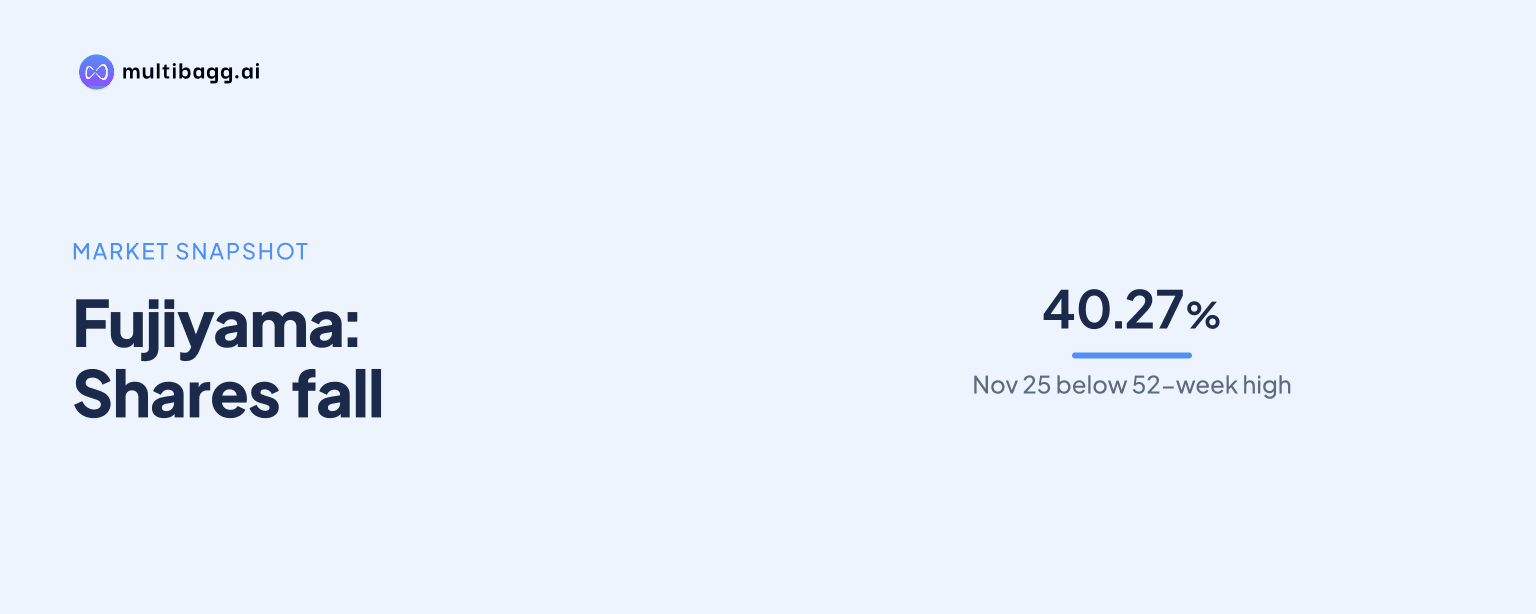
Fujiyama Power Systems Ltd was 40.27% below its 52-week high in the market snapshot cited on November 25, 2026, with profit-booking, weak technical signals, margin costs and uncertainty over ALMM 2 requirements and DCR cell supply cited as pressures.
Why did Fujiyama Power Systems shares fall?
Fujiyama Power Systems shares faced selling pressure from a combination of profit-booking, negative technical indicators and concerns about near-term operating and supply conditions. Social-media discussions linked the fall on November 17 to profit-taking after earlier gains, while also pointing to weak technical signals as a factor behind the day’s decline.
The price action has been volatile across the cited updates. Fujiyama Power Systems was reported down 4.27% at ₹329.45 on November 17, while another update said the stock closed at ₹347.50, down 2.11%, on November 13. On November 6, the stock reportedly touched an intraday low of ₹350.75 and fell 9.88% during the session, even as the Sensex rose 0.24%.
What did the recent Fujiyama Power Systems price snapshots show?
The supplied snapshots show a sharp retreat from the 52-week high, but they also contain differing price readings that should not be combined as one verified live quote. One market update placed Fujiyama Power Systems at ₹324.75, down 5.38% from ₹343.20, and described it as 40.27% away from its 52-week high.
A separate November 25 snapshot put the fall from the 52-week high at 44.16%. Another entry displayed a price of ₹0 and a 100% decline at 11:22, which is inconsistent with the other quoted market prices in the supplied material. That isolated reading does not establish a confirmed trading event from the information available.
Did the September-quarter performance remove investor concerns?
No, the September-quarter discussion did not remove concerns because consolidated revenue was reported to have fallen 2.9% quarter on quarter. The supplied material also flagged recent quarter-on-quarter weakness in revenue, profit and operating profit margin, despite other commentary describing the quarter as strong.
The margin debate appears central to sentiment. Higher sales and distribution expenses, seasonal softness, costs related to newly commissioned facilities and external purchases of tubular batteries were cited as factors affecting margins. This creates a distinction between demand-led growth commentary and investors’ focus on the cost of delivering that growth.
Fujiyama Power Systems was also described as having good quarterly growth in recent results in one market summary. However, that same set of discussions identified degrowth in revenue, profits and operating margin on a quarter-on-quarter basis as a threat. The mixed signals help explain why a positive demand narrative has not prevented share-price volatility.
Got a follow-up? Ask IRIS
What policy and supply issues are investors tracking?
Investors are tracking the company’s plan to revise guidance after the third quarter because of ALMM 2 requirements and shortages of DCR cells. The supplied discussion does not quantify the possible impact, but it identifies domestic cell availability and regulatory requirements as unresolved issues for the business outlook.
Demand visibility remains linked in commentary to the PM Surya Ghar Muft Bijli Yojana, expansion of the distribution network and improved after-sales capabilities. Fujiyama Power Systems operates four manufacturing units and has a distribution network across India, according to the supplied context. The question for investors is whether operational expansion and rooftop-solar demand can offset supply constraints and elevated costs.
Policy and imports were also identified as sector risks. The discussion noted that demand depends on government schemes, while easing trade restrictions could potentially increase competition from lower-priced imports. These are broader industry considerations rather than confirmed company-specific outcomes.
Is Fujiyama Power Systems underperforming only because of the wider market?
The available trading update suggests Fujiyama Power Systems had company-specific pressure rather than merely following the broader market. On November 6, the stock’s reported 9.88% decline contrasted with a 0.24% gain in the Sensex, while commentary also said it underperformed its sector and broader indices.
Technical commentary said the stock had failed to hold above short- and medium-term moving averages, indicating immediate price pressure. The same discussion highlighted high intraday volatility and unsettled market sentiment. Separately, Fujiyama Power Systems was described as a high-growth stock with average financial strength and high valuations, a combination that can amplify reactions to operational uncertainty.
Conclusion
The reported fall in Fujiyama Power Systems reflects more than a single weak session. Profit-booking and technical weakness have coincided with a 2.9% quarter-on-quarter revenue decline, margin-related costs and investor caution around supply and regulatory issues. The 40.27% retreat from the 52-week high captures that broader reassessment, although the supplied price snapshots are not fully consistent.
The next disclosed milestone is the planned guidance revision after the third quarter. Investors will watch for clarity on ALMM 2 requirements, DCR cell availability, the effect of externally procured tubular batteries and whether distribution expansion and rooftop-solar demand support margins as well as revenue.

