








Retail Investors Did Not Broadly Beat Foreign Institutional Investors
Max Plan at ₹4,999/yr₹8,999

Find your next multibaggerBe a Pro Investor
Research stocks and track your picks on the go. Download the app.
Key highlights
- Retail ownership increased in 118 Nifty 500 companies where FIIs reduced their stakes.
- Twenty-six stocks delivered gains of more than 30% for retail investors over the last two fiscal years.
- FIIs bought ₹94,229 crore in the cash market in November 2026 so far.
- DIIs sold ₹55,570 crore in November 2026 so far and were net sellers in 12 of 13 sessions.
powered by IRIS
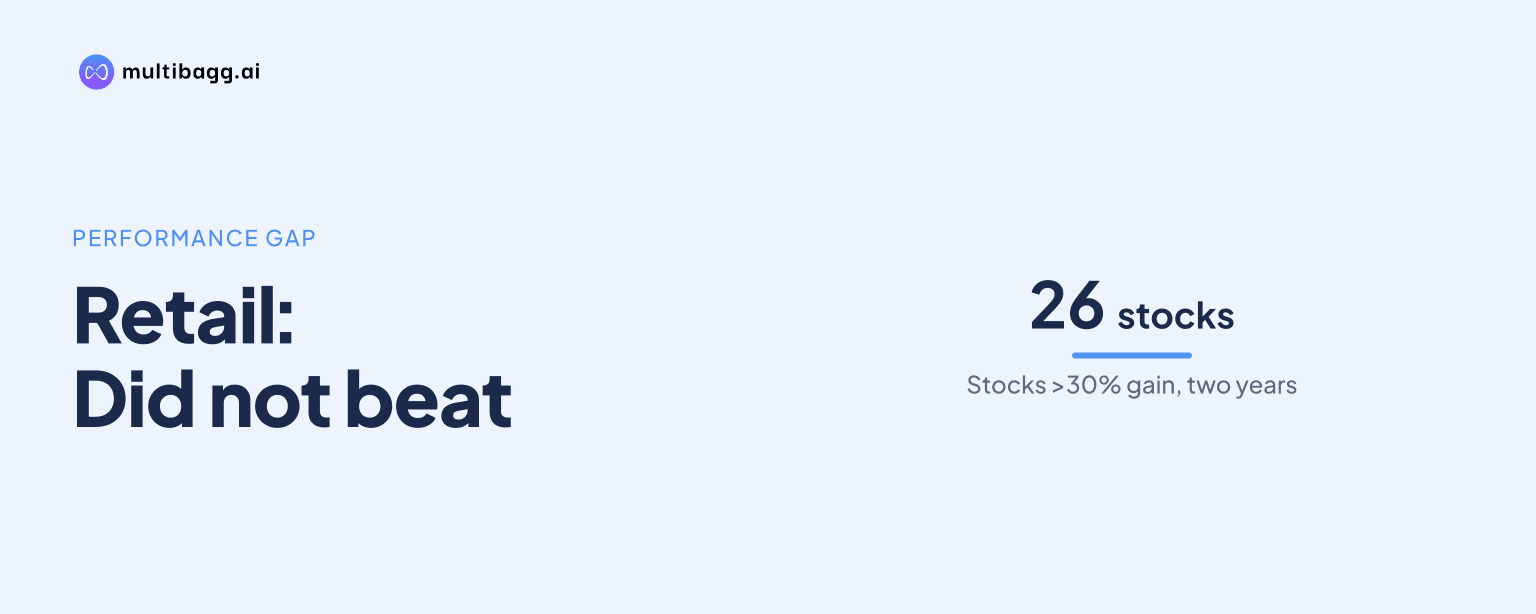
Retail investors did not broadly beat foreign institutional investors (FIIs) in the 118 Nifty 500 companies where FIIs reduced their stakes over the last two fiscal years. While 26 of these stocks delivered gains of more than 30%, the reported performance data do not establish that retail buying as a group outperformed.
Did retail investors outperform FIIs in the 118 Nifty 500 stocks?
No, the available data do not support a conclusion that retail investors broadly outperformed FIIs across the 118 companies. Retail ownership increased in these Nifty 500 companies after FIIs reduced their stakes, but a rise in ownership alone is not evidence of superior investment returns.
The reported set does contain notable winners. Twenty-six stocks generated gains of more than 30% for retail investors over the last two fiscal years. That result shows that some positions performed strongly, but it does not reveal the outcome for the other companies in the group or establish an aggregate return comparison with FIIs.
A stock-level ownership shift can occur for many reasons. FIIs may cut exposure because of global allocation decisions, while retail investors may buy on a company-specific view, after a correction, or through broader domestic participation. Without a complete return calculation for both investor groups over the same period, broad outperformance cannot be inferred.
What does higher retail ownership in 118 companies show?
Higher retail ownership in 118 companies shows that retail investors absorbed shares where FIIs cut stakes, not that their purchases were uniformly more successful. The ownership data point to a changing balance of market participation in a sizeable part of the Nifty 500 universe.
This matters because domestic participation can provide buying support when foreign capital is leaving. Social-media discussion around the data has focused on retail investors buying during corrections and potentially benefiting if FIIs return during a stronger market phase. That remains a market pattern rather than proof that every retail purchase will produce gains.
The distinction between ownership and performance is central. Shareholding data measure who owns a larger portion of a company at a particular date, whereas investment performance requires purchase prices, holding periods and a comparable benchmark. The reported figures provide the first measure but do not provide a complete comparison of the second.
What do November 2026 institutional flows say about market support?
November 2026 flow data show strong FII buying alongside DII selling during a market recovery. FIIs were reported to have bought ₹94,229 crore of Indian stocks through the cash market during the month so far, while domestic institutional investors, or DIIs, sold ₹55,570 crore and were net sellers in 12 of 13 cash-market sessions.
The Nifty 50 was up more than 9% so far in November, according to the cited market data. Separate reporting said net institutional buying of about ₹19,900 crore supported the rally. These figures illustrate how a rapid shift in foreign flows can coincide with a sharp change in market direction, even when domestic institutions are taking profits.
The November figures should not be treated as a verdict on the 118-company ownership study. They cover market flows and a short period, while the retail ownership discussion covers two fiscal years. They do, however, underline why daily foreign and domestic flow headlines can influence sentiment and index moves.
Got a follow-up? Ask IRIS
Why do FII and retail investor flows often diverge?
FII and retail investor flows often diverge because they respond to different considerations. The reported discussion describes FIIs as large, concentrated investors whose allocations can be shaped by global risk appetite, the US dollar, Federal Reserve policy and competing emerging-market opportunities.
Retail investors are more fragmented and can participate directly or indirectly through systematic investment plans, which feed domestic mutual fund flows. The context also notes that growing retail participation and DII buying have reduced the market's sole dependence on FIIs, helping cushion periods of foreign selling.
This does not mean that retail flows can permanently offset every foreign withdrawal. A short period of FII buying does not guarantee a sustained rally, and FII selling does not automatically cause a correction. Both sides can reverse course for reasons unrelated to a company's immediate operating performance.
How should retail investors use FII ownership and flow data?
Retail investors should use FII ownership and flow data as market-context indicators rather than as stand-alone buy or sell signals. A fall in FII ownership can identify companies experiencing a change in institutional positioning, but it does not determine whether the stock is undervalued or whether its future returns will be positive.
The stronger approach outlined in the discussion is to track market trends over a longer period and pair flow data with earnings and valuation information. That avoids treating a daily inflow number, a sudden rally or an ownership change as a complete investment case.
The November rebound also highlights timing risk. Patient investors who bought during a weak phase may benefit when foreign demand returns, but the result depends on the particular stock and entry point. The 26 stocks with gains above 30% are evidence of successful cases, not evidence that the entire retail cohort achieved the same result.
Conclusion
The reported ownership data show that retail investors increased their stakes in 118 Nifty 500 companies where FIIs reduced exposure, while 26 stocks posted gains above 30% over two fiscal years. Those facts demonstrate meaningful domestic participation and selected strong outcomes, but they do not prove broad retail outperformance over FIIs.
The next issue to watch is whether November's strong FII buying persists after the recovery and how DII sell-on-rise activity develops. Investors should also watch future ownership disclosures and company earnings and valuation data, which are needed to judge whether changes in investor mix are being matched by underlying business performance.

