








NIFTY 500 Index captures 89.87% of NSE listed free float
Max Plan at ₹4,999/yr₹8,999

Find your next multibaggerBe a Pro Investor
Research stocks and track your picks on the go. Download the app.
Key highlights
- NIFTY 500 represented 89.87% of NSE-listed stocks' free-float market capitalisation as of September 30, 2026.
- NIFTY 500 contains 500 stocks and uses free-float market capitalisation for index weighting.
- Reliance Industries had a reported NIFTY 500 weight of 4.31% in data updated on November 2, 2026.
- The reported aggregate NIFTY 500 free-float market capitalisation was ₹20,769.78 thousand crore on November 19, 2026.
powered by IRIS
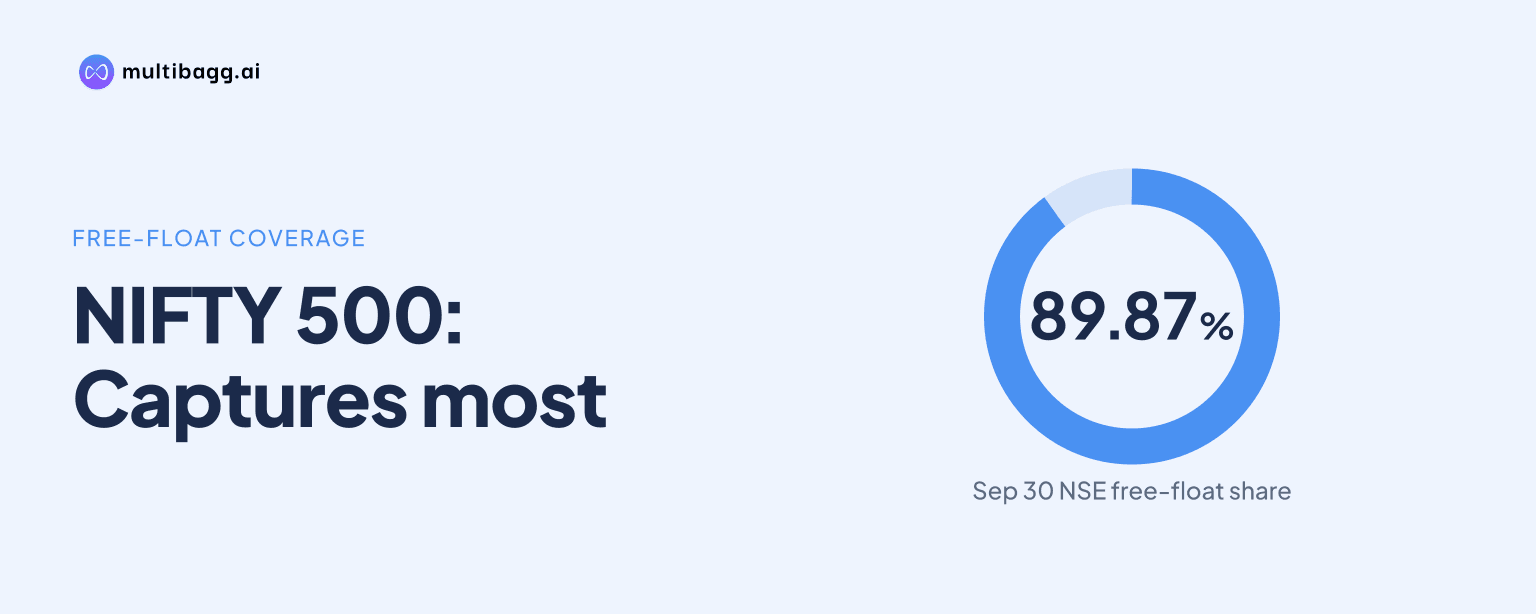
NIFTY 500 Index represented 89.87% of the free-float market capitalisation of stocks listed on the NSE as of September 30, 2026, making NIFTY 500 a broad measure of publicly tradable equity value rather than simply a ranking by companies' total market capitalisation.
What does NIFTY 500's 89.87% free-float coverage mean?
NIFTY 500's 89.87% coverage means that its 500 constituents accounted for nearly nine-tenths of the market value of NSE-listed shares that are available for public trading on September 30, 2026. The index is designed to represent the performance of the top 500 companies listed on the National Stock Exchange of India.
The metric is important because a company's full market capitalisation can differ materially from the value of shares that investors can actually trade. The index excludes holdings classified as non-free float, including shares held by promoters, governments and other entities. This approach makes constituent weights reflect the market value of the available public float rather than all outstanding shares.
How is NIFTY 500 weighted by free-float market capitalisation?
NIFTY 500 is calculated using the free-float market-capitalisation weighted method, so a stock's index influence depends on its tradable share value. The eligible universe and constituent selection are based on full market capitalisation and average daily turnover, while the subsequent index calculation uses free-float market capitalisation.
This distinction explains why a larger company by total market value may not necessarily have the same prominence in the index as its full market capitalisation suggests. Shares that are not considered freely available for trading do not carry the same weight in the index calculation. The methodology therefore links daily index movements to the publicly investible portion of its constituents.
Which NIFTY 500 stocks had the highest reported weights?
NIFTY 500's reported high-weight stocks included Reliance Industries at 4.31%, Bharti Airtel at 3.04% and HDFC Bank at 2.65% in a list updated on November 2, 2026. ICICI Bank was shown at 2.44%, State Bank of India at 2.23% and Tata Consultancy Services at 2.22%.
These weights are a useful illustration of concentration within a broad 500-stock benchmark. Reliance Industries, for example, was reported with a market capitalisation of ₹1,759,229.55 crore in that list, while Bharti Airtel was reported at ₹1,242,018.90 crore. However, reported company market capitalisation and index free-float weight are different measures, and should not be treated as interchangeable.
Got a follow-up? Ask IRIS
Why can free-float market-cap figures differ across data sources?
Free-float market-cap figures can differ because NSE Indices uses its own free-float factors, while another published list noted that its free-float values were sourced from BSE. The cited note specifically states that NSE Indices' figures can differ slightly from BSE-published free-float market capitalisation.
Investors comparing index weights should therefore check the source, methodology and date before drawing conclusions. The aggregate free-float market-cap figure of ₹20,769.78 thousand crore was marked as data as of the November 19, 2026 close, while the 89.87% coverage statistic refers to September 30, 2026. Mixing figures from different dates can produce misleading comparisons.
How should investors use NIFTY 500 free-float data?
Investors can use NIFTY 500 free-float data to understand which stocks have greater influence on a benchmark that tracks publicly tradable equity value. It is particularly relevant for evaluating index-linked exposure, where a stock's free-float-adjusted weight rather than its full market capitalisation helps determine its impact on index returns.
The data does not by itself establish whether any constituent is attractive or unattractive as an investment. It describes benchmark construction and representation. A reported 1.16% one-day NIFTY 500 return and a 100.00% aggregate index weight in the November 19 data show how individual stock attribution and weights are organised within the published index view.
Conclusion
NIFTY 500's 89.87% share of NSE-listed free-float market capitalisation highlights its role as a wide representation of India's publicly tradable equity market. Its methodology separates the size of a company from the value of shares available to market participants, which is central to understanding index weights and daily performance attribution.
Investors should watch future constituent data, index weights and updated free-float factors, while keeping the reporting date consistent across comparisons. The disclosed difference between BSE-published free-float values and NSE Indices' own factors remains an important unresolved source of variation when matching third-party data with official index calculations.

