










Fusion CX expects Q3 margin improvement after client ramp-up
Key highlights
- Fusion CX reported Q2 FY27 revenue of Rs 525.3 crore, up 22.1% year on year.
- Q2 FY27 EBITDA margin was 18.6%, down 110 bps from 19.7% in Q2 FY26.
- Fusion CX said training and certification for two top-five-client ramp-ups generally take five to eight weeks.
- H1 FY27 PAT rose 56.3% year on year to Rs 114.2 crore.
powered by IRIS
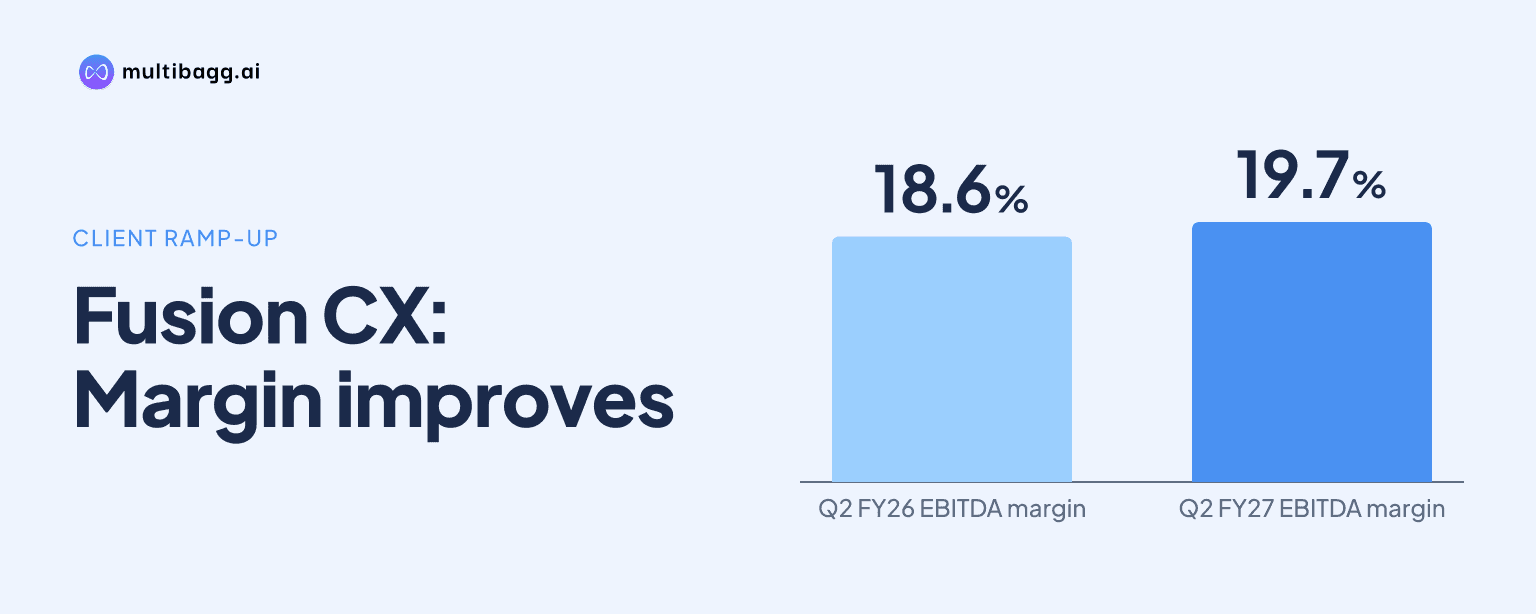
Fusion CX expects Q3 FY27 earnings before interest, tax, depreciation and amortisation, or EBITDA, margin to improve after training for two top-five clients reduced Q2 FY27 reported EBITDA margin to 18.6% from 19.7% a year earlier. Management said trained staff should become billable after five to eight weeks of training and certification.
Know Fusion CX inside out
Results, valuation, peers and who's buying, in one view.
Why did Fusion CX’s Q2 FY27 margin decline?
Fusion CX’s Q2 FY27 EBITDA margin declined by 110 basis points, or bps, because it incurred employee-training costs before staff assigned to two major-client ramp-ups entered production. Revenue from operations rose 22.1% year on year and 7.1% sequentially to Rs 525.3 crore, while EBITDA increased 15.2% year on year to Rs 97.6 crore. The slower EBITDA growth relative to revenue produced the margin decline.
Management said the ramp-ups involved two of Fusion CX’s top five clients, which together sit within a customer group accounting for 36.5% of company revenue. Training, including certification, generally takes five to eight weeks. Fusion CX can bill clients only once employees complete that process and start production, meaning Q2 carried the manpower cost before the associated production revenue.
Fusion CX estimated that EBITDA margin would have been about 20% in Q2 FY27 without the training expenditure, compared with the reported 18.6%. That estimate is management’s illustration of the cost timing rather than a revised reported result. The transcript did not quantify the training expense, the number of employees involved, or the revenue expected from the two ramp-ups.
How does Fusion CX expect Q3 FY27 to improve?
Fusion CX expects Q3 FY27 to receive both training revenue and higher production revenue as the two client cohorts complete training and become billable. Pankaj Dhanuka told an analyst that this interpretation was “exactly correct”: the cost had been incurred in the reported quarter, while the benefit of training and production would arrive in the next quarter.
Management also said EBITDA should improve from the Q2 FY27 level, referring to both the 18.6% quarterly margin and performance in earlier quarters. It did not provide a numerical target for Q3 FY27, the second half of FY27, or full-year FY27. The expected margin recovery is therefore a directional management outlook, dependent on training completion and the employees moving into production.
Profit after tax, or PAT, still increased 31.3% year on year to Rs 58.6 crore in Q2 FY27, and PAT margin rose 77 bps to 11.2%. Management attributed the improvement to revenue growth and lower finance cost, depreciation and amortisation, and tax. These benefits more than offset the 110-bps contraction in EBITDA margin during the quarter.
How did Fusion CX perform in H1 FY27?
Fusion CX reported H1 FY27 revenue from operations of Rs 1,015.8 crore, up 20.4% year on year, while EBITDA rose 27.7% to Rs 192.7 crore. H1 FY27 EBITDA margin was 19.0%, which was 40 bps above the 18.6% reported in Q2 FY27. That comparison indicates that the Q2 training cost reduced the margin level achieved in the first half.
H1 FY27 PAT rose 56.3% year on year to Rs 114.2 crore, with PAT margin at 11.2%. Fusion CX reported annualised return on capital employed of 40.1% and return on equity of 36.9% for H1 FY27. Days sales outstanding, or DSO, declined to 73 days from 80 days a year earlier, according to management.
Q2 FY27 growth was primarily organic. Fusion CX said organic growth contributed 16.8% year on year, driven by existing business growth and new deal wins, while the VAP acquisition in Australia contributed 5.2% of growth. For H1 FY27, organic growth was 12.7%, compared with total revenue growth of 20.4%, showing that acquired revenue also contributed to the half-year increase.
Got a follow-up? Ask IRIS
What business factors could affect Fusion CX’s next quarters?
Fusion CX said employee cost should remain within its current range, plus or minus 1%, because delivery is spread across geographies and client pricing reflects local employee costs. This means management does not expect a broad structural reduction in staff costs from using India to serve Australia, even as it considers India alongside the Philippines for Australian, Singaporean and New Zealand client delivery.
The company acquired Melbourne-headquartered VAP in August and said its integration with the Fusion CX platform was progressing, with completion expected over the next few months. Management is initially focusing on banking, financial services and insurance, or BFSI, work including mortgage-broking and financial-planning support. It also identified auto and retail as possible areas for Australian expansion and expects results from the sales effort in six to 12 months.
Fusion CX also completed the acquisition of Germany-based impacx shortly before the call and expects integration within six to eight months. impacx adds about 250 employees, German-language service capabilities and operations in Germany and Greece. Management said a meaningful portion of the consideration is tied to the acquired business’s future performance, but gave no specific FY27 revenue or profit contribution forecast.
AI data infrastructure remains a separate growth initiative rather than a disclosed contributor to the Q3 client ramp-up. The business accounted for about 5% of Q2 FY27 revenue and had 18 clients. Management said it completed pilots with three top-tier clients in the preceding two months and plans over time to increase AI data infrastructure to a double-digit share of overall revenue, without providing a timetable.
Conclusion
Fusion CX’s Q2 FY27 margin movement reflected the timing of costs and billings for two large-client ramp-ups. Revenue rose 22.1% to Rs 525.3 crore and PAT rose 31.3% to Rs 58.6 crore, but EBITDA margin fell to 18.6% as training costs were recognised before staff completed certification and entered billable production.
The next test is whether the five-to-eight-week training cycle converts into Q3 FY27 training and production revenue as management expects. Investors can also watch VAP’s integration over the next few months, impacx’s planned six-to-eight-month integration, and Fusion CX’s stated six-to-12-month effort to build Australian sales coverage.