










Fusion CX plans Annontera and Roborax AI data platform launch
Key highlights
- Fusion CX plans to launch its AI Data Infrastructure Platform in mid-Q3.
- Annontera will support digital AI models using enterprise text, images, video, audio and sensor logs.
- Roborax will target humanoid, surgical, industrial and warehouse robots through teleoperation and validation.
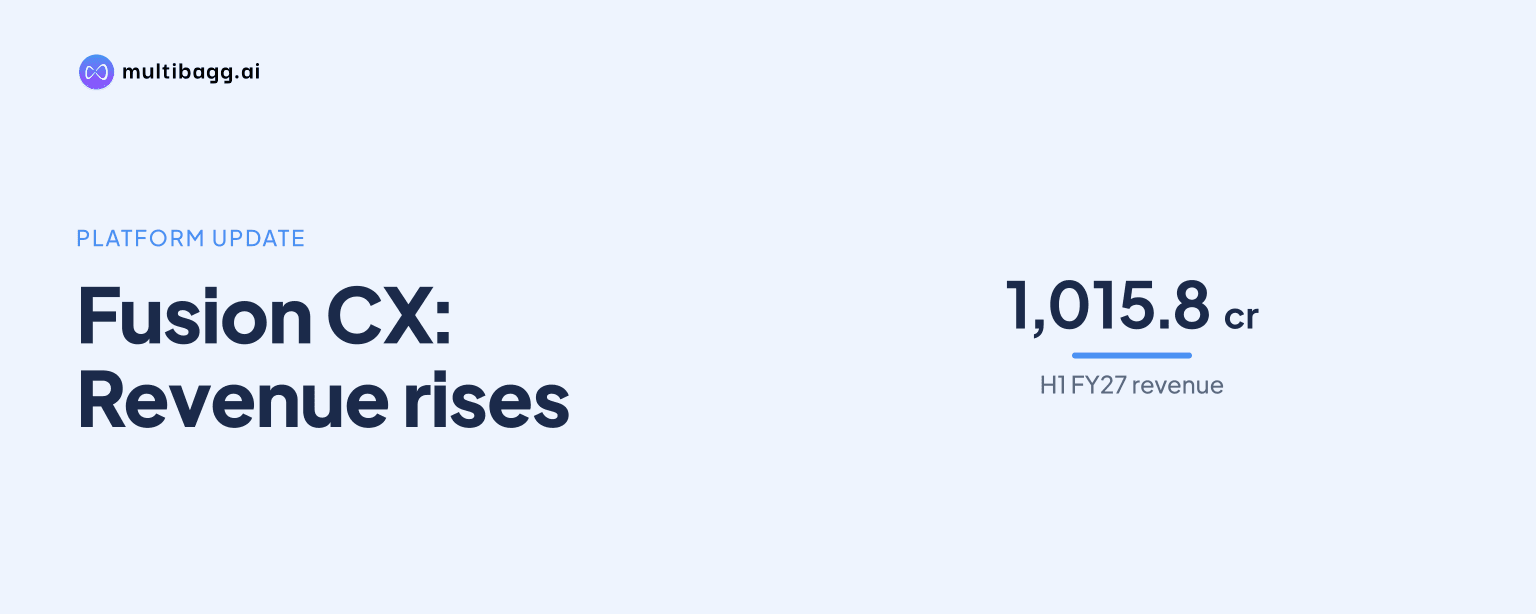
- Fusion CX reported H1 FY27 revenue from operations of Rs 1,015.8 crore, up 20.4% year on year.
powered by IRIS
Fusion CX Limited plans to launch its AI Data Infrastructure Platform in mid-Q3, using Annontera for digital artificial intelligence (AI) and Roborax for physical AI data workflows. The platform covers collection, annotation and evaluation, while the presentation cites a 34% compound annual growth rate for the data-collection-and-labelling market from 2025 to 2030.
Know Fusion CX inside out
Results, valuation, peers and who's buying, in one view.
What is Fusion CX's AI Data Infrastructure Platform?
Fusion CX's AI Data Infrastructure Platform is a planned training-data delivery business built around Annontera for digital AI and Roborax for physical AI. Its disclosed process has three stages: collecting raw signals, annotating them into usable labels, and curating and evaluating the resulting datasets. Fusion CX lists the platform among its delivery-embedded AI tools and says launch is planned for mid-Q3.
The platform is distinct from the company's existing customer-experience tools because it is designed to supply data for model training and testing. Fusion CX reports that Accent Harmonizer is used by 75% of its workforce, MindWorkplace by 100%, and TrainX across 100% of onshore programmes. By comparison, Annontera and Roborax are presented as products for digital-model and robot-data workflows.
How will Annontera create digital AI training data?
Annontera will process training data for large language models, vision, multimodal and generative AI models. Its collection stage covers enterprise text, images, video, audio and sensor logs that are sourced and de-identified. It then applies tasks including named entity recognition, which identifies and categorises entities in text, along with image segmentation, bounding boxes and transcription.
Annontera's evaluation stage includes reinforcement learning from human feedback, or RLHF, preference ranking, red-teaming and model evaluation. Fusion CX calls this the recurring layer, differentiating it from initial data capture and labelling. The presentation does not disclose customer contracts, data volumes, pricing, revenue or margin for Annontera at the planned mid-Q3 launch.
The platform's digital scope is broader than the AI tools already used within Fusion CX's delivery operations. AI QMS, or quality management system, can automatically score up to 100% of interactions across more than 200 client processes, while Sayin.AI supports five languages. Annontera instead targets the underlying datasets used to develop, tune and assess AI models.
What will Roborax provide for physical AI?
Roborax will provide data workflows for humanoid, surgical, industrial and warehouse robots. Its collection mechanism is teleoperation and human demonstration, where the physical operation itself produces the data. This differs from Annontera's enterprise-content inputs because the data is generated through actions, movements and task demonstrations.
Roborax will annotate action segments, object affordances, reward signals and trajectories. An affordance mask identifies how an object may be handled or used, while trajectory labelling records a machine's movement path. Fusion CX does not identify robot manufacturers, healthcare providers, warehouse operators or industrial customers that will use these services.
Roborax's final stage will test data and models through simulation-to-real validation, held-out benchmarks and long-tail edge-case scoring. A held-out benchmark uses data excluded from model training to measure results, while long-tail cases cover less frequent scenarios. The presentation gives no accuracy target, safety metric, validation volume or deployment timetable beyond the platform's mid-Q3 launch plan.
Got a follow-up? Ask IRIS
Why is Fusion CX adding AI data infrastructure?
Fusion CX is adding the platform while identifying AI data, health-plan work and telecom as areas with the strongest traction. Revenue from operations rose 20.4% year on year to Rs 1,015.8 crore in H1 FY27, from Rs 843.4 crore in H1 FY26. That is a company-wide comparison and is not a reported contribution from Annontera or Roborax.
The presentation places the platform in a data-collection-and-labelling market projected to increase from $2.0 billion in 2025 to $8.7 billion in 2030, representing a cited 34% compound annual growth rate. Annontera addresses language, vision, multimodal and generative models, whereas Roborax addresses robot demonstrations and validation. The two products therefore serve separate data types through one common collection-to-evaluation structure.
Fusion CX's wider revenue from operations increased from Rs 991.3 crore in FY24 to Rs 1,818.1 crore in FY26, for a stated 35.4% compound annual growth rate. The company says nearshore and onshore contact-centre demand is accelerating and that acquired entities will add to inorganic growth in H2 FY27. It does not state that those acquisitions will provide customers, capacity or technology for the AI Data Infrastructure Platform.
What has Fusion CX not disclosed about the platform?
Fusion CX has disclosed the product architecture and a mid-Q3 launch plan, but it has not disclosed an addressable revenue target, investment budget, employee count or client rollout schedule for either product. The digital workflow specifies data types and labelling tasks, while the physical workflow specifies teleoperation, demonstrations and validation. Neither disclosure provides a measure of commercial scale.
The financial results do not separately identify AI-data-infrastructure income or costs. Profit after tax rose 56.3% year on year to Rs 114.2 crore in H1 FY27, from Rs 73.1 crore in H1 FY26, while earnings before interest, tax, depreciation and amortisation rose 27.7% to Rs 192.7 crore. These are consolidated company figures rather than product-level measures.
Fusion CX also reports a 19.0% earnings before interest, tax, depreciation and amortisation margin in H1 FY27, compared with 17.9% in H1 FY26. That change cannot be attributed to Annontera or Roborax because the presentation does not report platform revenue, delivery costs or margins. The disclosed evidence supports a planned expansion into AI data infrastructure, not a measured financial contribution from it.
Conclusion
Fusion CX has outlined an AI-data-infrastructure business that goes beyond contact-centre automation. Annontera is intended to turn de-identified enterprise content into labelled, tuned and evaluated data for digital models, while Roborax applies a comparable process to physical robot tasks through teleoperation, action labelling and validation. The common pipeline gives the two products a shared operating framework despite their different end markets.
The next disclosed event is the planned mid-Q3 platform launch. Investors should watch for management disclosures on initial customers, delivery capacity, data volumes, platform investment and any separate revenue or cost reporting, because H1 FY27 results currently provide only company-wide figures and identify AI data as an area of traction rather than a reported segment.