










Fusion Finance Limited lifts AUM per branch to Rs 5.4 crore
Key highlights
- Fusion Finance reported Rs 5.4 crore of AUM per branch in Q2FY27, up from Rs 4.6 crore in Q2FY26.
- Fusion Finance reduced its branch count to 1,475 in Q2FY27 from 1,545 a year earlier.
- Fusion Finance plans to open about 50 branches after consolidating low-productivity outlets.
- Fusion Finance said MSME disbursement grew by about 21% in Q2FY27.
powered by IRIS
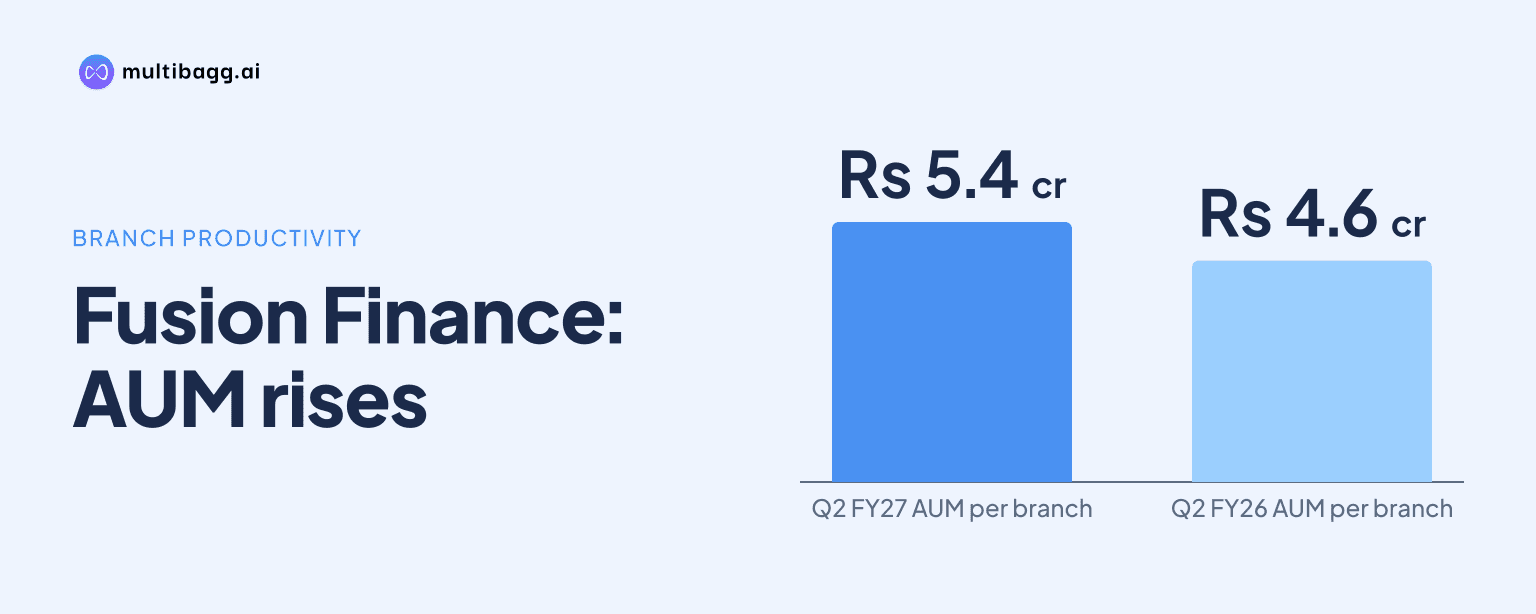
Fusion Finance Limited reported assets under management, or AUM, of Rs 5.4 crore per branch in Q2FY27, up from Rs 4.6 crore in Q2FY26, while its network declined to 1,475 branches from 1,545 and management outlined plans to open about 50 branches after consolidating low-productivity outlets.
Know Fusion Finance inside out
Results, valuation, peers and who's buying, in one view.
Why is Fusion Finance changing its branch network?
Fusion Finance is consolidating low-productivity branches while planning to open about 50 new outlets. The branch count fell by 70, from 1,545 in Q2FY26 to 1,475 in Q2FY27, and the presentation describes the approach as entering new markets while rationalising the existing network.
The reduction occurred over five reported quarters. Branches moved from 1,545 in Q2FY26 to 1,537 in Q3FY26 and 1,536 in Q4FY26, then declined to 1,512 in Q1FY27 and 1,475 in Q2FY27. Management did not disclose the locations or opening schedule for the planned branches, nor a target branch count after the expansion.
AUM per branch increased by Rs 0.8 crore year on year and by Rs 0.3 crore from Rs 5.1 crore in Q1FY27. The measure first declined to Rs 4.5 crore in Q3FY26 before rising in each of the next three reported quarters; the presentation does not separate the effects of branch consolidation, AUM growth or product mix.
How broad is Fusion Finance's branch footprint?
Fusion Finance operated 1,475 branches across 22 states, three Union Territories and 486 districts in Q2FY27. It reported more than 19 lakh active customers, while about 68% of its footprint was concentrated in its five largest states.
The presence mix was 95% rural and 5% urban. This footprint supports Fusion Finance's microfinance business of loans to women entrepreneurs through the joint liability group, or JLG, model, and its stated focus on underserved women in rural and semi-rural India.
The map in the presentation shows branch-count labels ranging from one to 291, although the supplied material does not connect those labels to state names. The network of 1,475 branches across 486 districts indicates that the company has multiple outlets in some districts, but it does not disclose district-level branch density.
What changed in Fusion Finance's borrower and loan mix?
Fusion Finance reported a shift to larger customer loan-ticket categories between June 2025 and September 2026. Customers in the Rs 40,000-or-less bucket fell to 34% from 67%, while the more-than-Rs 60,000-to-Rs 1 lakh bucket rose to 31% from 12%.
The Rs 1 lakh-and-above category accounted for 3% of customers in September 2026 after recording 0% through June 2026. The more-than-Rs 40,000-to-Rs 60,000 bucket was 31% in September 2026, versus 21% in June 2025, changing the distribution away from the smallest ticket-size category.
Borrower exposure data also showed a greater share of customers borrowing only from Fusion Finance. That category represented 39.5% in September 2026, compared with 37.1% in March 2026 and 35.5% in March 2025, while customers with Fusion Finance plus three or more other microfinance institution, or MFI, exposures declined to 5.8% from 18.1% in March 2025.
Fusion Finance says it onboards customers only if they are current on all MFI loans. Its approval rate was 27% in Q2FY27, compared with 25% in Q1FY27 and 14% in Q1FY26; average monthly disbursement was Rs 536 crore in Q2FY27, down from Rs 563 crore in the preceding quarter.
Got a follow-up? Ask IRIS
How is Fusion Finance using branches for MSME lending?
Fusion Finance plans to use its MFI branch infrastructure to source and disburse loans to micro, small and medium enterprises, or MSMEs. The company describes this as capital-efficient growth and operating leverage, and reported that MSME disbursement grew by about 21% in Q2FY27.
Its MSME product consists of loans against property for businesses in Tier 3 and Tier 4 locations. Fusion Finance said it is expanding geographically in the higher-ticket MSME offering, while its FY27 plan identifies expansion into Tamil Nadu as part of the growth programme.
Product expansion also includes premium JLG loans of up to Rs 1 lakh for customers earning Rs 3 lakh to Rs 6 lakh a year. Fusion Finance said it launched an individual loan product with MSME oversight in FY27, but did not disclose separate AUM, borrower numbers, disbursement or credit data for these products.
What technology and risk changes support the network plan?
Fusion Finance had deployed next-generation loan origination system, or LOS, and loan management system, or LMS, platforms in about 150 branches as of its November 1, 2026 presentation. Management plans to roll out the platforms to the remaining branches in H2FY27 to improve process efficiency.
The company also reported more than 10 million customer interactions through its artificial-intelligence-powered engagement platform and is building an in-house artificial intelligence centre of excellence. It says these initiatives are intended to automate processes and strengthen risk controls alongside redesigned underwriting architecture.
For FY26, Fusion Finance identified tighter underwriting, stronger collection performance, a rights issue and digital enablement as elements of its stabilisation programme. For FY27, management's disclosed plan centres on capitalisation, next-generation underwriting, technology-driven operating leverage and MSME-led growth; the presentation does not provide branch-level collection, delinquency or cost figures.
Conclusion
Fusion Finance's reported branch strategy combines a smaller operating base with higher AUM per branch, which reached Rs 5.4 crore in Q2FY27 as the network declined to 1,475 outlets. The disclosed borrower mix, tighter onboarding condition and use of MFI branches for MSME sourcing show that the plan extends beyond simply increasing outlet numbers.
The next developments to watch are the rollout of LOS and LMS platforms to remaining branches in H2FY27, execution of the planned approximately 50 branch openings and further MSME disbursement data after the about 21% increase in Q2FY27. Management has not disclosed a final network target, opening timetable or separate MSME AUM and credit-performance figures.